Advanced Higher Chemistry: Inorganic Chemistry
- (a) Electromagnetic Radiation and Atomic Spectra
- (b) Atomic Orbitals, Electronic Configurations and the Periodic Table
- (c) Transition Metals
These notes follow the Advanced Higher Chemistry course specification (version 4.0, valid from session 2026–27). All Advanced Higher topics
(b) Atomic Orbitals, Electronic Configurations and the Periodic Table
(iv) Atomic Orbitals
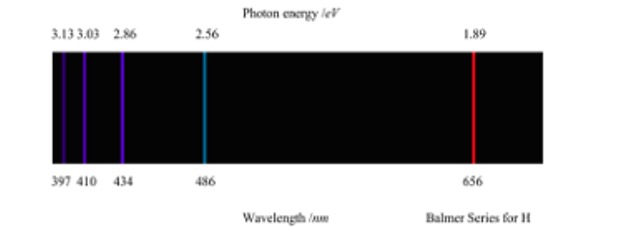
The discrete (singular) lines observed in the emission spectra of elements with more than one electron can be explained if electrons, like photons display the properties of both waves and particles.
This is called wave-particle duality.
In the past, scientists considered electrons simply as particles with a negative charge and almost zero mass but now we think of electrons as having the properties of both waves and particles.
For example, in an electron microscope, a beam of electrons of a particular wavelength is fired at the sample to produce an image. This suggests that the beam of electrons is behaving like a beam of light waves.
Sometimes the single lines seen at low resolution often appear as two or three lines very close together when viewed using a high resolution spectroscope.
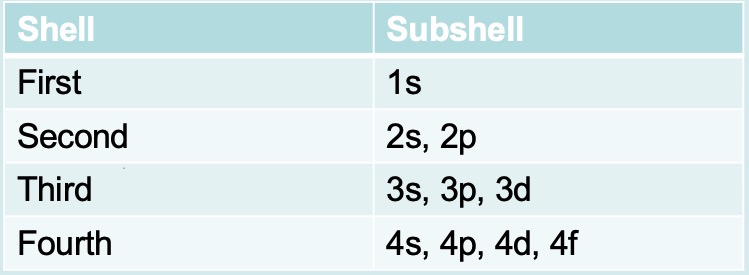
This suggests that shells are divided into subshells.
These subshells are labelled s,p,d, and f.
Each type of subshell contains one or more orbitals.
Orbitals
Within an atom, the electrons behave as waves and there are different shapes and sizes of standing waves possible around the nucleus.
These are known as orbitals.
The simplest orbital is spherical but more complex orbital shape are possible.
Any orbital, no matter its size or shape, can hold a maximum of two electrons (Pauli exclusion principle).
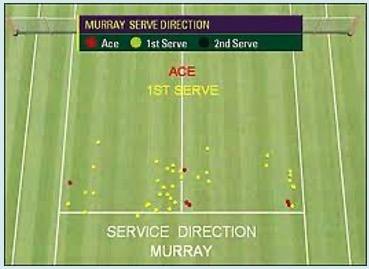
Orbitals are maps of electron abundance. Just as hawk eye shows areas of abundance in Andy Murray's serve (where it lands most).
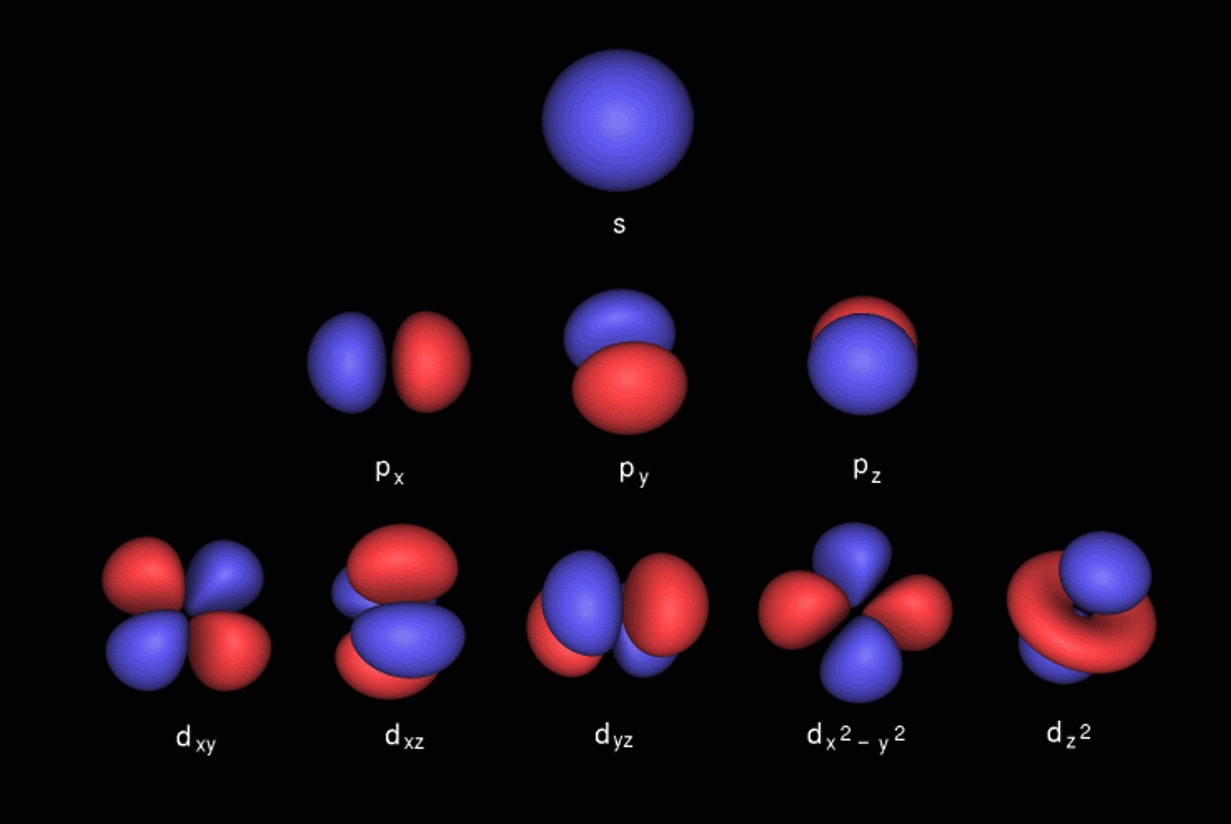
There are four types of orbitals, namely, s, p, d and f, each with a characteristic shape or set of shapes.
Here is the abundance of where it is most likely an electron can be found for the Px orbital.
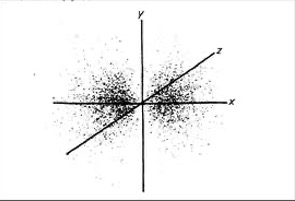
The more dots there are the higher the abundance.
The s orbital is spherical, like a ball.
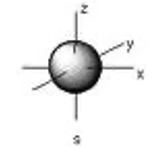
The p orbitals are dumbbell shaped.

The d orbitals each have 4 lobes except dz2 which has just two lobes and a 'doughnut'.
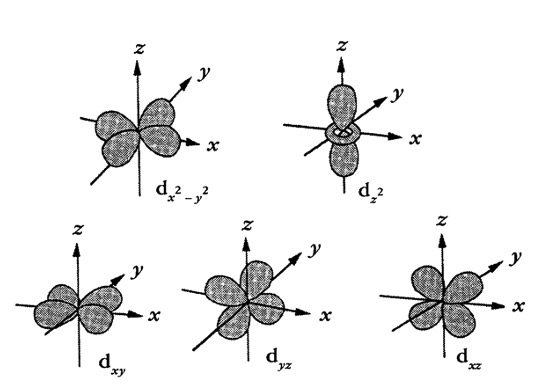
Each orbital can hold 2 electrons.
That means, that the s orbital can hold 2 electrons.
The 3 p orbitals can together hold 6 electrons.
The 5 d orbitals can hold 10 electrons between them.
Electrons behave as standing (stationary) waves: waves that vibrate in time but do not move in space. Electrons within atoms have fixed amounts of energy called quanta.
You need to know the shapes of s, p and d orbitals. The shapes of f orbitals are not required.
Taking National 5 to Advanced Higher
We now use these orbitals to better explain our National 5/Higher understanding of shells.
Up until this point, we have understood that the electrons in sodium have been in 3 shells in an 2,8,1 arrangement.
At advanced higher we look at what those 3 shells are comprised of.
| 2 | 8 | 1 |
|---|---|---|
| The first shell has 2 electrons, These electrons are held in an s orbital called 1s | The second shell holds 8 electrons. Two of these electrons are held in an s orbital called 2s. The remaining 6 electrons are held in each of the three different p orbitals. Remember each orbital can hold 2 electrons. | The third shell has 1 electron, this will go in the 3s orbital. |
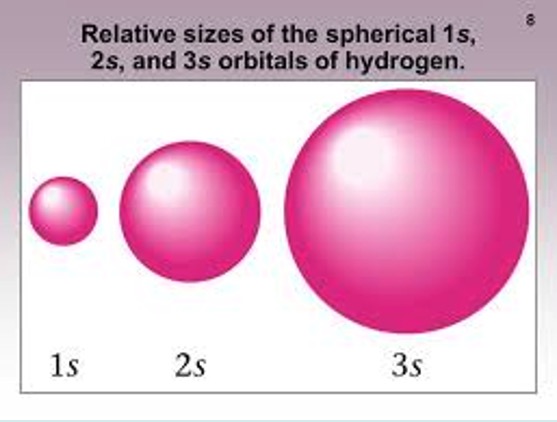
The s orbital increases in size with each shell.
Krypton 2,8,18,8
In National 5 and Higher, we only looked at the electron arrangements for the first 20 elements. However, many of you noticed that elements like krypton had shells with 18 electrons in them.
With orbitals we can now explain why.
2
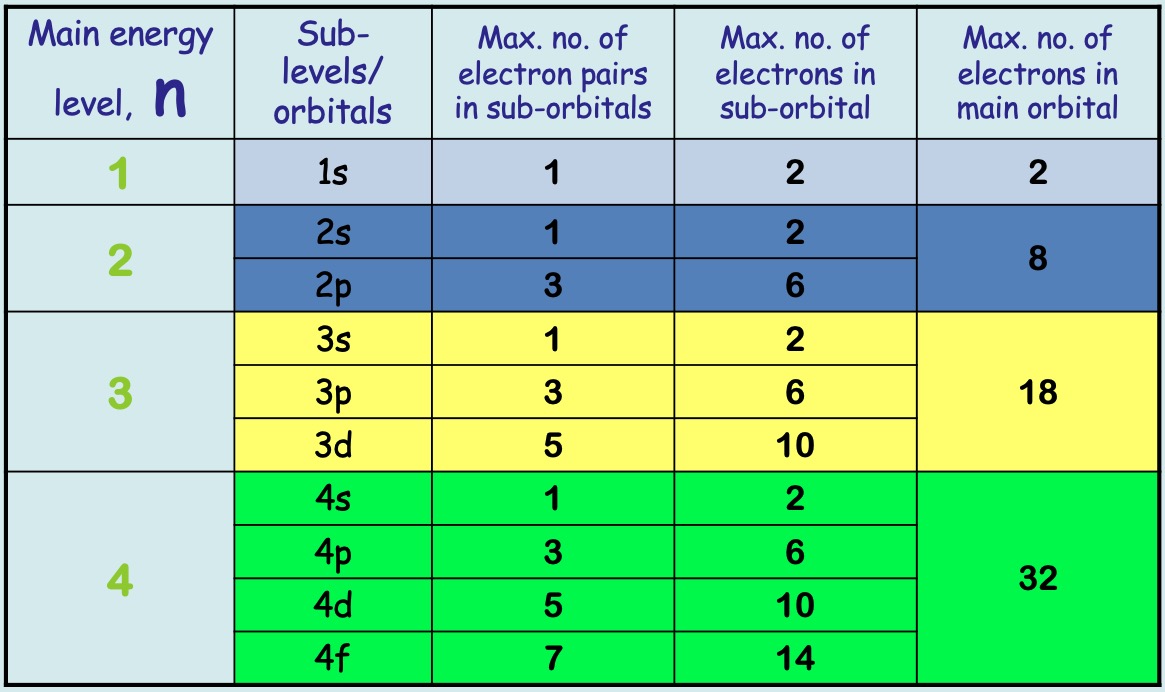
2 electrons are held in the 1s subshell.
8
2 electrons are held in the 2s subshell and 6 electrons are held in the three p orbitals called the 2p subshell.
18
2 electrons in 3s 6 electrons in 3p 10 electrons in 3d - There are 5 d orbitals, each containing 2 electrons.
8
2 electrons in 4s 6 electrons in 4p
The p orbitals are all degenerate. This means that they all have the same energy.
The d orbitals are all degenerate with each other but have higher energies than the s or p orbitals in the same shell as well. (p orbitals have higher energy than the s orbital )
The Periodic Table
The Periodic Table can be sub-divided into four blocks (s, p, d and f) corresponding to the outer electronic configurations of the elements within these blocks.
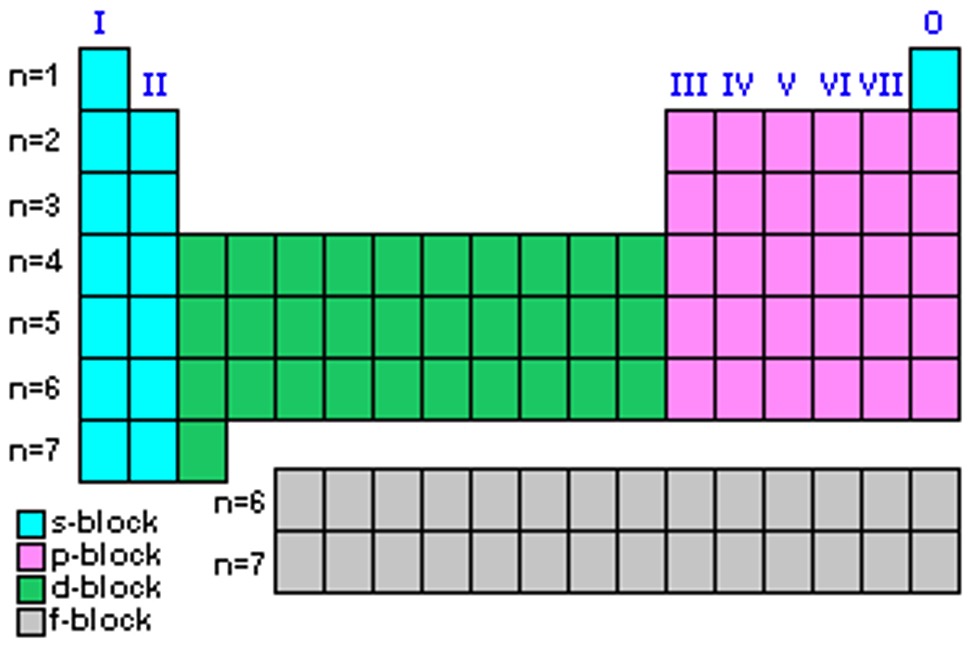
For example, the outer electron on sodium is held in the 3s subshell. If you look for sodium on the periodic table, you will find it is in the s block.
Energy levels and sub-levels review
(v) Quantum Numbers
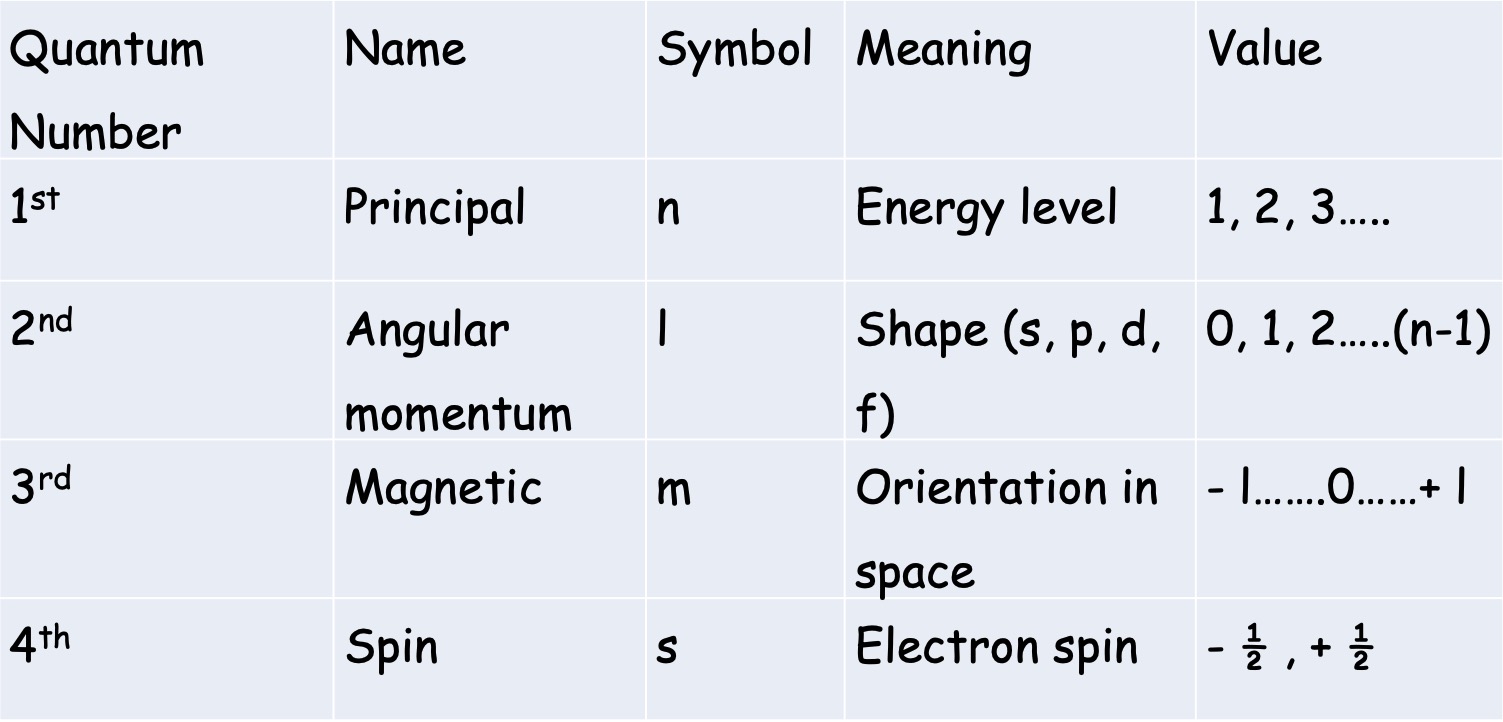
Each electron is unique, in that it occupies a position in space that no other electron can. Electrons are given an 'address' in terms of 4 quantum numbers.
Principal Quantum Number (n) - related to the size of the orbital.
Angular momentum quantum number (l) - determines the shape of the subshell. It can have values from 0 to n − 1.
Magnetic quantum number (ml) - determines the orientation of the orbital. It can have values from −l to +l.
Spin magnetic quantum number (ms) - determines the direction of spin. It can be +½ or −½.
Principal quantum number (n) - Energy level
The principal quantum number tells us which shell or energy level the electron is in.
The principal quantum number, symbol n, can be any positive integral number.
i.e. 1,2,3,4...n
The shell nearest the nucleus is the first shell and any electron in that shell has the quantum number n=1.
Value of n = 1 type of orbital = s
Value of n = 2 type of orbital = s or p
Value of n = 3 type of orbital = s, p or d
Angular momentum quantum number (l) - the shape
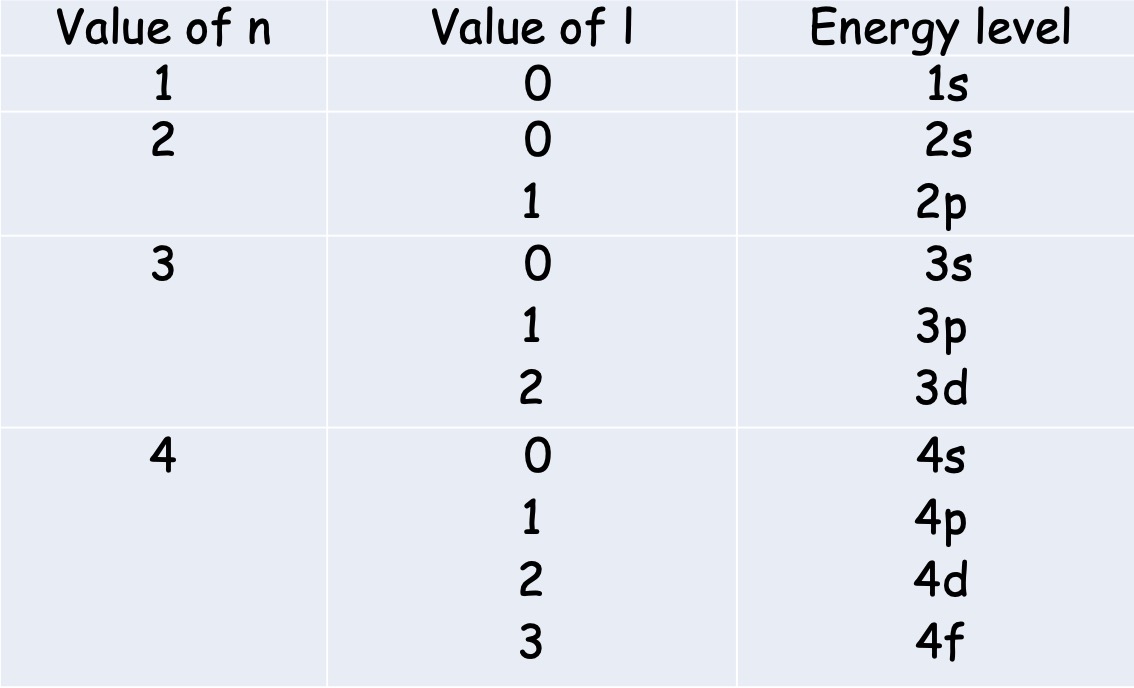
The values of l corresponds to s, p, d and f.
Value of l = 0 it will be an s orbital
Value of l = 1 it will be a p orbital
Value of l = 2 it will be a d orbital
Value of l = 3 it will be a f orbital
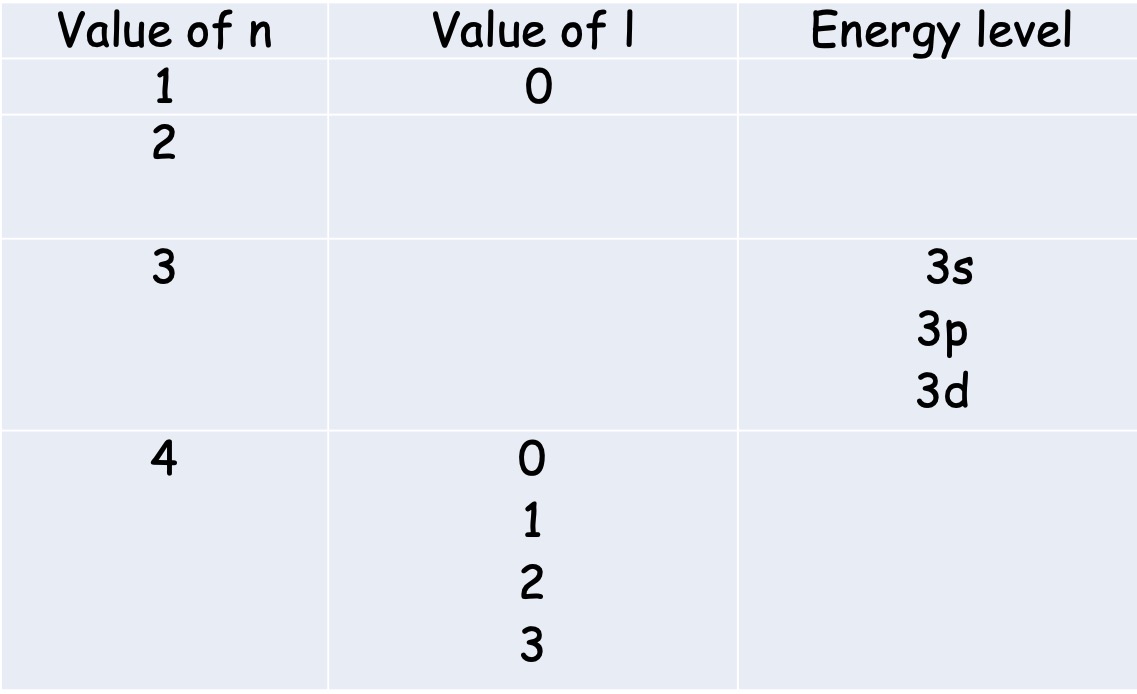
For any given value of n, l may take the value of 0, 1, 2...(n-1). To avoid confusion the values of l corresponding to 0, 1, 2 and 3 are given the letters s, p, d and f.
Complete the table
Magnetic quantum number (ml) - orientation in space
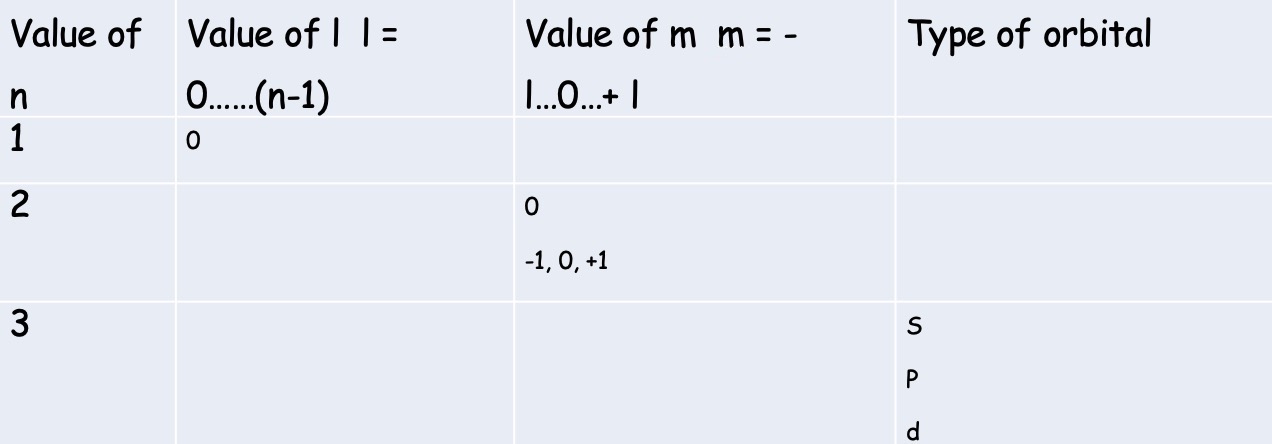
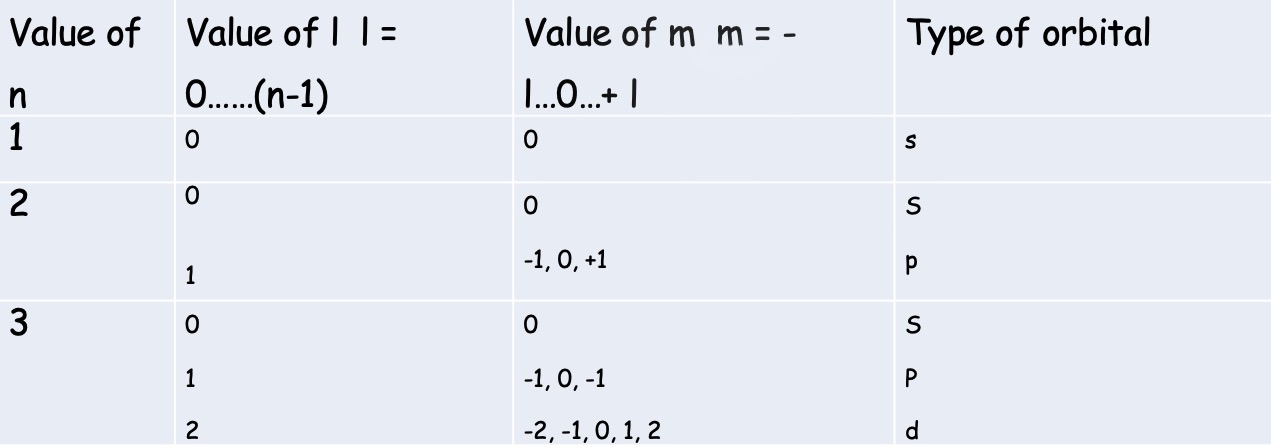
The magnetic quantum number, ml, gives the orientation of the orbital.
s orbitals have a magnetic quantum number = 0
p orbitals can have a magnetic quantum number = -1, 0 or +1
d orbitals a magnetic quantum number = -2, -1, 0, +1, +2
This quantum number indicates the orientation of the orbital in space. Where n=1 (and therefore l=0) a value of m is not necessary as a sphere can have only one orientation in space.
Complete the table.
Spin magnetic quantum number (ms) - electron spin
The spin magnetic quantum number, ms, gives the direction of spin of an electron within an orbital. ms = +½ or −½
Summary of 4 quantum numbers
Questions
1. If m has values of -1, 0, +1, write down the corresponding values of l.
2. If l has values of 0, 1, 2 and 3, deduce the corresponding value of n.
3. For n = 1, what are the allowed values of l and ml ?
4. Write down the possible types of atomic orbital for n = 4.
5. Which atomic orbital has values of n = 4 and l = 2?
6. Give the three quantum numbers that describe a 2s atomic orbital.
7. State whether each of the following sets of quantum numbers is permissible for an electron in an atom. If a set is not permissible, explain why.
a) n = 1, l = 1, ml = 0, ms = + ½
b) n = 3, l = 1, ml = -2, ms = -½
c) n = 2, l = 1, ml = 0, ms = + ½
d) n = 2, l = 0, ml = 0, ms = 1
Past Paper Questions
Q1
The number of orbitals and the number of electrons in an energy level or sublevel is limited.
(a) Give the number of orbitals that make up:
(i) the s sublevel.
(ii) the d sublevel.
(b) Give the number of electrons that are needed to completely fill:
(i) the p sublevel
(ii) the first energy level
(iii) the third energy level
(c) Give the sublevels in:
(i) the first energy level
(ii) the fourth energy level
Q2
The electron configuration of an atom of element Y in the ground state can be represented as:
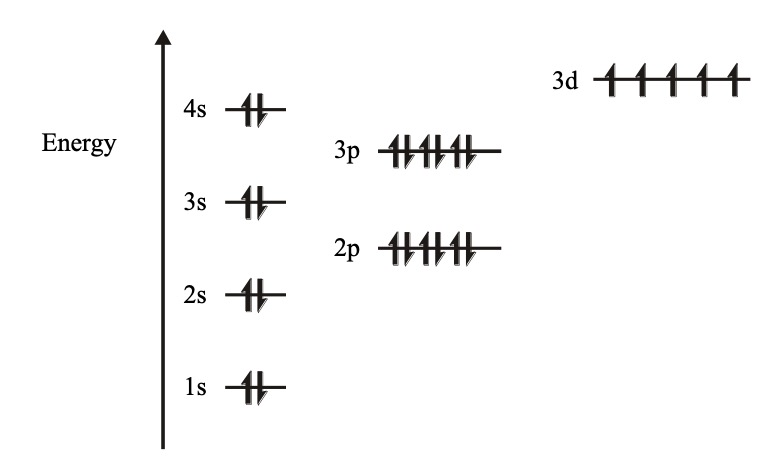
(a) Identify the element.
(b) The electron configuration of an atom or ion may also be expressed in another form, e.g. 1s2 2s2 2p1 for boron. Give the electron configuration for Y in this form.
(c) Give the electron configuration of the ion Y3+.
Quantum Numbers and Orbital Theory Test
(vi) Spectroscopic and Orbital Box Notation
The Pauli Exclusion Principle
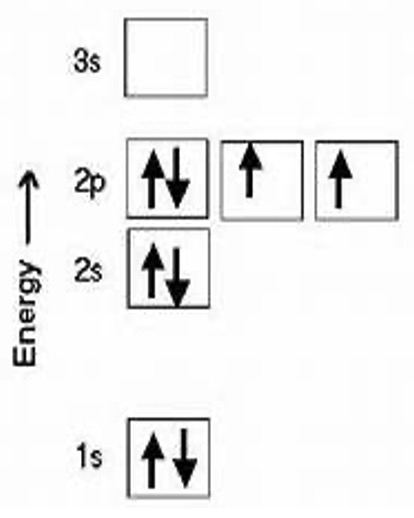 'no two electrons in the same atom can have the same set of quantum numbers'.
This means:
- only two electrons can be held in any orbital
- electrons must have opposite spins (drawn as an up and down arrow)
The Aufbau Principle
Orbitals are filled in order of increasing energy.
The only change in the order is that the 4s orbital has a lower energy than the 3d orbital and therefore appears first.
1s 2s 2p 3s 3p 4s 3d 4p
Hund's Rule
When degenerate orbitals are available, electrons fill each singly, keeping their spins parallel before spin pairing starts.
The diagram to the right shows that each 2p orbital gets one 'up' electron before any of them gets a 'down' electron.
In an isolated atom the orbitals within each subshell are degenerate (are of the same energy).
Spectroscopic and Orbital Box Notation
The electronic configuration of calcium can be written using spectroscopic notation or orbital box notation.
Spectroscopic Notation:
1s22s22p63s23p64s2
The superscript numbers show how many electrons are in each orbital.
Orbital Box Notation:

Ionisation Energies and Electronic Configurations
In general, the ionisation energy increases going across a period.
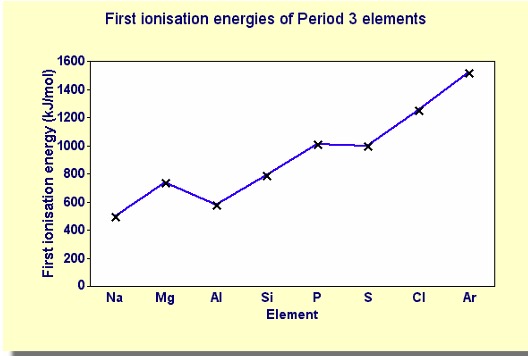
However, there are decreases from Mg to Al and P to S.
This is because there is a special stability associated with a filled or half filled sub shell. The more stable an arrangement is, the more difficult it is to remove an electron and therefore, the ionisation energy gets higher.
Going across the period from Mg to Al moves from the filled 3s subshell (high stability) to an incomplete 3p subshell (low stability).
Going from phosphorus, which has a half filled 3p subshell (high stability) to Sulfur (low stability) will decrease the energy required to remove the first electron.
The variation in first, second and subsequent ionisation energies for the first 36 elements is evidence for these electronic configurations. The more stable the electronic configuration, the higher the ionisation energy.
Electron Configuration and Quantum Rules Test
(vii) Shapes of molecules and polyatomic ions
The Bonding Continuum
In 1916 Gilbert Newton Lewis recognised that in simple molecules there had to be an alternative to ionic bonding and suggested that electrons could be shared in pairs to allow atoms to attain the full octet / noble gas structure.
Lewis electron dot diagrams are used to represent electron pairs in molecules and in polyatomic ions.
For normal use this is drawn Cl-Cl, with a single line to show the single bond present.

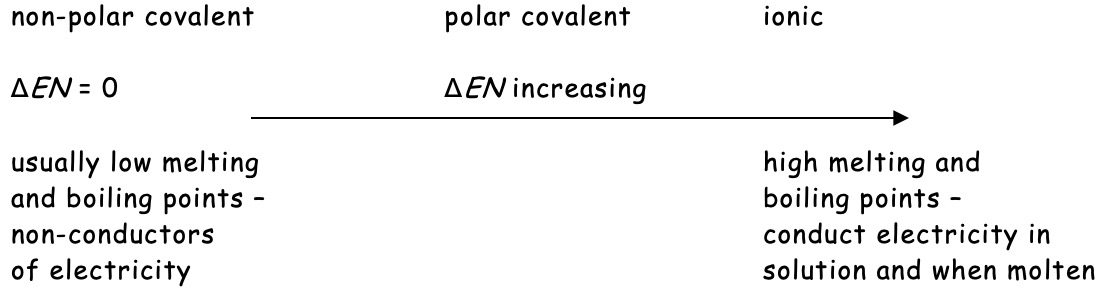
Covalent bonding usually involves elements close together in the periodic table resulting in little or no electronegativity difference. Ionic bonding generally involves metals from the left hand side and non-metals from the right hand side of the table resulting in a large difference of electronegativity.
This difference in electronegativity puts covalent and ionic bonding at two ends of a spectrum with polar covalent being found somewhere in between.
Polar Covalent Bonds
In a polar covalent bond, the electrons are not shared equally between the atoms.
Identical atoms share the electrons in a covalent bond equally. However, if the two atoms are not identical the bonding electrons are not equally shared and are pulled closer to one of the atoms. When this occurs the bonding is said to be polar covalent.

The atom with the higher electronegativity (chlorine) will have a slight negative charge compared to hydrogen (see the data booklet).
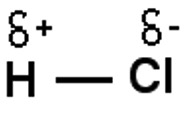
δ - is the greek letter delta meaning 'slightly'.
In some symmetrical molecules the polar nature of the bonds tends to cancel out.
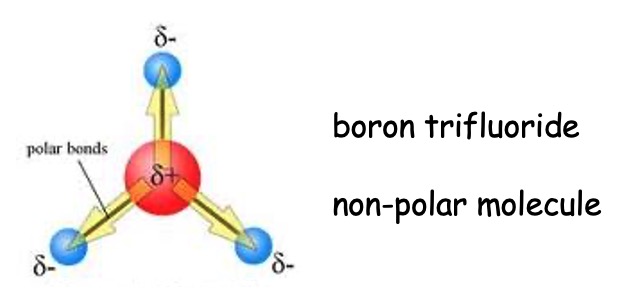
Lewis Diagrams
Lewis diagrams or dot cross diagrams are used to represent bonding or non-bonding electron pairs in molecules or polyatomic ions.
Resonance structures
Lewis diagrams can be used to illustrate resonance structures. Resonance structures exist when there is more than one way of drawing the Lewis diagram of a molecule. For example, O3:
Shapes of molecules and polyatomic ions
The shapes of molecules or polyatomic ions can be predicted from the number of electron pairs involved in bonding in the valence (outer) shell and the number of lone pairs it has.
When drawing molecules we need to know that non-bonding pairs of electrons (lone pairs) take up more space. This is because the repulsive effect of a lone pair is greater than that of a bonding pair and so the shape of the molecule becomes one in which the lone pairs are as far away as possible.
Bonded:bonded pair < bonded:lone pair < lone pair:lone pair
This is called the valence-shell electron-pair repulsion theory (VSEPR) which is a lot easier than the name suggests.
Molecules take the shape of one of the following structures. Complete the table with the structure of each shape. The first one is completed for you.
| Number of filled orbitals | Diagram | Shape |
|---|---|---|
| 2, AX2 | X - A - X | Linear |
| 3, AX3 | Trigonal Planar | |
| 4, AX4 | Tetrahedral | |
| 5, AX5 | Trigonal Bipyramidal | |
| 6, AX6 | Octahedral |

VSEPR - A simple step by step guide
REMEMBER
- H and the halogens, F, Cl, Br and I can only form one single covalent bond to another atom.
- O forms either one double bond or two single bonds (CO2 or H2O).
- Atoms of H and He only ever have 2 valence electrons around them.
- Atoms of the second period, Li - Ne, never have more than 8 valence shell electrons (of course there will be a few exceptions...).
- Draw a Lewis structure of the molecule assigning valence shell (outer) electrons as pair if possible.
- Arrange the valence shell electrons not used for bonding into lone pairs.
- Count the number of bonding and non-bonding pairs you have in total and choose the structure required.
- Arrange the bonds and lone pairs so the lone pairs are as far away as possible from each other.
- Now draw the shape without the lone pairs.
Counting Electron Pairs
The number of electron pairs around a central atom can be found by:
- taking the number of valence (outer) electrons on the central atom and adding one for each atom attached
- adding an electron for every negative charge
- removing an electron for every positive charge
- dividing the total by two to give the number of electron pairs
| Species | Calculation | Electron pairs | Arrangement of pairs | Shape |
|---|---|---|---|---|
| NH3 | (5 + 3) ÷ 2 | 4 (3 bonding, 1 non-bonding) | tetrahedral | trigonal pyramidal |
| H2O | (6 + 2) ÷ 2 | 4 (2 bonding, 2 non-bonding) | tetrahedral | bent (angular) |
| NH4+ | (5 + 4 − 1) ÷ 2 | 4 (all bonding) | tetrahedral | tetrahedral |
| PCl5 | (5 + 5) ÷ 2 | 5 (all bonding) | trigonal bipyramidal | trigonal bipyramidal |
| SF6 | (6 + 6) ÷ 2 | 6 (all bonding) | octahedral | octahedral |
The arrangement of the electron pairs is linear (2 pairs), trigonal planar (3), tetrahedral (4), trigonal bipyramidal (5) or octahedral (6). The shape of the molecule is described by the positions of the atoms only. Electron dot diagrams can be used to show these arrangements.
Questions
1. Draw the structures of the following molecules:
(i)BF2-
(ii) H2O
2. Compare the two structures that you have drawn.
3. Similarly compare CH4 and NH3.
Show answer
1. (i) BF2−: (3 + 2 + 1) ÷ 2 = 3 pairs (2 bonding, 1 non-bonding), so it is bent, based on a trigonal planar arrangement. (ii) H2O: (6 + 2) ÷ 2 = 4 pairs (2 bonding, 2 non-bonding), so it is bent, based on a tetrahedral arrangement.
2. Both are bent, but water has two lone pairs on a tetrahedral arrangement, so its bond angle (about 104.5°) is smaller than the angle for three pairs (about 120°).
3. CH4 is tetrahedral (109.5°). NH3 has the same tetrahedral arrangement of four pairs, but one is a lone pair, so it is trigonal pyramidal and the extra repulsion closes the angle to about 107°.
Bond Angles
The following table shows the angles found in each structure, complete the name of each structure.
| Number of electron pairs | Arrangement | Angle in degrees | Example |
|---|---|---|---|
| 2 | Linear | 180 | BeCl2 |
| 3 | 120 | BF3 | |
| 4 | 109.5 | CH4 | |
| 5 | 90, 120, 180 | PCl5 | |
| 6 | 90 | SF6 |
What effect do bonding and non-bonding pairs of electrons have on the shape of covalent molecules and polyatomic ions?
The effect of bonding and non-bonding pairs on shape
In molecules with non bonding pairs this angle between molecules decreases slightly due to the greater repulsion from the lone pairs compared to bonding electron pairs.
e.g. the angle between the hydrogens in ammonia is only 107o instead of 109.5o.
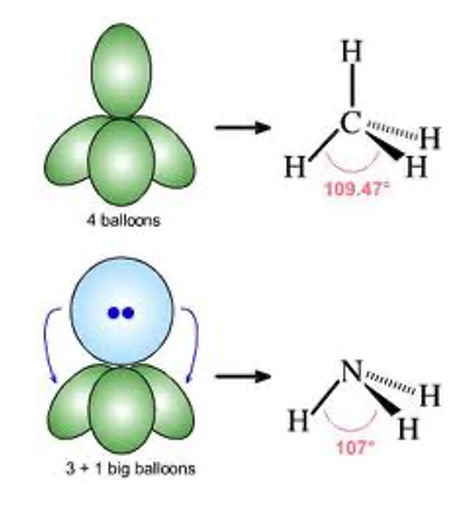
If we think of the lobe of a lone pair as an extra big balloon in comparison to the skinny lobes of a bonding pair. We can see that the big balloon pushes (due to lone pairs having greater repulsion) which decreases the angle in the bonding pairs.
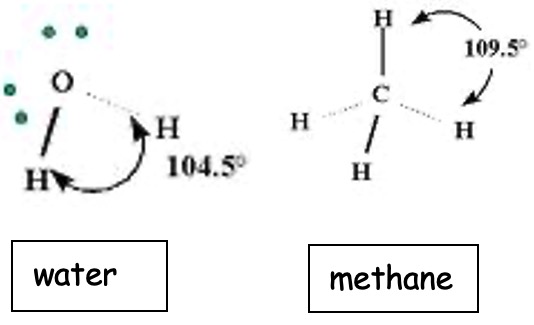 We can see the effect of repulsion from the lone pairs in water also compared with the basic tetrahedral shape of methane from which it comes.
Questions
1. What geometry would you expect of tellurium tetrachloride, TeCl4?
2. Xenon tetrafluoride, XeF4 exists.
(a) What sort of bonding might be found in xenon tetrafluoride?
(b) What geometry would you expect of xenon tetrafluoride?
Show answer
1. TeCl4: (6 + 4) ÷ 2 = 5 pairs (4 bonding, 1 non-bonding). The arrangement is trigonal bipyramidal and the shape is a see-saw.
2. (a) Covalent bonding. (b) XeF4: (8 + 4) ÷ 2 = 6 pairs (4 bonding, 2 non-bonding). The arrangement is octahedral, with the lone pairs opposite each other, so the shape is square planar.
Covalent Bonding
When atomic orbitals overlap a molecular orbital is formed. This is known as a covalent bond. The bonding exists as continuum from pure (non-polar) covalent to polar covalent and onto ionic.
The shapes of molecules and polyatomic ions can be predicted using Valence Shell Electron Pair Repulsion (VSEPR) theory.
For example, in a hydrogen molecule the two positively charged nuclei repel each other, and so do the two electrons. However, these repulsive forces are outweighed by the attraction between each nucleus and the shared pair of electrons.
The diagram below shows how the distance between two approaching hydrogen atoms is related to the potential energy.
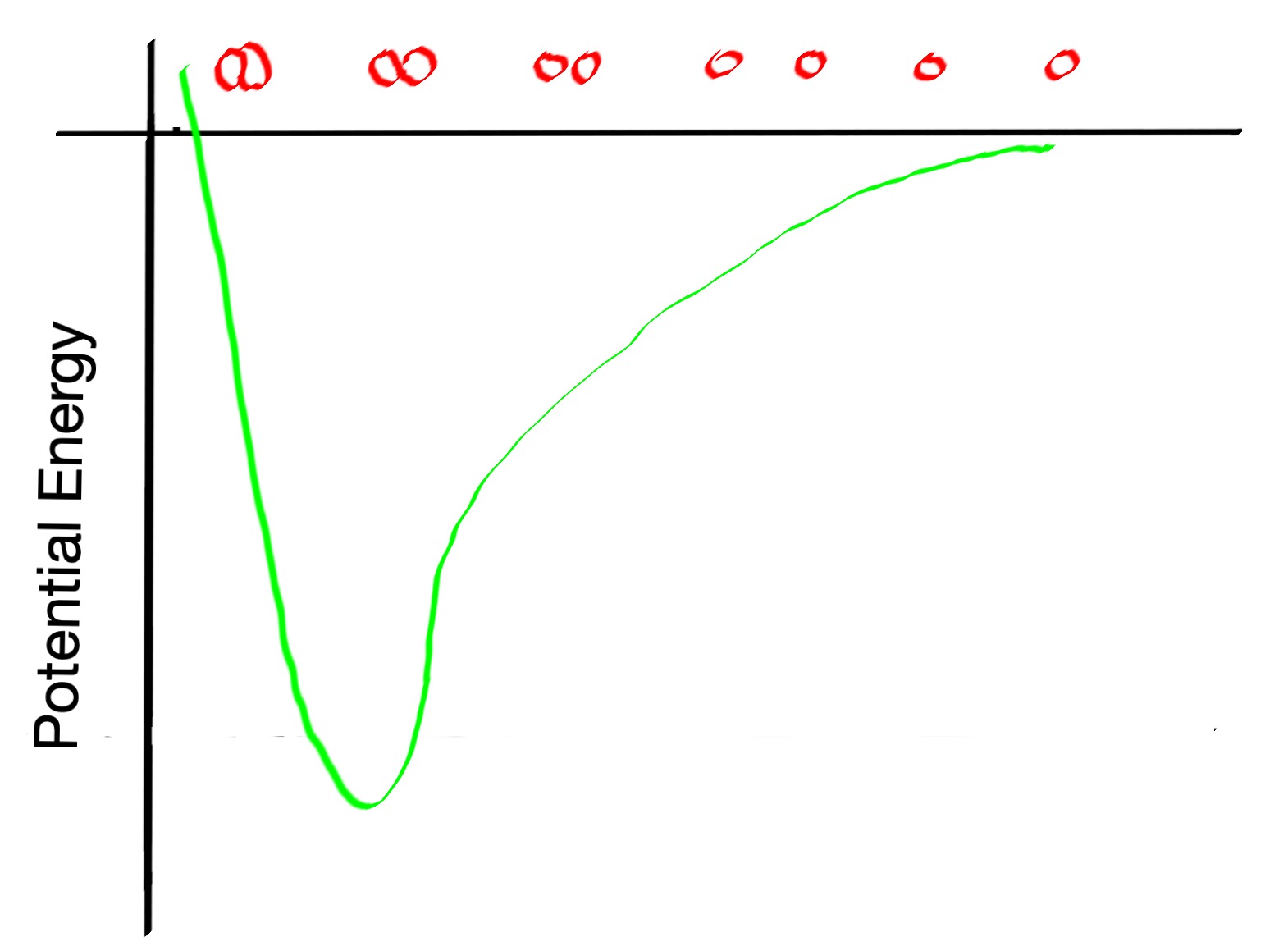
This graph is best read from right to left. As the Hydrogen atoms approach each other the potential energy decreases to the point of lowest potential energy. If they are forced closer together than this, repulsion between the nuclei makes the potential energy rise steeply. At the point of lowest potential energy, atomic orbitals form molecular orbitals. An equivalent amount of energy would be needed to break one mole of these atoms apart. This corresponds to the bond enthalpy.
Covalent Bonding and Bond Length
Covalent bonding occurs when the positive nuclei of two atoms are held together by their common attraction for a shared pair of electrons.
A covalent bond is formed when atomic orbitals overlap to form a molecular orbital.
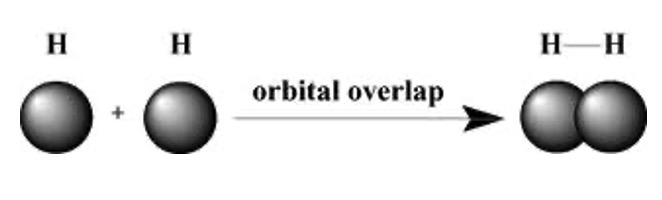
The potential energy change that this produces is shown in the graph below.
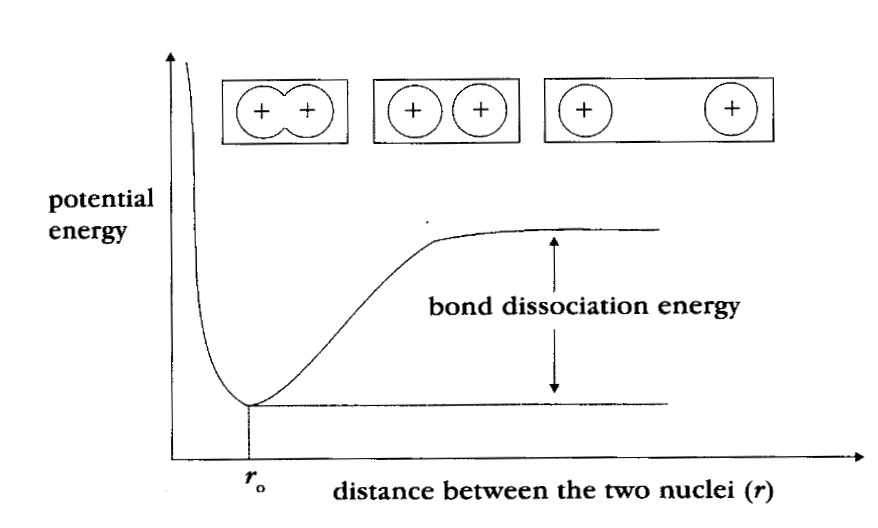
ΔH - Bond enthalpy or bond dissociation energy is the energy required to break one mole of the bonds formed.
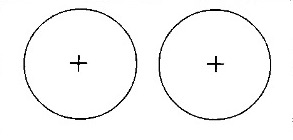
As the atoms approach each other the potential energy gets lower and lower (going along the potential energy the curve from right to left). This decrease continues until the atoms reach their optimum distance apart, where the potential energy is lowest.
The distance between the nuclei at this minimum energy is the bond length ro. This is the normal distance between the nuclei in this molecule.
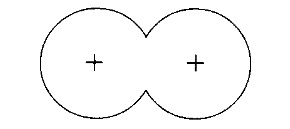
This bond length is due to the common attraction of the nuclei for the shared region of electron density.
If the atoms were to get too close the repulsion of the positive charges in the nuclei becomes important and the potential energy increases again (as seen on the graph, to the left of ro).
Dative Covalent Bonds
Dative covalent bonds are formed when both electrons making up a covalent bond come from the same atom.
Both oxygen and nitrogen have lone pairs (non bonding pairs of electrons) which have a powerful influence on their chemistry. In some cases a lone pair from one atom contributes both electrons to make the covalent bond.
This is co-ordinative or dative covalent bonding.
e.g. BCl3.NH3 is a stable complex
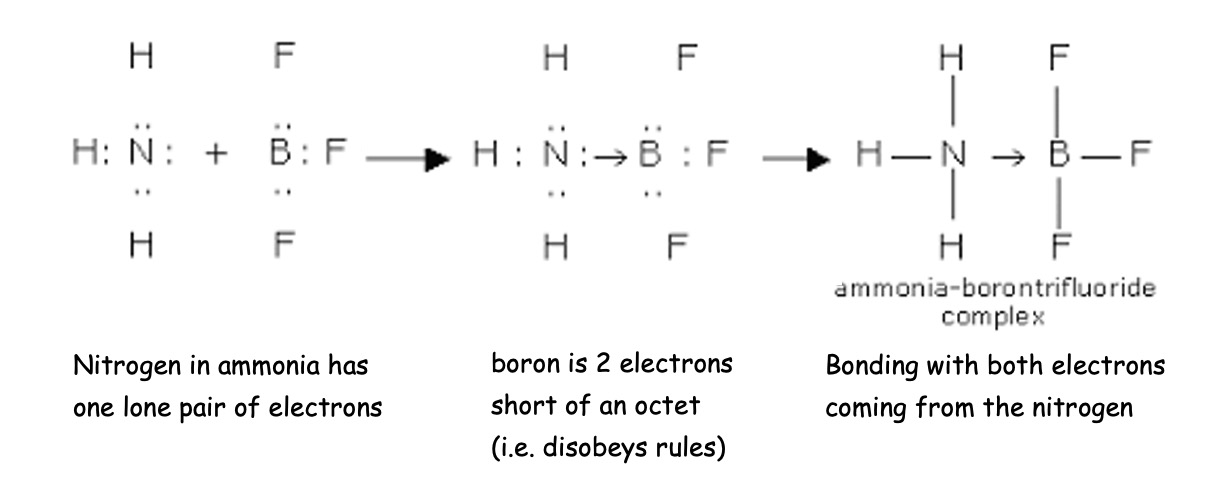
The dative bond can be drawn as an arrow from the donor to the acceptor or with a negative sign on the acceptor and a positive sign on the donor.
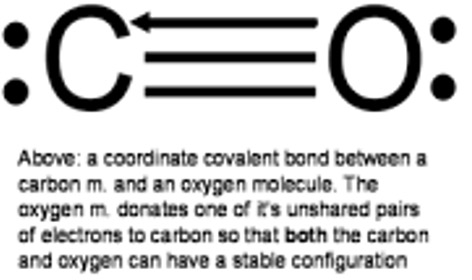
Another example is carbon monoxide in which oxygen is a donor.