Higher Chemistry: Chemistry in Society
Notes, worked examples and questions for Higher Chemistry Chemistry in Society. Tap a topic to open it.
- (a) Getting the Most from Reactants
- (b) Controlling the Rate
- (c) Chemical Energy
- (d) Equilibria
- (e) Chemical Analysis
- (f) Researching Chemistry
These notes follow the Higher Chemistry course specification (version 4.0, valid from session 2026–27).
(a) Getting the Most from Reactants
What you need to know
- Factors that influence industrial process design, and environmental considerations
- Calculations from balanced equations using masses, solutions and gas volumes
- Limiting reactants and excess
- Percentage yield, including working out the cost of reactants
- Atom economy
Industrial Chemistry
Industrial processes are designed to maximise profit and minimise the impact on the environment.
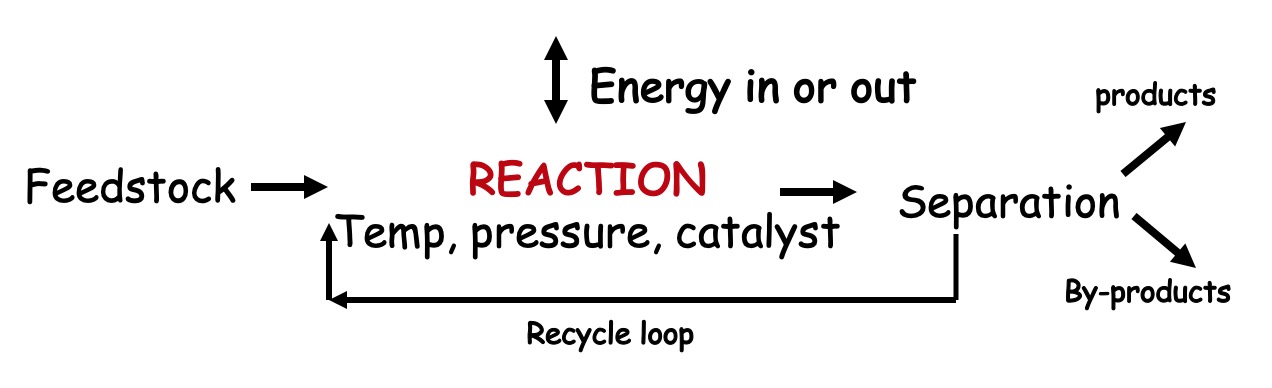
The key factors to take into consideration when manufacturing a new chemical are as follows:
- availability, sustainability and cost of feedstock(s)
- opportunities for recycling
- energy requirements
- marketability of by-products
- product yield and atom economy
- Safety
Environmental considerations include:
- minimising and disposing of waste
- avoiding the use or production of toxic substances
- designing products which will biodegrade if appropriate
Fertiliser Industry - Haber Process
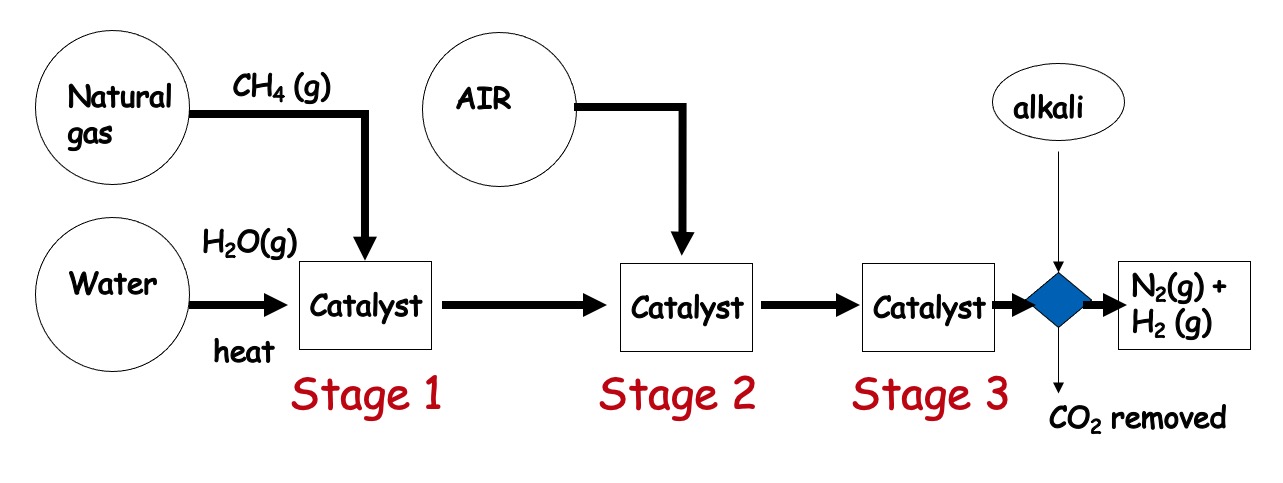
Ammonia is manufactured from N2 and H2. The nitrogen is available from the raw material, air. (something which is available naturally). The other feedstock for the manufacture of NH3 is hydrogen which is usually produced from methane.
Sulfuric Acid Industry
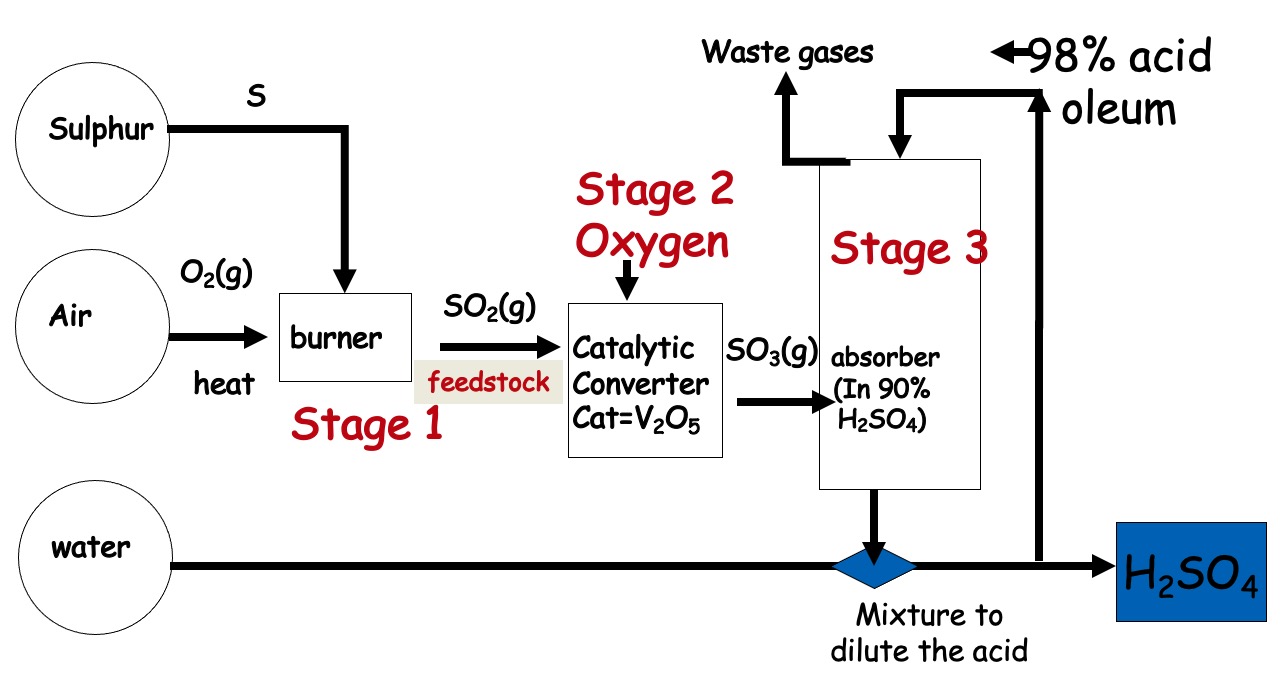
Sulfuric acid is manufactured by the Contact Process.
Calculations
Balanced Equations
Using your knowledge from National 5 Chemistry you should be able to perform calculations from balanced equations, using gram formula masses, masses, numbers of moles, concentrations and volumes of solutions, molar volumes and volumes of gases.
Moles: Reminder
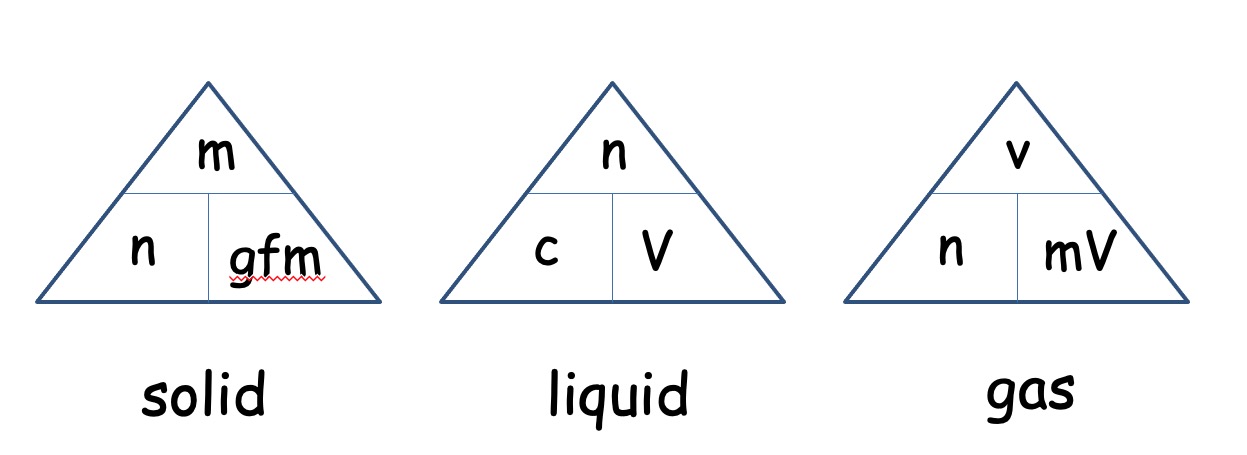
Balanced equations, with formulae and state symbols, show the mole ratio of reactants and products. You will need these relationships:
| Working with | Relationship | Units |
|---|---|---|
| Mass | n = m ÷ GFM | n in mol, m in g, GFM in g mol-1 |
| Solutions | n = c × V | c in mol l-1, V in litres |
| Gases | n = V ÷ molar volume | V in litres, molar volume in litres mol-1 |
The gram formula mass (GFM) is the mass of one mole, in grams, worked out from relative atomic masses.
Worked Example 1: Calculation from balanced equation
Molar Volume
The molar volume of a gas is its volume per mole, litre mol-1. It is the same for all gases at the same temperature and pressure. The value, though, depends on the temperature and pressure.
The molar volume of all gases is approximately 24 litre mol-1 at 20 °C and normal atmospheric pressure.
Worked Example 2: Calculating volume from number of moles and molar volume.
Calculate the volume of 0.025 moles of oxygen.
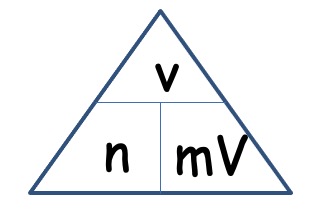
V = n x mV
V =
Show answer
0.025 x 24 = 0.6 litres
Worked Example 3: Calculating the number of moles from volume and molar volume.
Calculate the number of moles in 72 litres of hydrogen.
n = V / mV
n =
Show answer
72 / 24 = 3 moles
Gas Volume Calculations
As all gases have the same molar volume, volume can be taken as moles.
Worked Example 4: Using gas volumes
What volume of CO2 is produced if 100 cm3 of O2 is used to completely burn some CH4 gas?
Calculations Involving Molar Gas Volume
1. What is the mass of steam in 180 cm3 of the gas, when the molar volume is 24 litres mol-1?
Show answer
180 cm3 = 0.18 litres. n = 0.18 ÷ 24 = 0.0075 mol. Mass = 0.0075 × 18 = 0.135 g
2. The equation below shows the reaction between calcium carbonate and hydrochloric acid.
CaCO3(s) + 2HCl(aq) → CaCl2(aq) + CO2(g) + H2O(l)
20g of calcium carbonate reacts with excess hydrochloric acid.
Calculate the volume of carbon dioxide gas formed. (Take the molar volume to be 24.0 litre mol-1)
Show answer
20 g CaCO3 = 20 ÷ 100 = 0.2 mol, giving 0.2 mol CO2. Volume = 0.2 × 24 = 4.8 litres
3. Calculate the number of moles in 0.36 litres of argon (molar gas volume = 24 litres mol-1 ).
Show answer
0.36 ÷ 24 = 0.015 moles
4. Calculate the volume of 0.04 moles of CO2. (molar gas volume = 24 litres mol-1 ).
Show answer
0.04 × 24 = 0.96 litres
Excess
You can use the relative numbers of moles of substances, as shown in balanced equations, to calculate the amounts of reactants needed or the amounts of products produced.
A limiting reactant is the substance that is fully used up and thereby limits the possible extent of the reaction. Other reactants are said to be in excess.
In order to ensure that a costly reactant is converted into product, an excess of the less expensive reactant(s) can be used.
Worked Example 5: Identifying Limiting and Excess Reactants
Which reactant is in excess when 10g of calcium carbonate reacts with 100cm3 of 1 mol l-1 hydrochloric acid?
CaCO3 + 2HCl → CaCl2 + H2O + CO2
Show answer
n(CaCO3) = 10 ÷ 100 = 0.1 mol
n(HCl) = 1 × 0.1 = 0.1 mol
0.1 mol CaCO3 needs 0.2 mol HCl, but there is only 0.1 mol. So HCl is the limiting reactant and calcium carbonate is in excess.
Worked Example 6: Identifying Limiting and Excess Reactants
1.2g of magnesium was added to 100cm3 2 mol l-1 hydrochloric acid. Calculate the reagent in excess.
Mg + 2HCl → MgCl2 + H2
Show answer
n(Mg) = 1.2 ÷ 24.3 = 0.049 mol
n(HCl) = 2 × 0.1 = 0.2 mol
0.049 mol Mg needs 0.099 mol HCl, and there is 0.2 mol. So hydrochloric acid is in excess.
Calculations Involving Excess
For each of the following reactions calculate which reagent is in excess and make a statement as to why.
1. 4.86g magnesium added to 250cm3 2 mol l-1 hydrochloric acid.
Show answer
HCl
2. 2.7g aluminium added to 200cm3 1 mol l-1 hydrochloric acid.
Show answer
Al
3. 2.43g magnesium added to 200cm3 1 mol l-1 sulfuric acid.
Show answer
sulfuric acid
4. 3.27g zinc added to 100cm3 0.2 mol l-1 hydrochloric acid.
Show answer
Zn
In the following calculations you have to find which reactant is the limiting reagent to answer the question.
5. What mass of calcium oxide is formed when 0.4 g of calcium reacts with 0.05 mole of oxygen?
2Ca + O2 → 2CaO
Show answer
0.56g
6. What mass of hydrogen is formed when 3.27g of zinc is reacted with 25cm3 of 2 mol l-1 hydrochloric acid?
Zn + 2HCl → ZnCl2 + H2
Show answer
0.05g
Percentage Yield
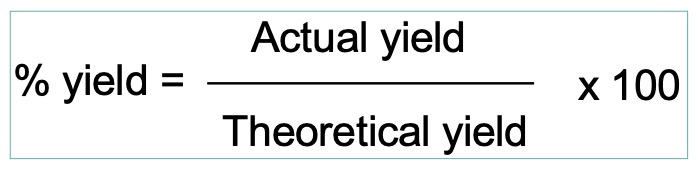
Percentage yield can be used to measure the efficiency with which reactants are converted into the desired products.
For a particular set of reaction conditions, the percentage yield provides a measure of the degree to which the limiting reagent is converted into the desired product.
The 'theoretical yield' is the quantity of desired product obtained, assuming full conversion of the limiting reagent, as calculated from the balanced equation.
The 'actual yield' is the quantity of the desired product formed under the prevailing reaction conditions.
Very few chemical reactions have a yield of 100% because:
- The raw materials may not be pure
- Some of the products may be left behind in the apparatus
- The reaction may not have completely finished
- Some reactants may give some unexpected products
- Some reactions involve an equilibrium
Careful planning and design of the equipment and reaction conditions can help keep % yield high.
Worked Example 7: Percentage Yield
Calcium carbonate is used to make calcium oxide for cement making.
CaCO3 → CaO + CO2
1 mole of CaCO3 should produce 1 mole of CaO.
Theoretical yield: 1 mole CaO = (1 x 40.1 + 1 x 16) = 56 g
Actual yield: 48g
Percentage yield = 48/56 x 100 = 85.7%
Calculations involving Percentage Yield
1. In the reaction below, the theoretical yield was 10.7g but the actual yield was 4.5g. Calculate the percentage yield.
Be + 2HCl → BeCl2 + H2
Show answer
4.5 ÷ 10.7 × 100 = 42%
2. In the reaction below:
TiS + H2O → H2S + TiO
What is the percentage yield of titanium(II) oxide if you start with 20g of titanium(II) sulfide and the actual yield of titanium (II) oxide is 12g?
Show answer
75%
3. In the reaction below:
U + 3Br2 → UBr6
What is the actual yield of uranium hexabromide if you start with 100g of uranium and get a percentage yield of 83%?
Show answer
250g
Percentage Yield and Cost
Given costs for the reactants, a percentage yield can be used to work out the cost of the reactant(s) needed to make a given mass of product.
Example: calcium oxide is made from calcium carbonate (CaCO3 → CaO + CO2) with an 80% yield. Calcium carbonate costs £0.15 per kg. Calculate the cost of the calcium carbonate needed to make 1.00 kg of calcium oxide.
Show answer
1 mol CaCO3 (100.1 g) → 1 mol CaO (56.1 g)
At 100% yield, 1.00 kg CaO needs 1.00 × 100.1 ÷ 56.1 = 1.784 kg CaCO3
At 80% yield, mass needed = 1.784 ÷ 0.80 = 2.230 kg
Cost = 2.230 × £0.15 = £0.33
Atom Economy

The atom economy measures the proportion of the total mass of all starting materials converted into the desired product in the balanced equation.
Reactions which have a high percentage yield may have a low atom economy value if large quantities of by-products are formed.
Compare these two industrial reactions. What do you notice about each one?
2Mg + O2 → 2MgO
Show answer
In this equation the reactants are converted into one product.
CaCO3 → CaO + CO2
Show answer
In this equation a single reactant is converted into two products.
In the reaction above CO2 is a waste product.
Often, chemical reactions produce unwanted products along with the product you want.
Worked Example 8: Atom Economy
Calculate the atom economy for the reaction below.
CaCO3 → CaO + CO2
mass of desired product = 56g
mass of reactant = 100g
% atom economy = (56 / 100) x 100 = 56%
Calculations involving Atom Economy
1. What is the percentage atom economy for the following reaction for making hydrogen by reacting coal with steam?
C(s) + 2H2O(g) → CO2(g) + 2H2(g)
Show answer
Mass of desired product (2H2) = 4 g; total mass of reactants = 12 + 36 = 48 g. 4 ÷ 48 × 100 = 8.3%
2. Calculate the percentage atom economy for the reaction below.
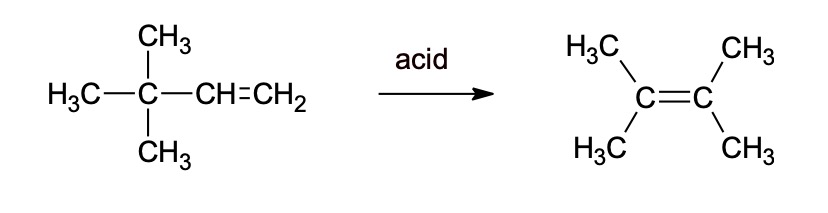
Show answer
100%
3. Hydrazine (N2H4) is used for rocket fuel. Calculate the atom economy for hydrazine production.
2NH3 + NaOCl → N2H4 + NaCl + H2O
Show answer
30%
Worked Examples from textbook questions
Example 2: Molar Volume and Excess textbook Q16
Molar Volume and Excess - textbook Q20
Molar Volume and Excess - textbook Q21
Molar Volume and Excess - textbook Q22
(b) Controlling the Rate
What you need to know
- Why reaction rates must be controlled in industry
- Calculating relative rate from reaction time
- Using collision theory to explain the effects of concentration, pressure, surface area, temperature and collision geometry
- Potential energy diagrams: enthalpy change, activation energy, the activated complex and catalysts
- Energy distribution diagrams: the effects of temperature and catalysts
Why Control the Rate?
Reaction rates must be controlled in industrial processes.
- If the rate is too low, the process will not be economically viable.
- If the rate is too high, there is a risk of explosion.
Relative Rate
The time taken for a reaction (or for a colour change, or for a set volume of gas to be made) can be used to work out a relative rate:
relative rate = 1 ÷ time
If the time is in seconds, the unit of relative rate is s-1.
e.g. a reaction takes 25 s. Relative rate = 1 ÷ 25 = 0.04 s-1
Rearranged: time = 1 ÷ relative rate. e.g. a relative rate of 0.02 s-1 means the reaction took 1 ÷ 0.02 = 50 s.
Collision Theory
For a reaction to happen, particles must collide. A collision only leads to a reaction if the particles have enough energy (at least the activation energy) and collide the right way round.
| Factor | Effect on rate | Explanation |
|---|---|---|
| Concentration | Higher concentration, faster rate | More particles in the same volume, so more collisions. |
| Pressure (gases) | Higher pressure, faster rate | Gas particles are pushed closer together, so more collisions. |
| Surface area (particle size) | Smaller particles, faster rate | More surface is exposed, so more collisions. |
| Temperature | Higher temperature, faster rate | Particles move faster, so there are more collisions, and many more of them have energy greater than the activation energy. |
| Collision geometry | Only collisions with the right orientation work | Particles must collide with the reacting parts of the molecules lined up, or no reaction happens even if they have enough energy. |
Potential Energy Diagrams
A potential energy diagram shows the energy pathway for a reaction.
- The enthalpy change (ΔH) is the energy difference between the products and the reactants. It is negative for exothermic reactions and positive for endothermic reactions.
- The activation energy (Ea) is the minimum energy required by colliding particles to form an activated complex. On the diagram it is the height from the reactants to the top of the curve.
- The activated complex is an unstable arrangement of atoms formed at the maximum of the potential energy barrier, during a reaction.
- A catalyst provides an alternative reaction pathway with a lower activation energy (dashed line). It does not change ΔH.
Example: the reactants have a potential energy of 50 kJ, the products 20 kJ and the top of the barrier 110 kJ.
Show answer
Ea = 110 − 50 = 60 kJ
ΔH = 20 − 50 = −30 kJ (exothermic)
Kinetic Energy Distribution
Temperature is a measure of the average kinetic energy of the particles in a substance. The particles do not all have the same energy: an energy distribution diagram shows how many particles have each amount of kinetic energy.
The activation energy is the minimum kinetic energy required by colliding particles before a reaction may occur. Only the particles to the right of Ea (shaded) can react.
T1 = lower temperature (dark line) T2 = higher temperature (blue line)
- Raising the temperature moves the curve to the right. Many more particles have energy greater than the activation energy, so the rate increases a lot even for a small temperature rise.
- Adding a catalyst lowers the activation energy (Ea moves to the left), so more particles have energy greater than the activation energy at the same temperature.
Check Your Understanding
- A reaction takes 40 s. Calculate the relative rate.
Show answer
1 ÷ 40 = 0.025 s-1
- Explain why powdered calcium carbonate reacts faster with acid than lumps of the same mass.
Show answer
Powder has a larger surface area, so there are more collisions with acid particles.
- Explain, in terms of kinetic energy, why a higher temperature speeds up a reaction.
Show answer
More particles have energy greater than the activation energy, so more collisions are successful.
- What is the activated complex?
Show answer
An unstable arrangement of atoms formed at the maximum of the potential energy barrier during a reaction.
- How does a catalyst speed up a reaction?
Show answer
It provides an alternative pathway with a lower activation energy, so more particles have enough energy to react.
(c) Chemical Energy
What you need to know
- Enthalpy, and exothermic and endothermic reactions in industry
- Calculating Eh, c, m or ΔT using Eh = cmΔT
- Enthalpy of combustion, and calculating it from experimental results
- Hess's law
- Molar and mean molar bond enthalpies, and using them to estimate enthalpy changes
Enthalpy and Industry
Enthalpy is a measure of the chemical energy in a substance.
- A reaction or process that releases heat energy is exothermic. In industry, exothermic reactions may need heat to be removed to stop the temperature rising.
- A reaction or process that takes in heat energy is endothermic. In industry, endothermic reactions may cost money to supply the heat energy needed to keep the reaction going at a good rate.
(i) Enthalpy of Combustion
The enthalpy of combustion of a substance is the enthalpy change when one mole of the substance burns completely in oxygen.
The enthalpy of combustion of methanol can be represented by the equation:
CH3OH(l) + 1½O2(g) → CO2(g) + 2H2O(l)
The heat energy released when alcohols burn can be measured, and calculated using Eh = cmΔT.
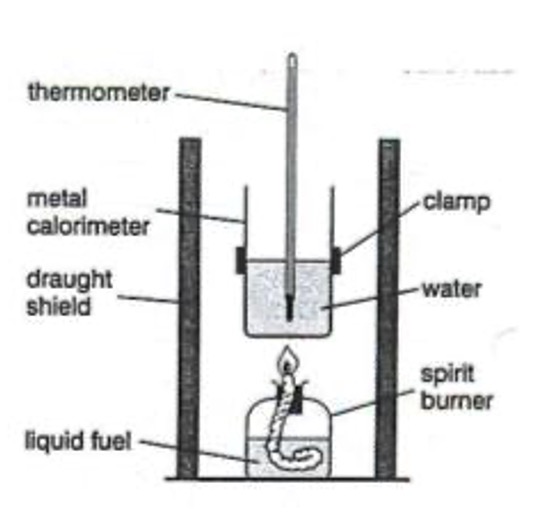
Worked Example - Calculating the Enthalpy of Combustion
Suppose 0.25 g of ethanol had been burned to raise the temperature of 100 g of water by 12.5 °C.
Step 1 - The heat energy gained by the water (Eh) is calculated using the formula:
Eh = cmΔT
Eh = 4.18 x 0.10 x 12.5
Eh = 5.225 kJ
The heat energy released on burning 0.25 g of ethanol = 5.225 kJ
Step 2 - The mass of one mole of ethanol can be calculated:
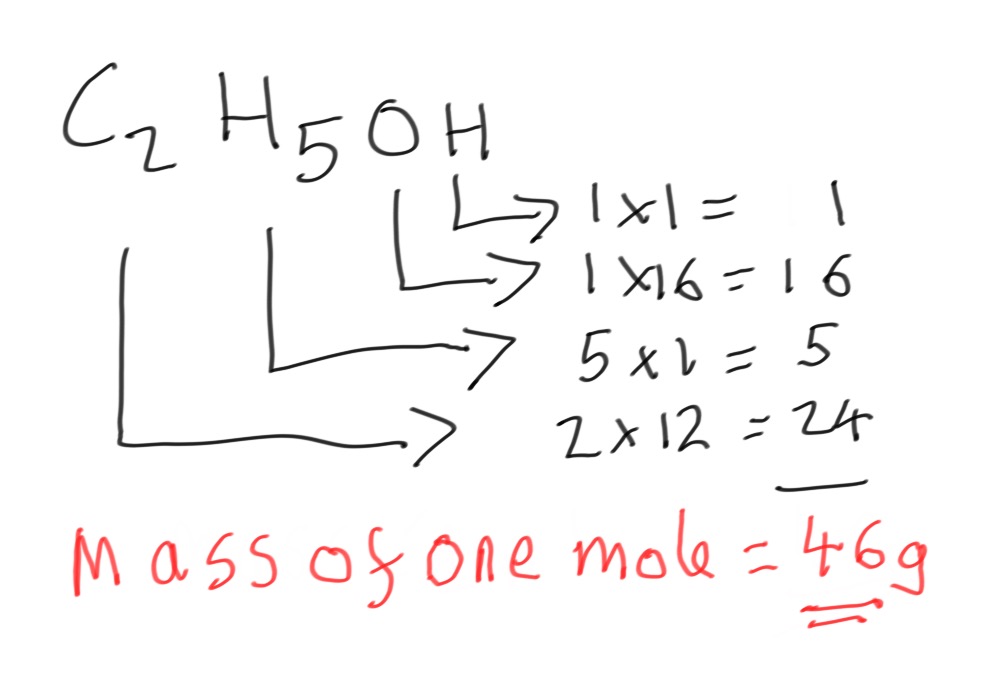
Step 3 - The heat energy released on burning 1 mole of ethanol can now be calculated:
ΔH =( Eh x n ) / m
ΔH = (5.225 x 46) / 0.25
ΔH = 961 kJ
The enthalpy of combustion of ethanol = −961 kJ mol-1
(A negative sign is used because combustion is an exothermic reaction)
The data booklet value is −1367 kJ mol-1. The experimental value is lower because heat is lost to the surroundings and the ethanol may not burn completely.
Rearranging Eh = cmΔT
You may be asked to calculate any of Eh, c, m or ΔT. Use c = 4.18 kJ kg-1 °C-1 for water, m in kg and Eh in kJ.
ΔT = Eh ÷ (c × m) m = Eh ÷ (c × ΔT)
Example: 8.36 kJ of heat is absorbed by 200 cm3 of water. Calculate the temperature rise.
Show answer
m = 0.200 kg
ΔT = 8.36 ÷ (4.18 × 0.200) = 10 °C
(ii) Hess's Law
Hess's law states that the enthalpy change for a chemical reaction is independent of the route taken. The enthalpy change for a reaction can be calculated using Hess's law, given appropriate data.

From previous work you should know and understand the following:
- Enthalpy (H) is a measure of the energy stored in a chemical.
- The enthalpy change in a chemical reaction: ΔH = Hproducts − Hreactants
- If a reaction is exothermic ΔH is negative; if endothermic ΔH is positive.
Hess's law can be shown in different ways
Carbon can burn to produce carbon dioxide directly by route X or it can form the intermediate CO by route Y, then the CO can burn to produce CO2 by route Z.
1.
2.
3.
Hess's Law Calculations
Previously we have used experimental data to work out ΔH combustion.
To do this we have carried out the reaction.
However sometimes we want to work out the enthalpy change for a reaction which cannot be measured directly because it does not usually occur e.g.
C(s) + 2H2(g) → CH4(g)
We can work out the enthalpy change for this reaction using Hess's law from the enthalpy of combustion of C(s), H2(g) and CH4(g)
Because the reaction forms one mole of a compound from its elements, this is called an enthalpy of formation (you do not need to learn this term for Higher).
Worked Example 1 - method 2
Worked Example 2 - method 3
Worked Example 3 - method 3
Worked Example - Hess's Law from Enthalpies of Combustion
Calculate the enthalpy change for C(s) + 2H2(g) → CH4(g), using these enthalpies of combustion:
C: −394 kJ mol-1 H2: −286 kJ mol-1 CH4: −891 kJ mol-1
Show answer
Write the combustion equations, keeping the ones for the reactants and reversing the one for the product:
C + O2 → CO2 ΔH = −394
2H2 + O2 → 2H2O ΔH = 2 × (−286) = −572
CO2 + 2H2O → CH4 + 2O2 ΔH = +891 (reversed, so the sign changes)
Add the equations (CO2, H2O and O2 cancel) and add the ΔH values:
ΔH = −394 + (−572) + 891 = −75 kJ mol-1
(iii) Molar and Mean Bond Enthalpy
Breaking bonds
If we want to break a covalent bond between two atoms, we need to put energy in to overcome the attractive force.
Bond breaking is an endothermic process.
Molar and mean molar bond enthalpies
The molar bond enthalpy is the energy required to break one mole of bonds in a diatomic molecule.
A mean molar bond enthalpy is the average energy required to break one mole of bonds, for a bond that occurs in a number of compounds (e.g. C-H).
H-H bond enthalpy
The H-H bond enthalpy is the energy required to break one mole of H-H bonds.
The product is 2 H atoms in the gaseous state.
This is equal and opposite to the energy given out when 2 H atoms in the gaseous state form 1 mole of H-H bonds.
Diatomic molecules
For a diatomic molecule, the bond enthalpy values can be measured directly
- H-Cl
- O=O
- Br-Br
- Cl-Cl
Mean bond enthalpies
Mean bond enthalpies have to be calculated as the value of a C-H bond enthalpy will vary according to the environment it is in.
Energy used to break a bond (endothermic) will equal that released when the bond is made (exothermic).
Bond Enthalpy calculations
Bond enthalpies can be used to estimate the enthalpy change occurring for a gas phase reaction, by calculating the energy required to break bonds in the reactants and the energy released when new bonds are formed in the products.
Using bond enthalpies
ΔH can be calculated from bond enthalpies using the equation:
ΔH = Σ ΔH (bonds broken) + Σ ΔH (bonds made)
Bonds broken values are positive (endothermic) and bonds made values are negative (exothermic).
Making bonds
The opposite is true if we want to make new bonds.
Energy is released when new chemical bonds are formed.
Bond making is an exothermic process.
Breaking or making the same chemical bond will require the same energy to be put in or released.
H-H → 2H ΔH = +436 kJ mol-1
2H → H-H ΔH = −436 kJ mol-1
Bond enthalpy values
The values for bond enthalpies are found in the data booklet.
For some bonds, the mean bond enthalpy is quoted. This is to give an average value to work from since the precise enthalpy value for a bond may be different in different molecules.
For example, the energy needed to break a C-C bond in ethane (C2H6) will be different to the energy needed to break a C-C bond in decane (C10H22)
Gaseous state
The bond enthalpies quoted in the data book are the energies required to break 1 mole of a particular bond between a pair of atoms in the gaseous state.
We can use these bond enthalpies to approximately calculate the enthalpy change for a given reaction.
Worked Example 1
What is the enthalpy change when hydrogen is added to ethyne to produce ethane?
C2H2 + 2H2 → C2H6
Step 1
Draw the full structural formulae of all the molecules from the equation. This will show exactly what bonds are involved.

Step 2
Make a list of all the bonds being broken in the reactants
Bond Breaking
1 x C≡C
2 x C-H
2 x H-H
Step 3
Fill in the values for the bond enthalpies from the data booklet.
Bond Breaking
1 x C≡C = 838
2 x C-H = 2 x 412 = 824
2 x H-H = 2 x 436 = 872
Step 4
Repeat this process for the Bond Making steps.
Bond Making
1 x C-C = 348
6 x C-H = 6 x 412 = 2472
Step 5
Calculate the total energy put in breaking bonds and total energy given out making new bonds.
Remember: Bond breaking is an endothermic process and bond making is an exothermic process.
Bond Breaking
1 x C≡C = 838
2 x C-H = 2 x 412 = 824
2 x H-H = 2 x 436 = 872
Total put in = 2534 kJ
Bond Making
1 x C-C = 348
6 x C-H = 6 x 412 = 2472
Total given out = -2820 kJ
Step 6
Calculate the enthalpy change for the reaction.
ΔH = 2534 + (-2820)
ΔH = 2534 - 2820
ΔH = −286 kJ mol-1
Worked Example 2
(d) Equilibria
What you need to know
- Reversible reactions and dynamic equilibrium
- Why chemists move the position of equilibrium towards the products
- Predicting the effect of temperature, pressure and adding or removing reactants or products
- The effect of a catalyst
Reversible Reactions
Chemical reactions which take place in both directions are called reversible reactions.
Reactants ⇋ Products
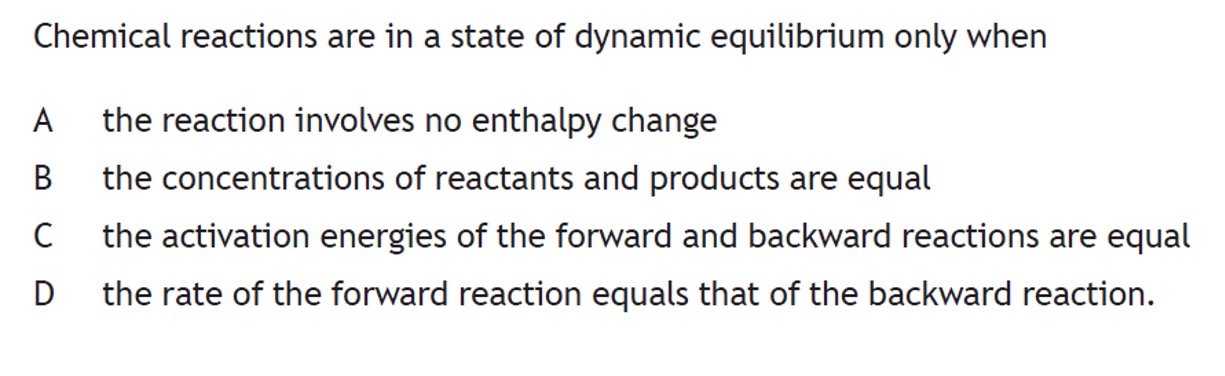
In a closed system, reversible reactions attain a state of dynamic equilibrium when the rates of forward and reverse reactions are equal.
At equilibrium, the concentrations of reactants and products remain constant, but are rarely equal.
Dynamic equilibrium
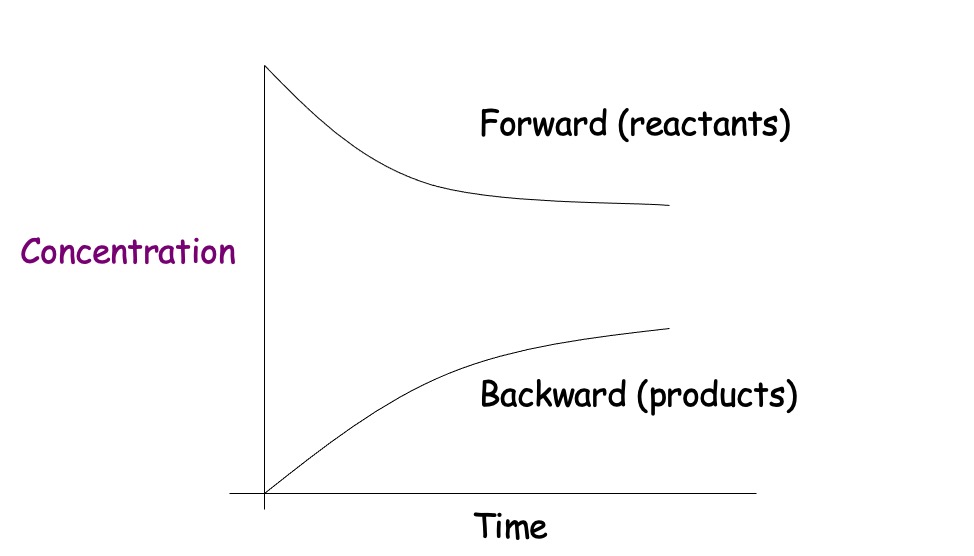
Reactants ⇋ Products
Position of Equilibrium
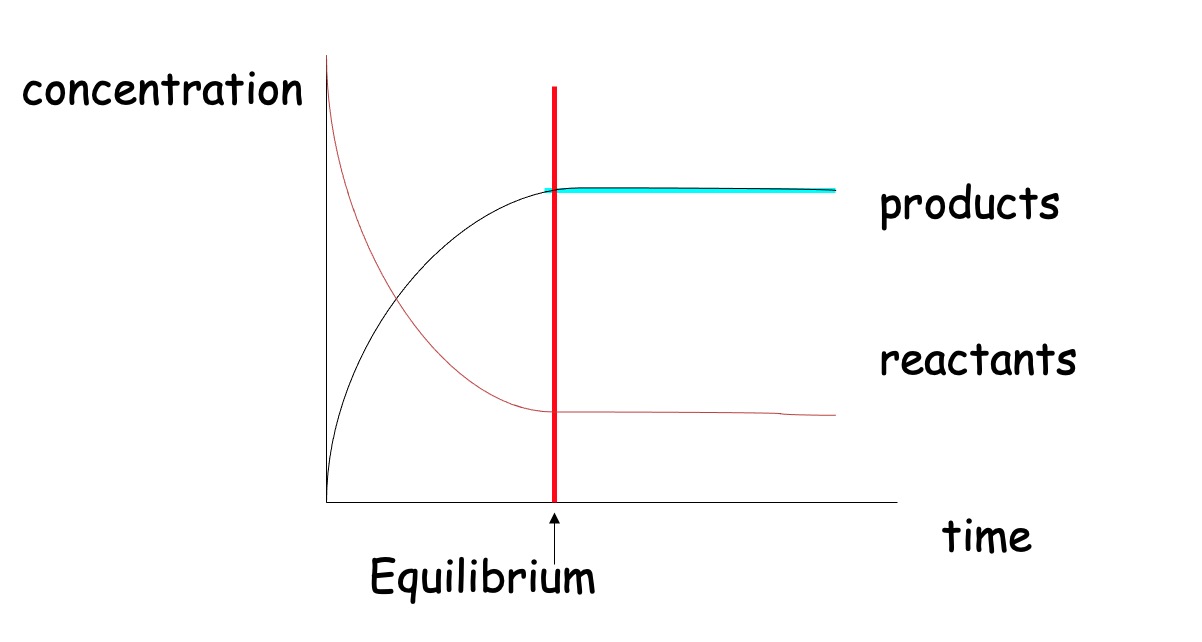
At equilibrium the concentrations of products and reactants stay constant (but they are rarely equal).
Iodine Equilibrium
Iodine is soluble in both cyclohexane and KI solution. In cyclohexane it is purple. In KI solution, yellow-brown.
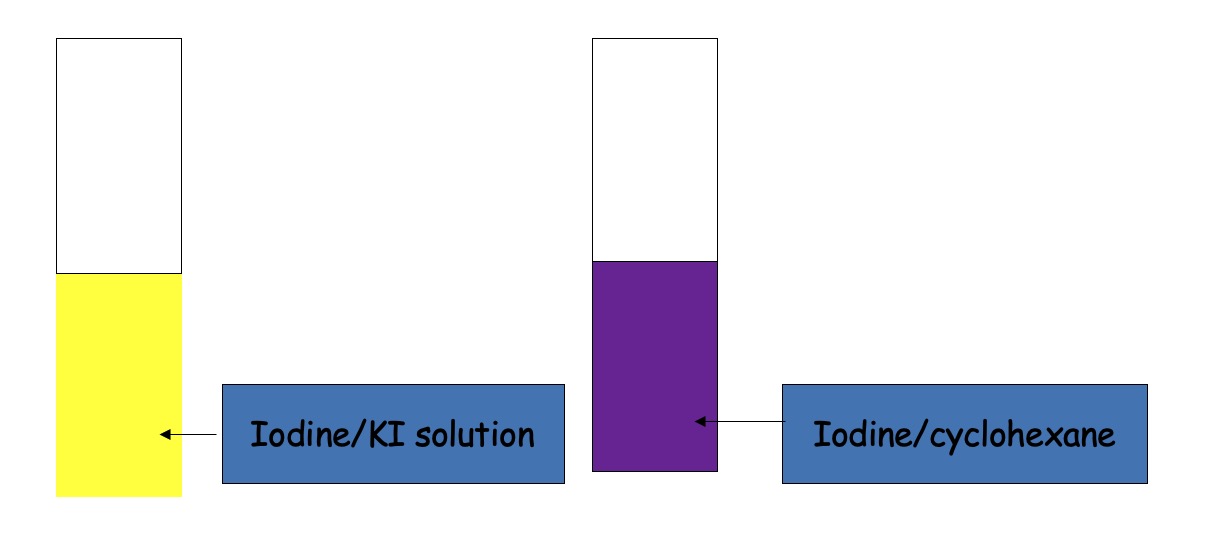
To each test tube, the other liquid/solution is added.
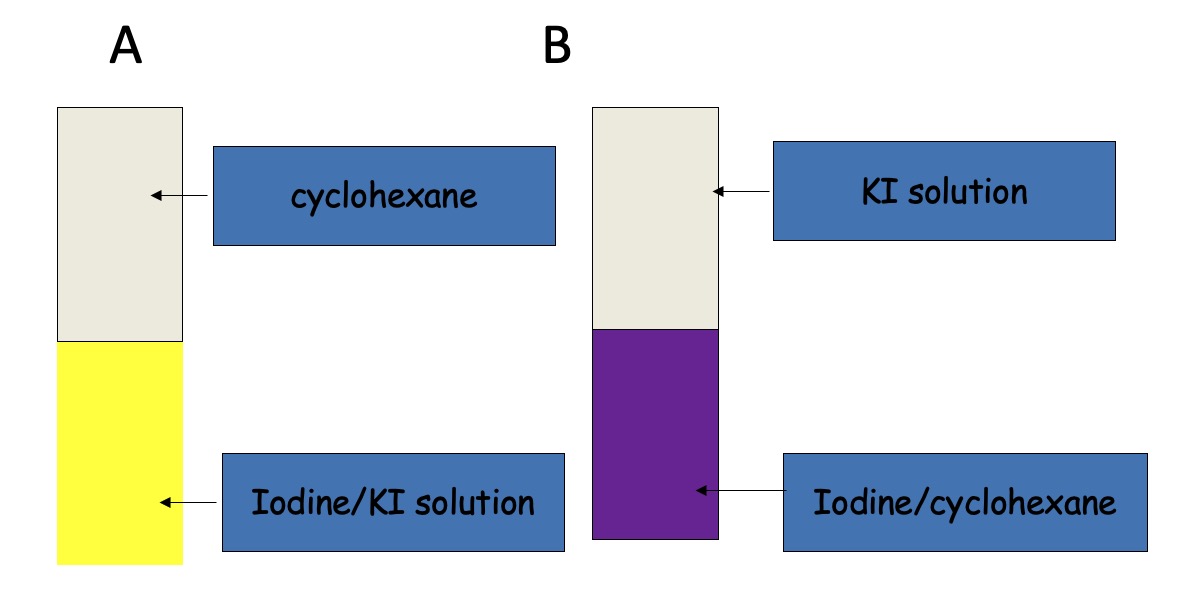
Final equilibrium is the same

Question 1
Show answer
D
Le Chatelier's Principle
An equilibrium will move to undo any change imposed upon it.
If the forward reaction is favoured we say the equilibrium has moved to the right.
If the reverse reaction is favoured we say the equilibrium has moved to the left.
To maximise profits, chemists employ strategies to move the position of equilibrium in favour of the products.
(i) Temperature
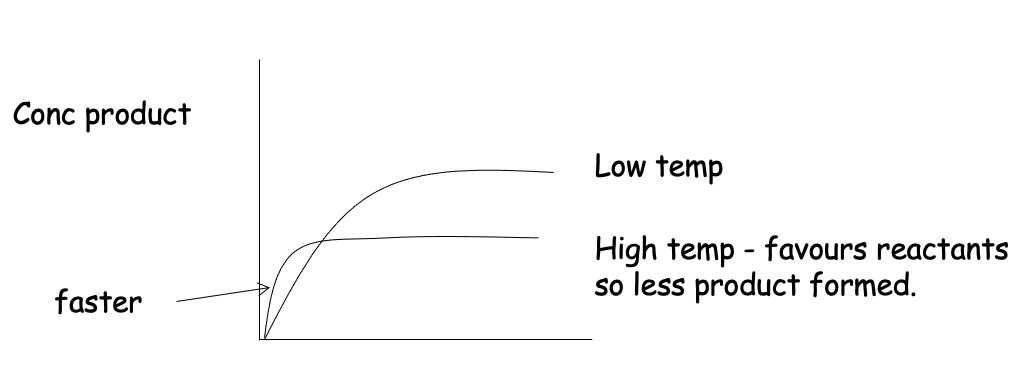
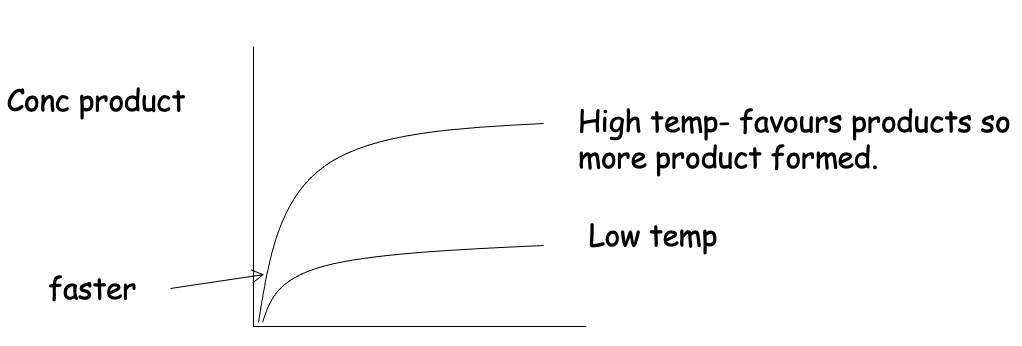
Heating a reversible reaction at equilibrium shifts the reaction in the direction of the ENDOTHERMIC REACTION
Cooling a reversible reaction at equilibrium shifts the reaction in the direction of the EXOTHERMIC REACTION
Exothermic reaction
Consider the following equilibrium:
A + B ⇋ C + D ΔH = −ve
Forward reaction is exothermic
Increasing temperature shifts equilibrium to the left.
Endothermic Reaction
Consider the following equilibrium:
A + B ⇋ C + D ΔH = +ve
Forward reaction is endothermic.
Increasing temperature shifts equilibrium to the right.
Example
Consider the following equilibrium:
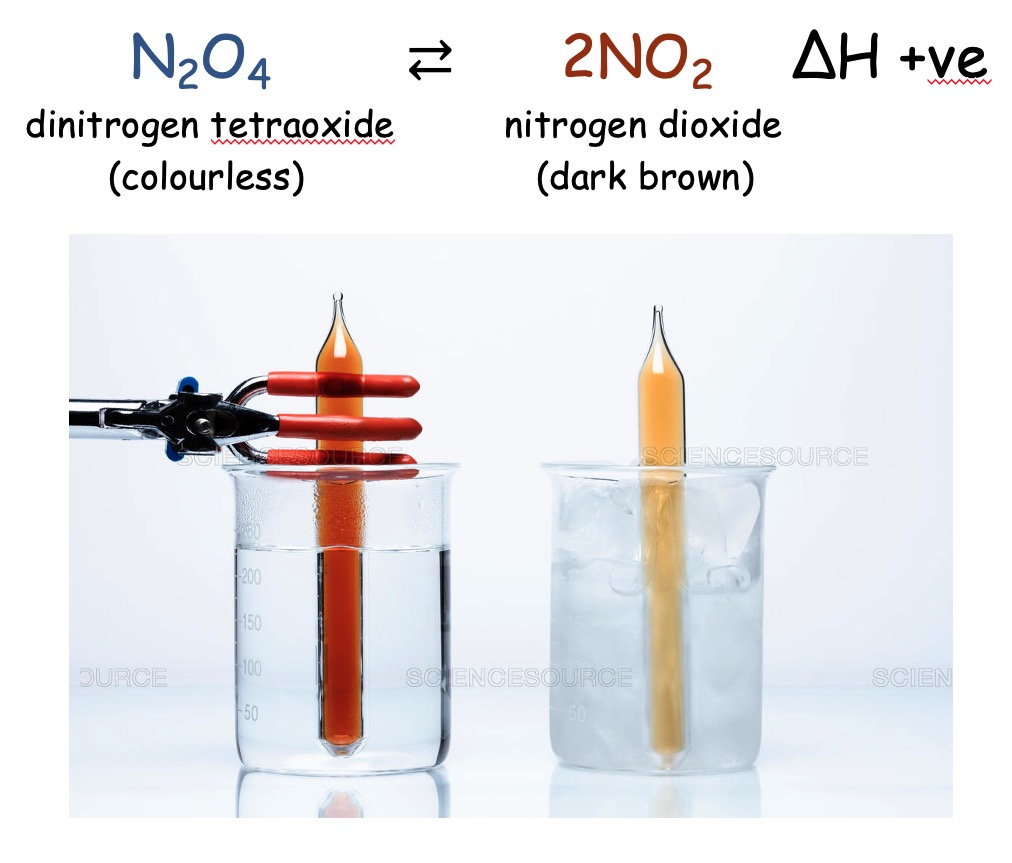
Increasing the temperature favours the forward reaction as it takes in energy, so the equilibrium moves to the right producing more NO2 and less N2O4. So the colour becomes darker.
Decreasing the temperature favours the reverse reaction as it gives out energy so the equilibrium moves to the left producing more N2O4 and less NO2. So the colour becomes lighter.
(ii) Pressure
Consider the following equilibrium:
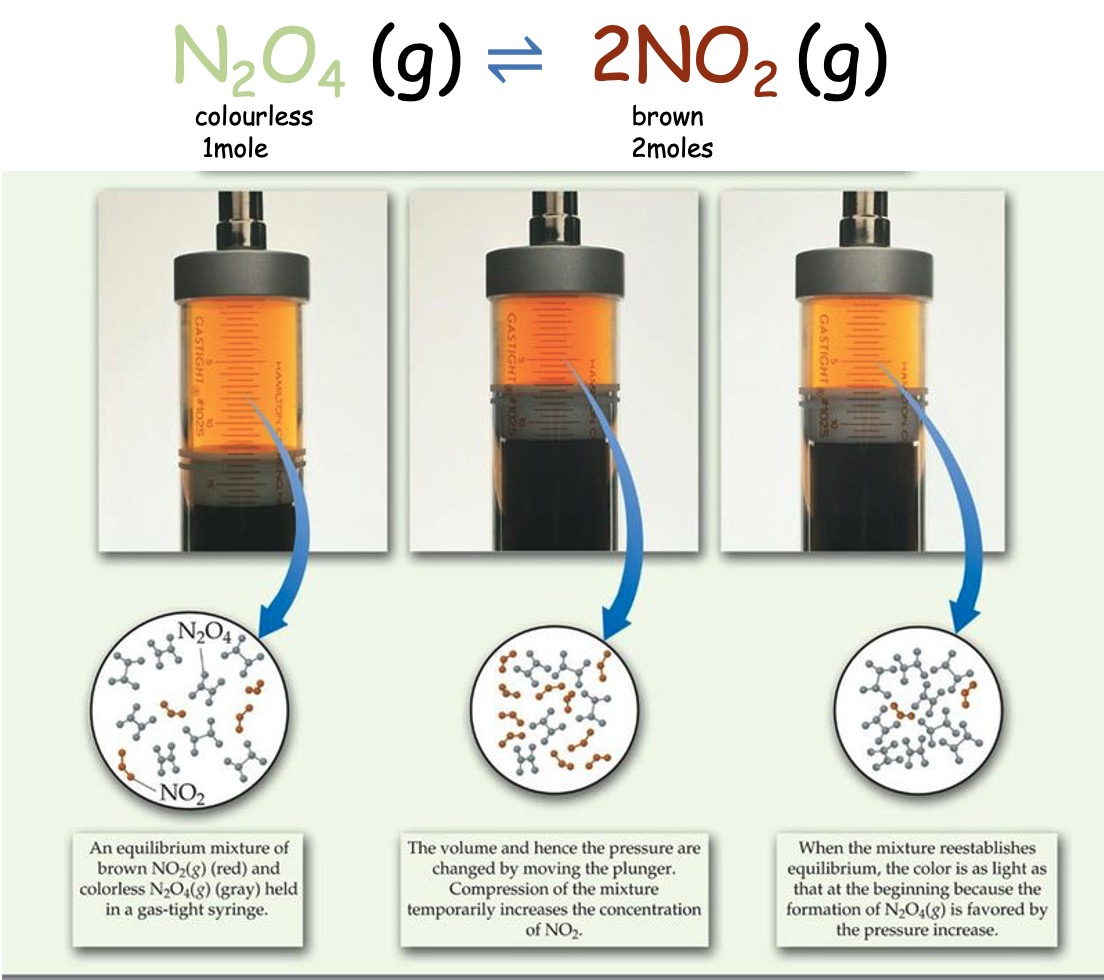
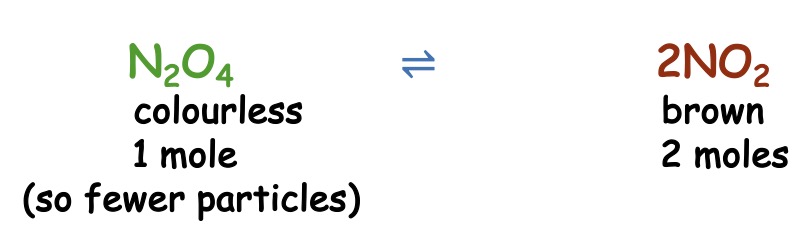
Increasing the pressure will cause the equilibrium to move to decrease the pressure. The equilibrium will move to reduce the number of gas particles.
The equilibrium moves to the left producing more N2O4 and less NO2 so the colour lightens.
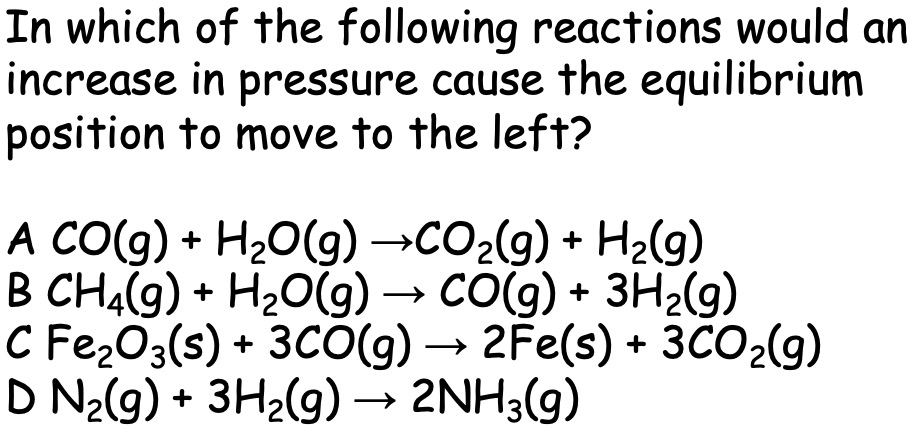
Question 2
Show answer
B
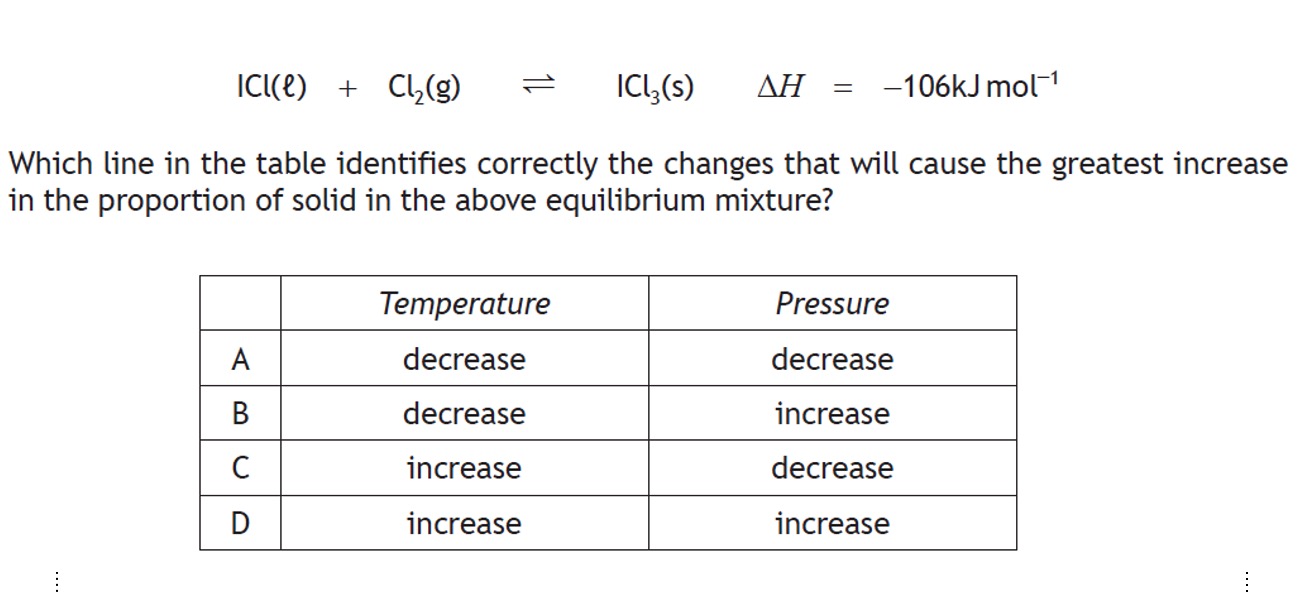
Question 3
Show answer
B
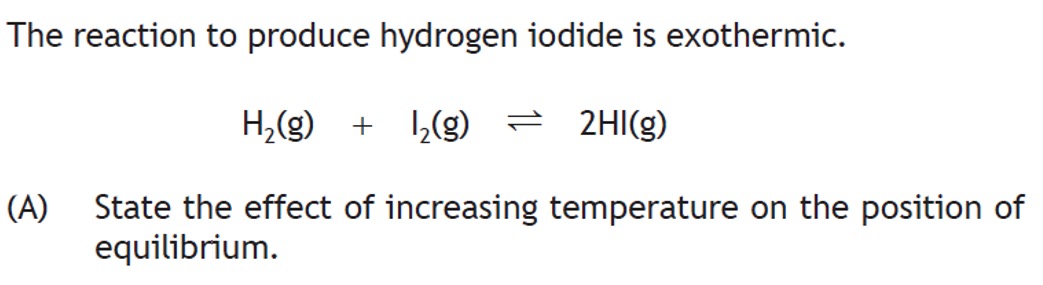
Question 4
Show answer
Favours reverse reaction

Show answer
2 moles of gas on both sides.
(iii) Concentration
Consider the following equilibrium:
A + B ⇋ C + D
Increasing the concentration of A or B speeds up the forward reaction, so the equilibrium moves to the right and the concentrations of C and D increase.
Removing C or D has the same effect: the equilibrium moves to the right to replace them.
Example
A mixture of cobalt chloride and concentrated HCl sets up the following equilibrium:
Co(H2O)62+ + 4Cl- ⇋ CoCl42- + 6H2O ΔH +ve
- Co(H2O)62+ is pink in colour.
- CoCl42- is blue in colour.
Adding extra Cl- ions forces the equilibrium to try to remove these. The forward reaction is favoured because this uses up chloride ions.
The equilibrium has moved to the right so the solution becomes blue in colour.
(iv) Catalysts
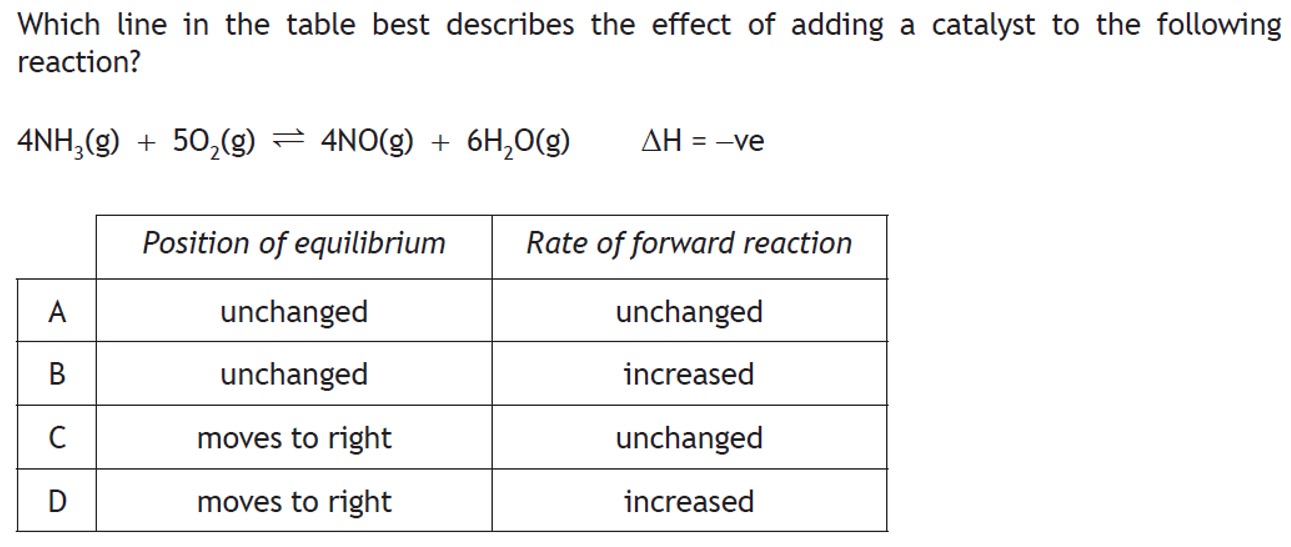
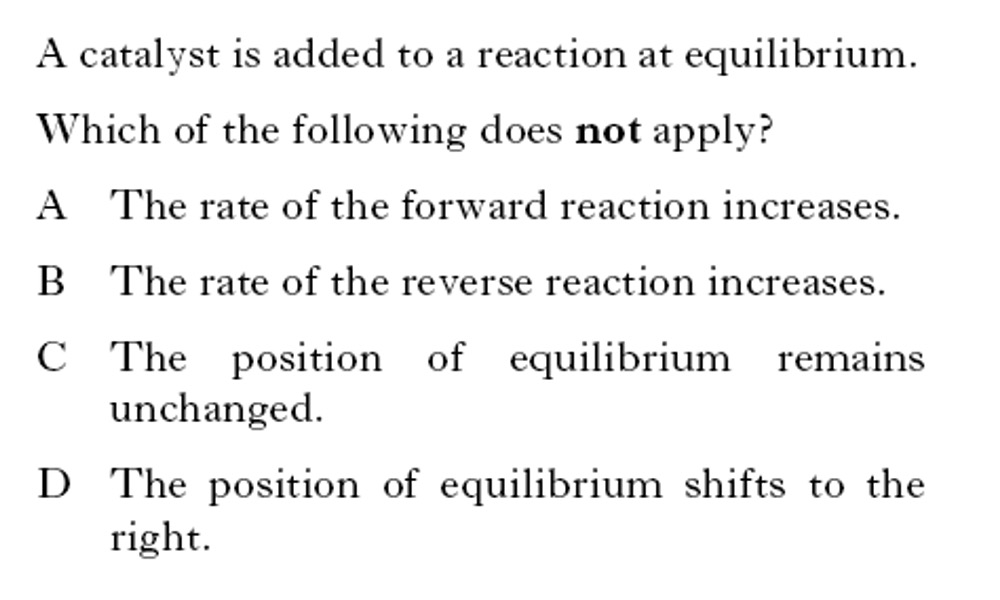
The addition of a catalyst increases the rates of the forward and reverse reactions equally. The catalyst increases the rate at which equilibrium is achieved but does not affect the position of equilibrium.
Question 5
Show answer
B
Question 6
Show answer
D
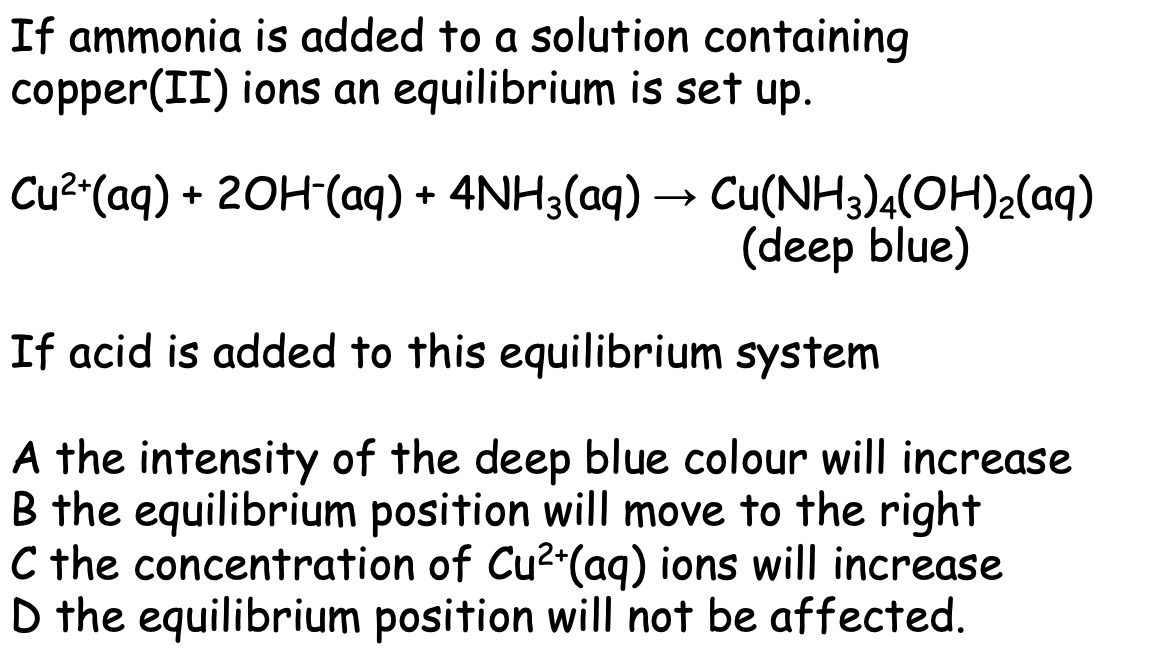
(v) Effect of chemicals not shown in the equilibrium
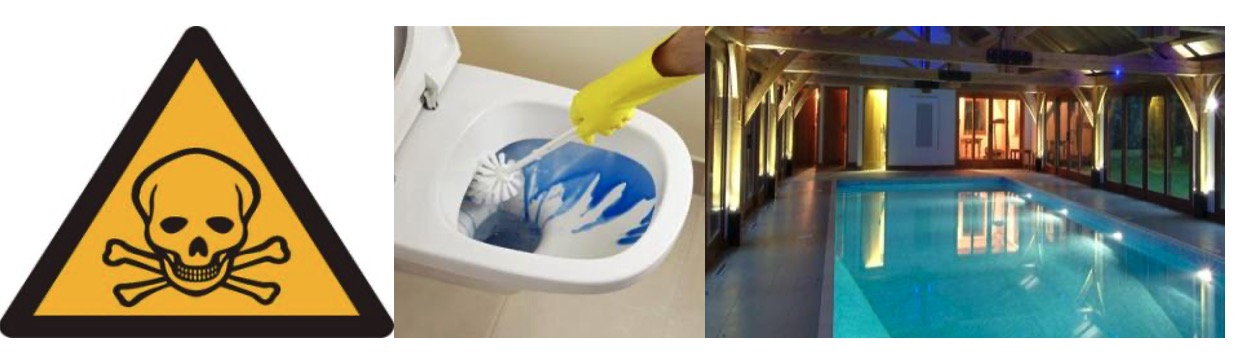
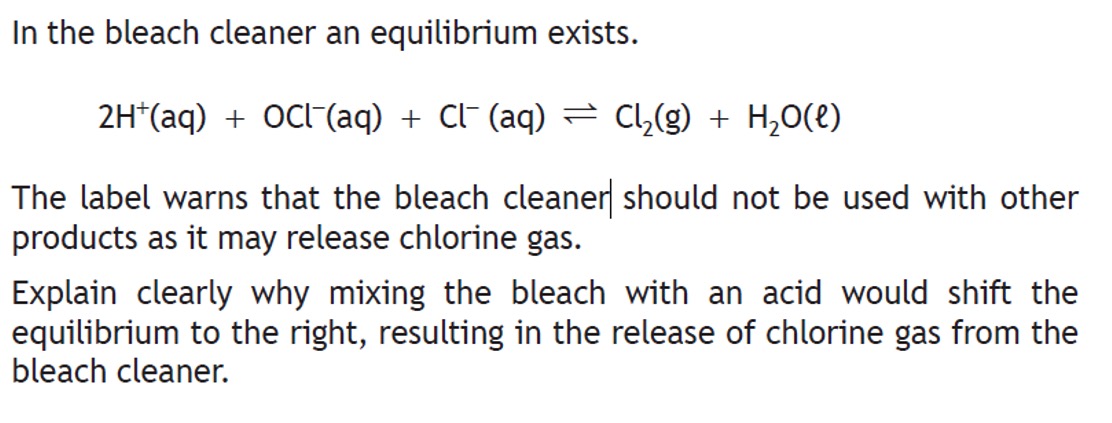
Dissolving chlorine in water produces the hypochlorite ion, ClO-, which has a bleaching effect.
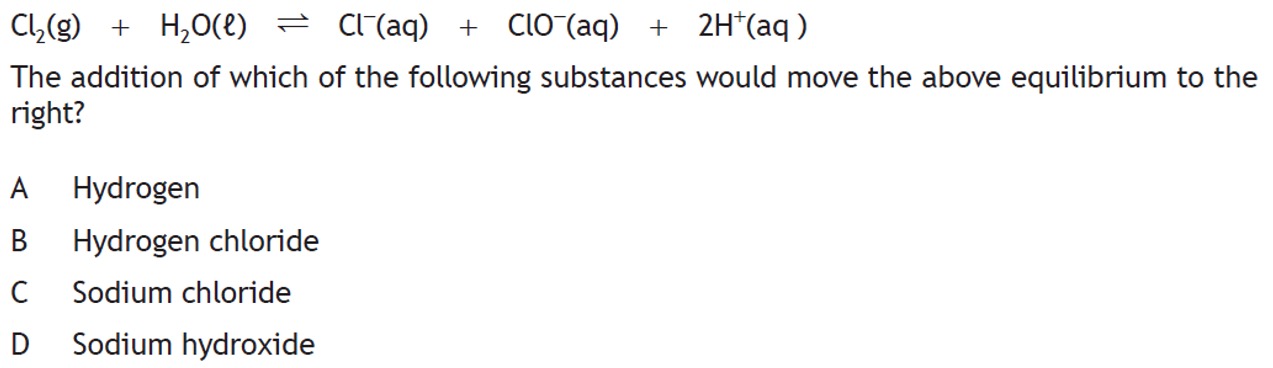
Cl2 + H2O ⇋ 2H+ + ClO- + Cl-
Effect of Neutralisation
Adding an alkali will remove hydrogen ions from the equilibrium which will move to the right to replace them.
The bleaching effect will be increased.
Effect of Precipitation
Adding silver nitrate will remove chloride ions from the equilibrium, because a precipitate of silver chloride forms. (Check the solubility table in the data booklet.)
The equilibrium will move to the right to replace them so the bleaching effect will be increased.
Effect of adding an acid
Adding an acid causes the equilibrium to move to 'use up' H+ ions. The equilibrium moves to the left producing more toxic Cl2.
This can be fatal and accidents caused by mixing bleach and acid are not unusual.
Question 7
Show answer
D
Question 8
Show answer
C
Question 9
Show answer
Adding acid would increase the concentration of hydrogen ions. This would cause the equilibrium to shift to the right producing more chlorine.
(e) Chemical Analysis
What you need to know
- Chromatography: what it does, and identifying components by distance travelled or retention time
- Reading chromatography results shown as a graph
- Volumetric analysis: titration, end-points, concordant titres and standard solutions
- Redox titrations
- Titration calculations
(i) Chromatography
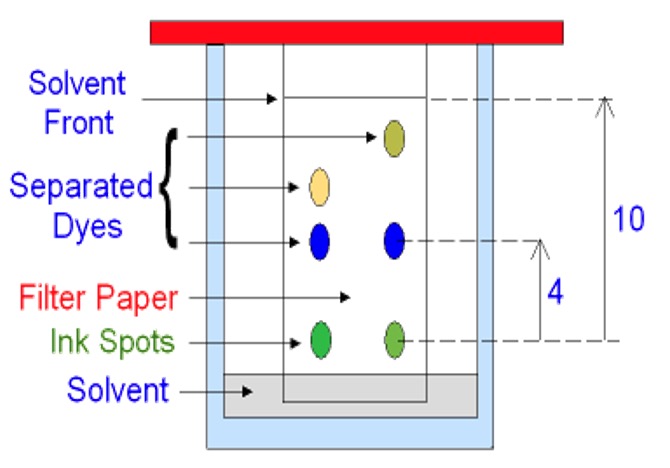 Chromatography is one technique widely used for analysis.
Chromatography derives from the Greek word 'Chroma' meaning colour and 'graphia' to mean writing.
The results of a chromatography experiment can sometimes be presented graphically, showing an indication of the quantity of substance present on the y-axis and retention time on the x-axis.
Chromatography is one technique widely used for analysis.
Chromatography derives from the Greek word 'Chroma' meaning colour and 'graphia' to mean writing.
The results of a chromatography experiment can sometimes be presented graphically, showing an indication of the quantity of substance present on the y-axis and retention time on the x-axis.
Chromatography is a technique used to separate the components present within a mixture. Chromatography separates substances by making use of differences in their polarity or molecular size.
Depending on the type of chromatography, a component can be identified by the distance it has travelled, or by the time it has taken to travel through the apparatus (its retention time). You do not need to know the details of any particular chromatography method.
Calculating Rf
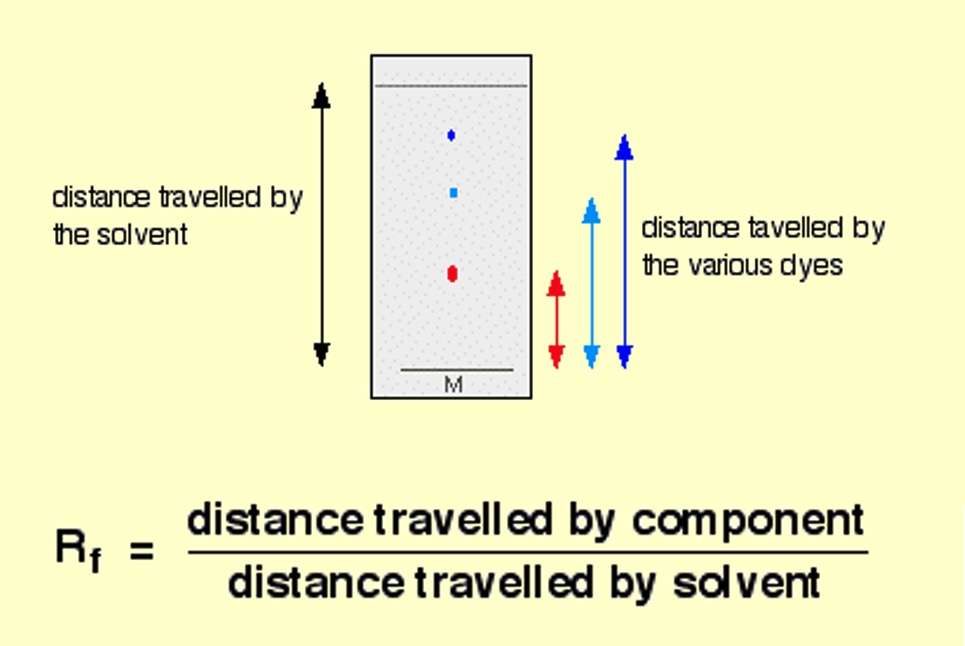
Question 1
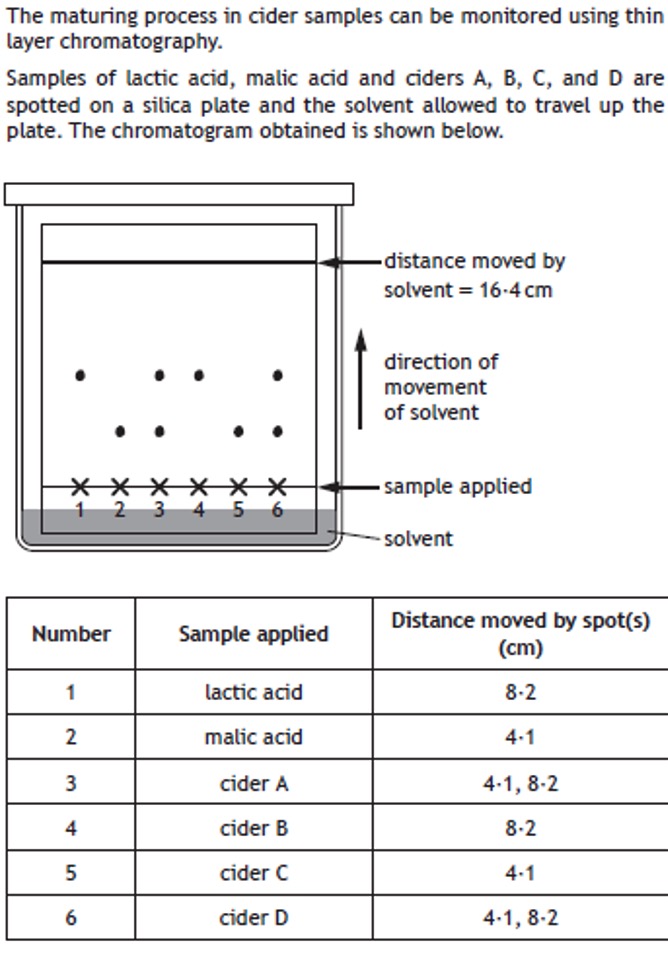
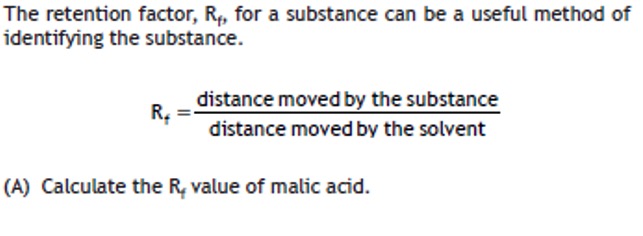
Show answer
4.1 ÷ 16.4 = 0.25
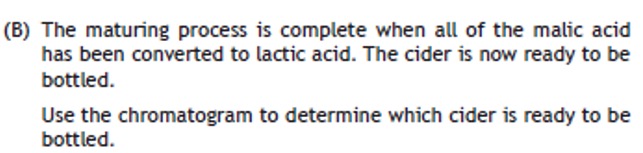
Show answer
B
Question 2
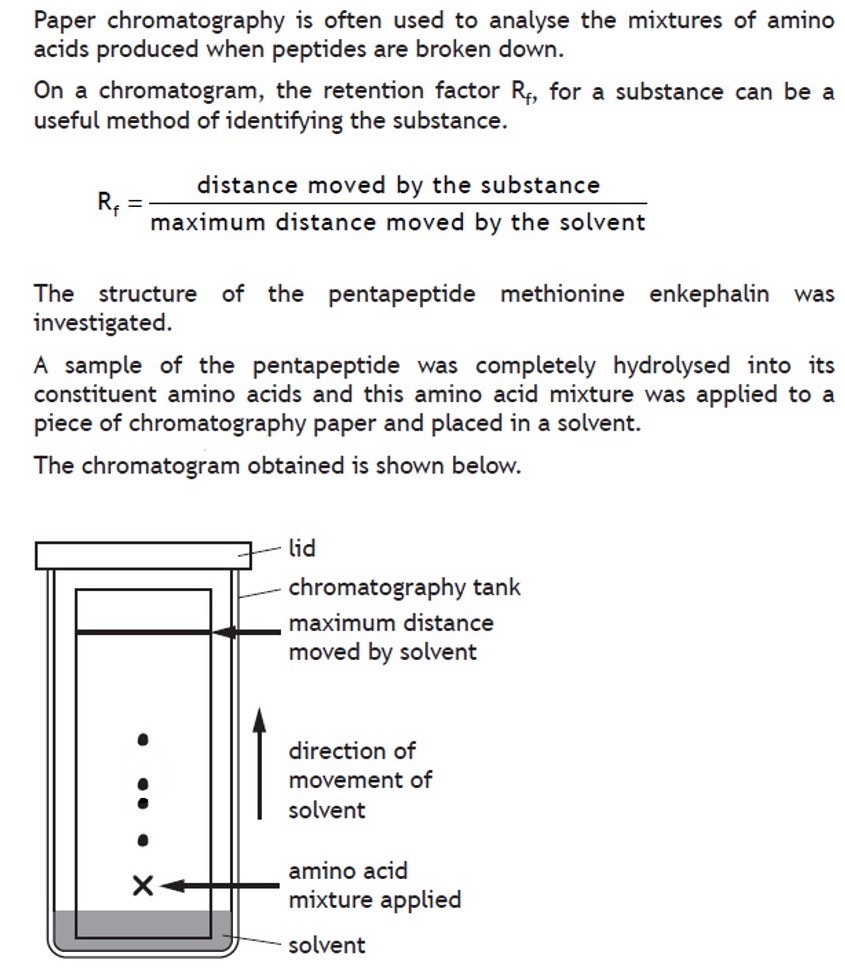

Show answer
Only 4 different amino acids in chain OR Two amino acids moved the same distance.

Show answer
Circle should be drawn around dot that is second from top.
Question 3
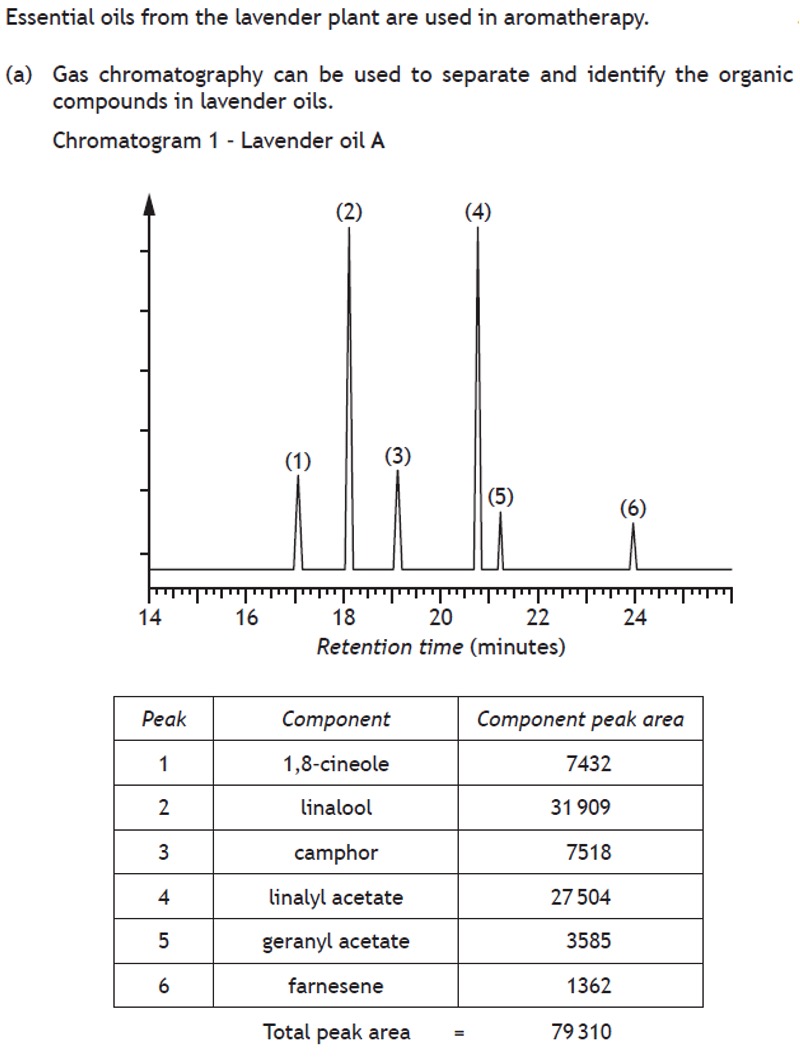
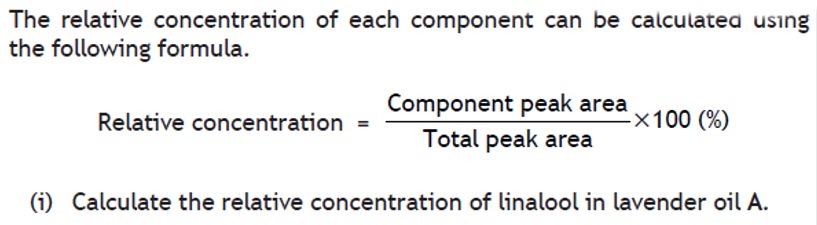
Show answer
(31909 ÷ 79310) × 100 = 40.2%
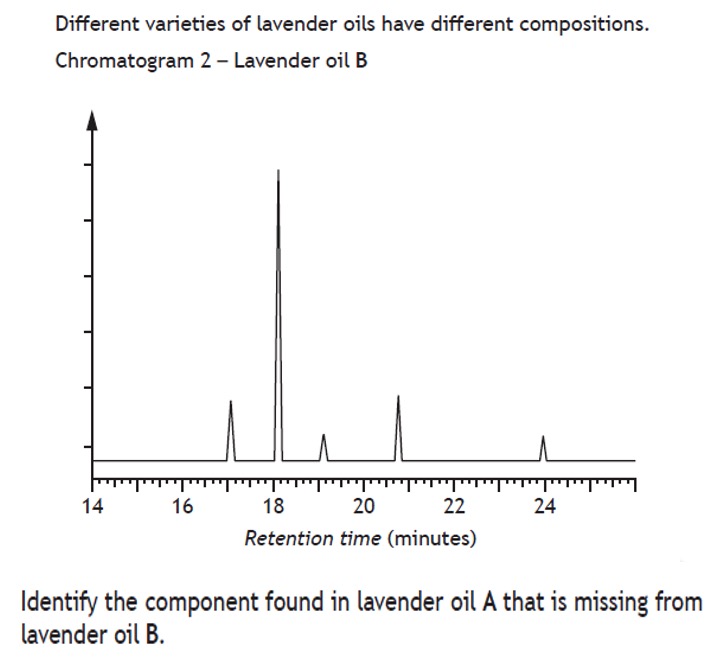
Show answer
Geranyl acetate
(ii) Volumetric analysis
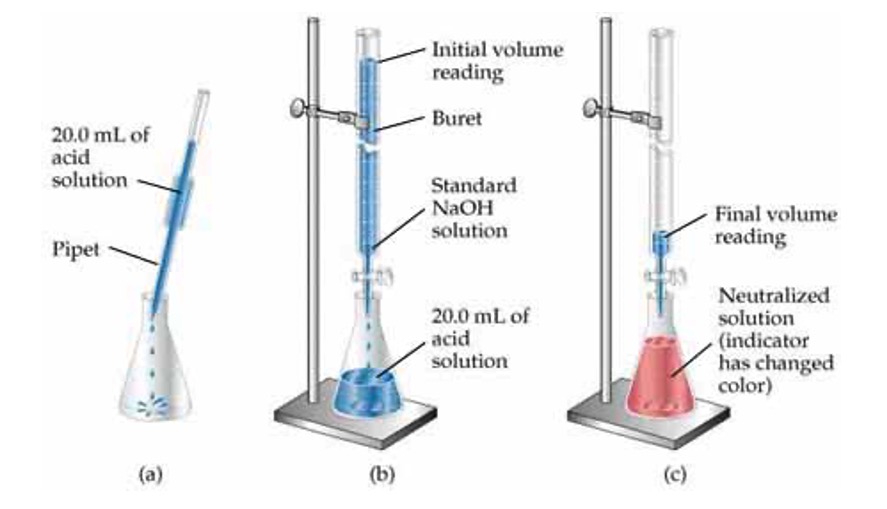
Volumetric analysis involves using a solution of accurately known concentration in a quantitative reaction to determine the concentration of another substance.
Titrations
- Titration is used to find, accurately, the volume of solution needed to reach the end-point of a reaction. An indicator is normally used to show the end-point.
- Titre volumes within 0.2 cm3 of each other are concordant. The first titre is usually a rough one and is not used in the average.
- A solution of accurately known concentration is a standard solution.
- Redox titrations are based on redox reactions. With acidified permanganate no indicator is needed, because the purple permanganate turns colourless when it is reduced.
Given the balanced equation, you can calculate:
- the concentration of one reactant from the concentration of the other and the volumes of both solutions
- the volume of one reactant from the volume of the other and the concentrations of both solutions
Method: moles of the known solution (n = c × V) → use the mole ratio → moles of the unknown → c = n ÷ V.
Question 4
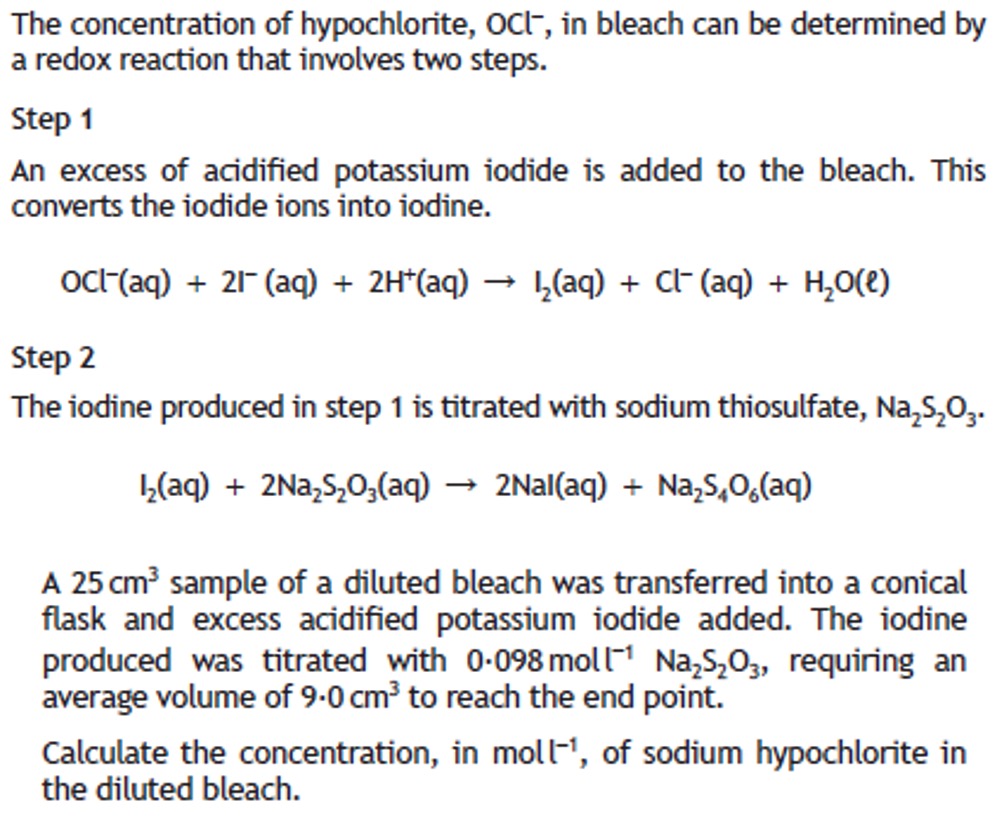
Show answer
0.018 mol l-1
Question 5
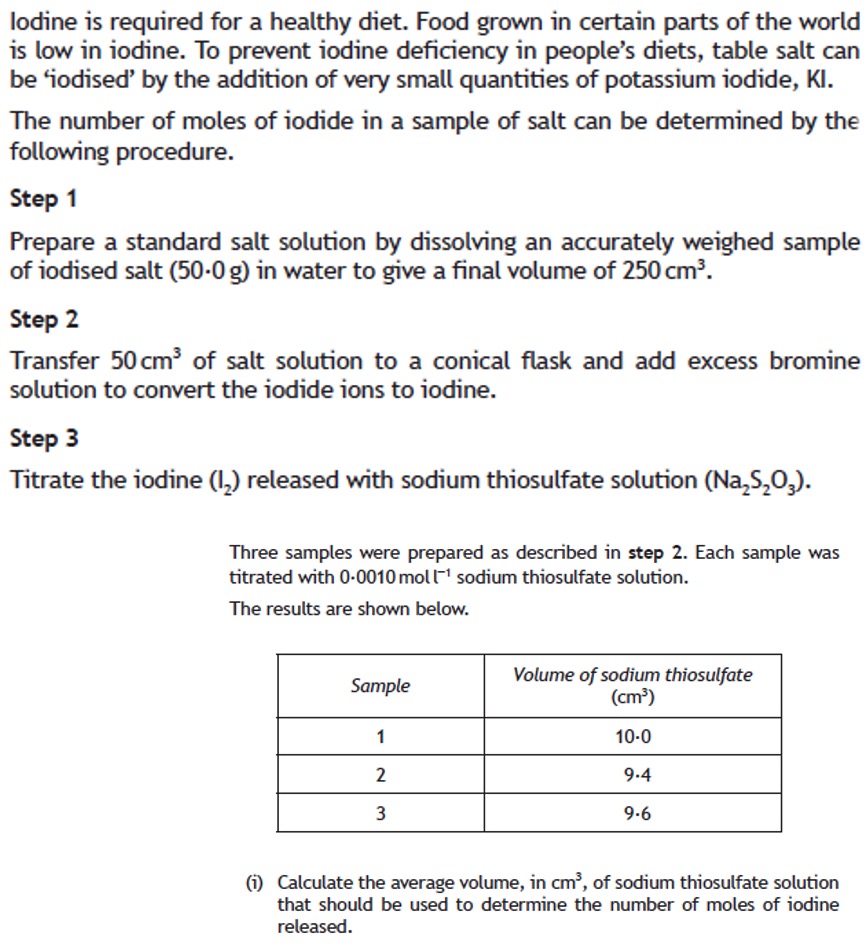
Show answer
9.5 cm3
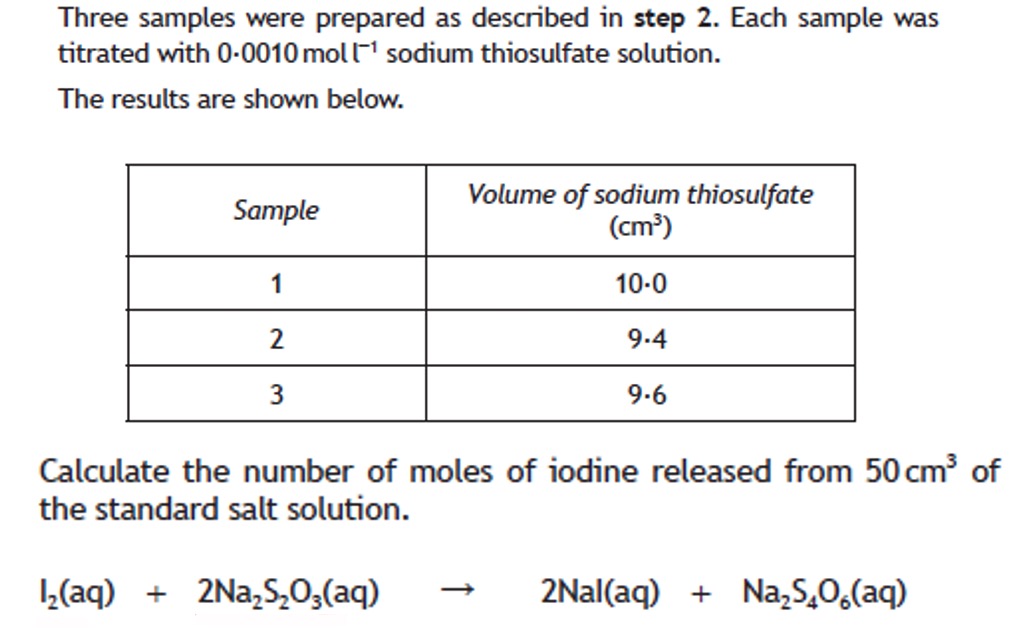
Show answer
4.75 × 10⁻⁶ mol
Question 6
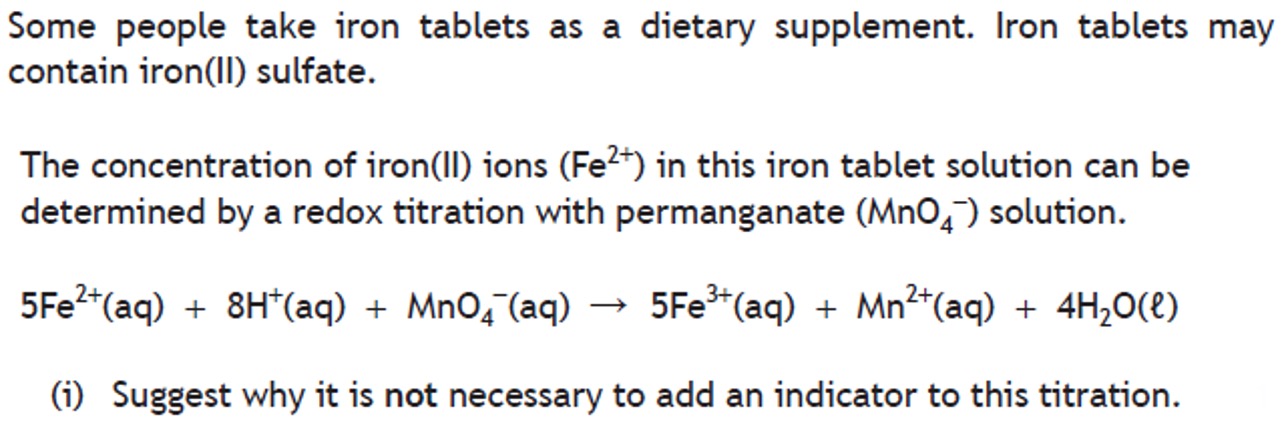
Show answer
The reaction is self-indicating (the permanganate colour shows the end-point).

Show answer
To provide H+ ions for the reaction.
Question 7
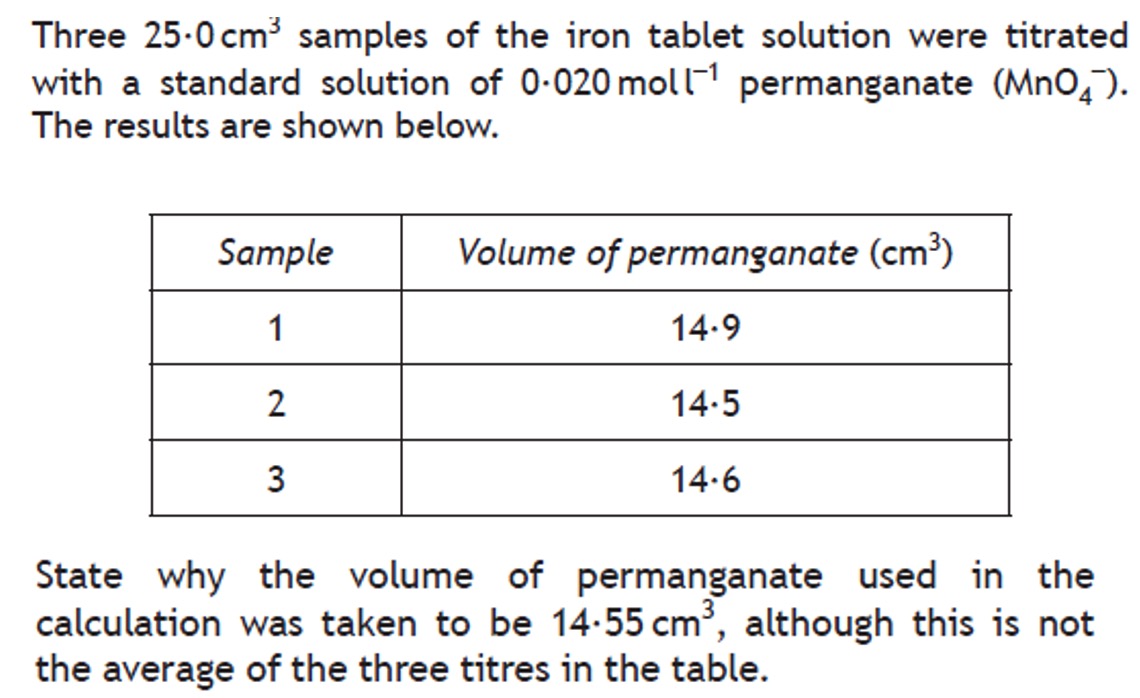
Show answer
The first titre is a rough (practice) titration, so it is not included in the average.

Show answer
0.0583 mol l-1
(f) Researching Chemistry
What you need to know
- The uses of common chemical apparatus, and drawing labelled diagrams of it
- General practical techniques
- Suggesting and justifying improvements to an experiment
- Reporting experimental work: tables, graphs, averages, rogue points, reproducibility and uncertainty
Common Chemical Apparatus
You need to know what each of these is used for, and be able to draw labelled, sectional diagrams of them.
| Apparatus | Use |
|---|---|
| Conical flask | Holding and mixing solutions, e.g. in a titration. It can be swirled without spilling. |
| Beaker | Holding, mixing and heating liquids. Its volume markings are only a rough guide. |
| Measuring cylinder | Measuring volumes of liquid when great accuracy is not needed, e.g. in preparations. |
| Delivery tube | Carrying a gas from the reaction vessel to where it is collected. |
| Dropper | Adding small volumes of liquid, a drop at a time. |
| Test tubes / boiling tubes | Small-scale reactions. Boiling tubes are larger and used for heating. |
| Funnel | Filtering, and pouring liquids into narrow openings. |
| Filter paper | Used with a funnel to separate a solid (residue) from a liquid (filtrate). |
| Evaporating basin | Evaporating the solvent from a solution to leave the solid. |
| Pipette with safety filler | Measuring and transferring an accurate, fixed volume of solution, e.g. 25.0 cm3. |
| Burette | Delivering accurately measured, variable volumes of solution in a titration. |
| Volumetric flask | Making up a standard solution to an accurate volume. |
| Distillation flask | Holding the mixture that is heated during distillation. |
| Condenser | Cooling a vapour so that it condenses back to a liquid. |
| Thermometer | Measuring temperature. |
General Practical Techniques
Filtration: filter paper in a funnel separates the solid residue from the liquid filtrate.
Using a balance, and mass by difference: weigh the container with the substance, transfer the substance, then reweigh the empty container. The difference is the mass transferred.
Collecting gases:
- over water: for gases that are relatively insoluble, or when a dry sample is not needed
- using a gas syringe: for soluble gases, or when a dry sample is needed (it also measures the volume)
Heating safely: use a Bunsen burner, a water bath or a heating mantle. Flammable liquids, such as alcohols, should be heated with a water bath or heating mantle, not a flame.
Enthalpy changes: measure the temperature change of a known mass of water and use Eh = cmΔT.
Volumetric analysis:
- the volume markings on beakers give only a rough indication of volume
- measuring cylinders are usually accurate enough for preparative work
- for analytical work, burettes, pipettes and volumetric flasks are more appropriate
- titration is used to find accurately the volume of solution needed to reach the end-point
Preparing a standard solution:
- Accurately weigh the solid, by difference.
- Dissolve it in a small volume of deionised water in a beaker.
- Transfer the solution to a volumetric flask, rinsing the beaker and adding the rinsings to the flask.
- Add deionised water until the bottom of the meniscus is on the mark.
- Stopper the flask and invert it several times to mix.
Simple distillation: a flask, condenser and suitable heat source separate a mixture of liquids with different boiling points.
Improving an Experiment
Given a description of an experiment or its results, you may be asked to suggest an improvement and justify it (say why it helps). For example:
- Repeat the measurement and calculate an average, to make the result more reliable.
- Use a burette or pipette instead of a measuring cylinder, to measure volumes more accurately.
- Insulate the container or use a lid in an Eh experiment, to reduce heat loss to the surroundings.
Reporting Experimental Work
- Tables: give every column a heading with its unit, e.g. Time (s).
- Graphs: draw a scatter graph with suitable scales and labelled axes (with units).
- Line of best fit: sketch a straight or curved line that shows the trend in the data.
- Averages: calculate the mean of repeated results.
- Rogue points: identify results that do not fit the pattern and leave them out of averages.
- Reproducibility: comment on how close repeated results are to each other.
- Uncertainty can be shown as measurement ± uncertainty, e.g. 25.0 ± 0.1 cm3. You do not need to know uncertainty values for apparatus or calculate uncertainties.
Practical Work in This Course
These practicals link to the notes on this site:
- Redox titration: Chemical Changes and Structure (c) and Chemical Analysis (e)
- Oxidation of alcohols: Nature's Chemistry (g)
- Making esters: Nature's Chemistry (d)
- Effect of concentration and temperature on reaction rate: Controlling the Rate (b)
- Enthalpy of combustion and Hess's law: Chemical Energy (c)
Enthalpy of combustion experiment: