Higher Chemistry: Nature's Chemistry
Notes, worked examples and questions for Higher Chemistry Nature's Chemistry. Tap a topic to open it.
- (a) Systematic Carbon Chemistry
- (b) Alcohols
- (c) Carboxylic Acids
- (d) Esters, Fats and Oils
- (e) Soaps, Detergents and Emulsions
- (f) Proteins
- (g) Oxidation of Food
- (h) Fragrances
- (i) Skin Care
These notes follow the Higher Chemistry course specification (version 4.0, valid from session 2026–27).
(a) Systematic Carbon Chemistry
What you need to know
- Saturated and unsaturated compounds, and the bromine test
- Addition reactions
- Full and shortened structural formulae
- Isomers: what they are, and how to draw them
- Predicting solubility, boiling point and volatility from intermolecular forces
Alkanes
Alkanes are a group of hydrocarbons that are made up of chains of carbon atoms joined together by single covalent bonds. Compounds containing only single carbon–carbon bonds are described as saturated.
Each carbon atom has the maximum number of hydrogen atoms that can bond to it and they are often described as being saturated and insoluble in water.
Alkanes have a general formula given by:
CnH2n+2
where n = the number of carbon atoms given by the prefix.
e.g. propane:
Full Structural Formula:
Shortened Structural Formula:
Chemical or Molecular Formula:
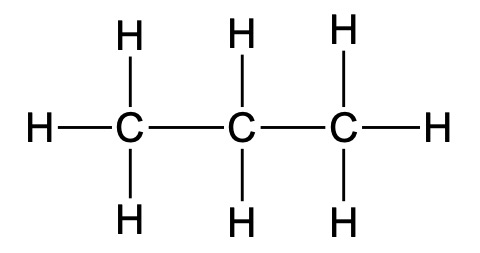
CH3CH2CH3
C3H8
Alkenes
Alkenes are made up of chains of carbon atoms joined together by covalent bonds. At least one of the carbon–carbon bonds is a double bond.
Alkenes are often described as being unsaturated and insoluble in water.
Alkenes have a general formula given by:
CnH2n
where n = the number of carbon atoms given by the prefix.
e.g. propene
Full Structural Formula:
Shortened Structural Formula:
Chemical or Molecular Formula:
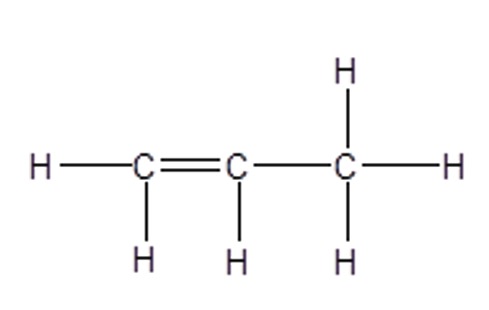
CH2=CHCH3
C3H6
Cycloalkanes
Cycloalkanes are another type of hydrocarbon that can be formed by a variety of chemical reactions in the petrochemical industry.
Like alkanes they are described as being saturated as they contain only single bonds between the carbon atoms, but unlike alkanes they form a ring structure. They are also insoluble in water.
Cycloalkanes have a general formula given by:
CnH2n
where n = the number of carbon atoms given by the prefix.
e.g. cyclopropane
Full Structural Formula:
Shortened Structural Formula:
Chemical or Molecular Formula:
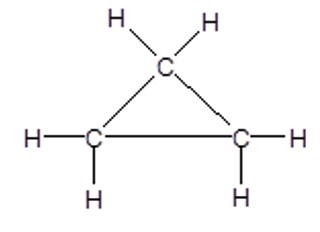
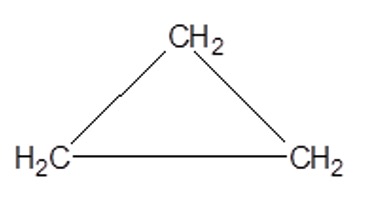
C3H6
Testing for Unsaturation
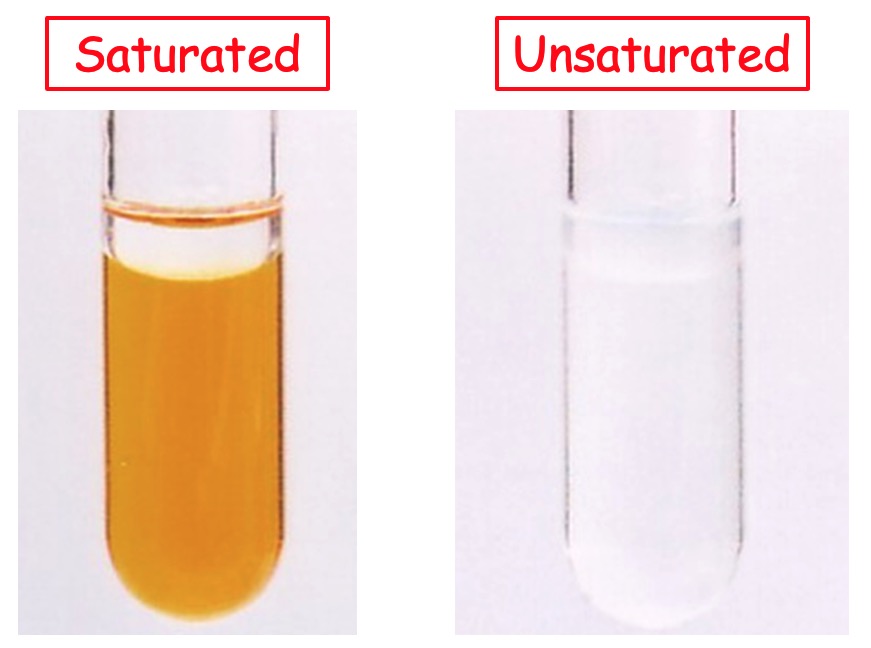
Unsaturated molecules such as alkenes can be identified using bromine water.
Unsaturated compounds quickly decolourise bromine solution. Saturated compounds do not.
Addition Reactions
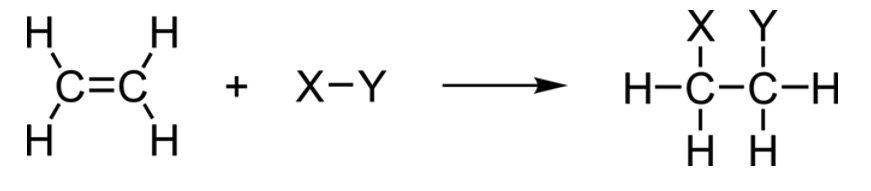
In an addition reaction, two molecules combine to form a single molecule. When bromine is decolourised, the bromine molecule adds across the carbon–carbon double bond. Other small molecules can add to alkenes in the same way.
Hydrogenation (H2)
Alkenes become alkanes with the addition of hydrogen. This is called hydrogenation.
Hydration (H2O)
Alkenes become alcohols with the addition of water. This is called hydration and is a reversible reaction.
Isomers
Isomers are compounds which have the same molecular formula but different structural formulae.
Isomers can belong to different homologous series. For example, propene and cyclopropane (above) are isomers: both are C3H6.
Isomers usually have different physical properties, such as boiling point.
Systematic Naming Rules
- Identify the longest chain of carbon atoms.
- Number the carbon atoms starting at the end carbon nearest the branch.
- Identify the type, position and number of the branch(es).
- Put together in the following format; position of, number of and type of branches (in alphabetical order), then the number of carbons in the longest chain.
Predicting Solubility, Boiling Point and Volatility
The solubility, boiling point and volatility (how easily a compound evaporates) of a compound depend on the type and strength of the intermolecular forces between its molecules. To predict them, look at:
- O-H or N-H bonds, which mean hydrogen bonding
- the spatial arrangement of polar covalent bonds, which could give the molecule a permanent dipole
- molecular size, which affects the strength of the London dispersion forces
- the polarities of the solute and solvent: polar or ionic compounds tend to dissolve in polar solvents, and non-polar compounds tend to dissolve in non-polar solvents
Stronger intermolecular forces mean a higher boiling point and a lower volatility.
e.g. ethanol (C2H5OH) and propane (C3H8) both have 26 electrons, so their London dispersion forces are similar. Ethanol boils at 78 °C but propane boils at −42 °C, because ethanol molecules hydrogen bond to each other. Ethanol is also soluble in water; propane is not.
(b) Alcohols
What you need to know
- The hydroxyl functional group
- Naming and drawing straight-chain and branched alcohols (up to eight carbons in the longest chain)
- Primary, secondary and tertiary alcohols
- Diols and triols
- How hydrogen bonding explains the properties of alcohols
Alkanols
Important characteristics of the alkanols homologous series;
- The names of all alkanols end in '-ol'
- The functional group of the alkanols is -OH (hydroxyl group)
- The -OH group makes alcohols polar and allows hydrogen bonding. Small alcohols (methanol, ethanol and propanol) mix completely with water; solubility decreases as the carbon chain gets longer.
- All alkanols follow the general formula:
CnH2n+1OH
Primary, Secondary and Tertiary Alcohols
There are three categories of alcohol - primary, secondary and tertiary.
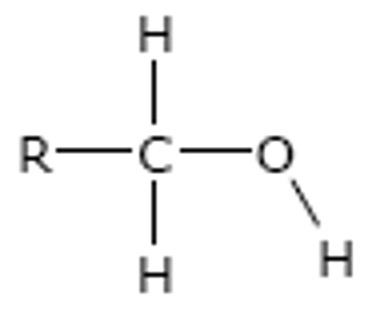
Primary
The carbon attached to the -OH group is directly bonded to only one alkyl group (i.e. 1 other carbon). Methanol is also counted as primary.
e.g.
Secondary
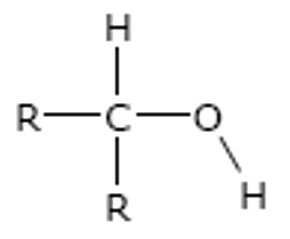
The carbon attached to the -OH group is directly bonded to two alkyl groups (i.e. 2 other carbons).
e.g.
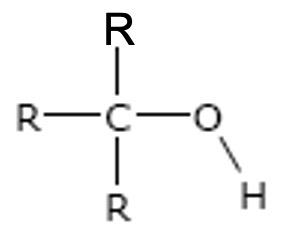
Tertiary
The carbon attached to the -OH group is directly bonded to three alkyl groups (i.e. 3 other carbons).
e.g.
Isomers and Naming Rules
Isomers can result from both chain branching and varying the position of the -OH group.
- The main (longest) chain must contain the carbon attached to the -OH group.
- Number the chain from the end that gives the -OH group the lowest possible number. The position of the -OH goes in front of "-ol", e.g. butan-2-ol.
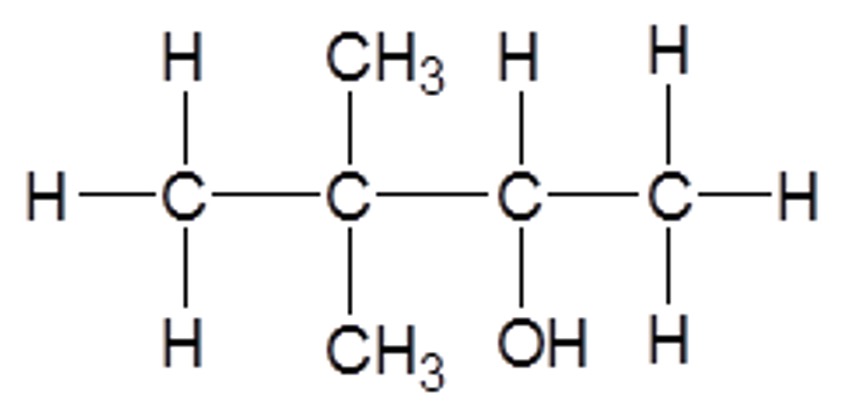
- Name any branches: methyl (-CH3), ethyl (-C2H5), propyl (-C3H7) etc. Put them in alphabetical order, each with its position, e.g. 3,3-dimethylbutan-2-ol.
Diols and Triols
Alcohols with two hydroxyl groups are called diols, and those with three are called triols.
e.g. ethane-1,2-diol (used in antifreeze) and propane-1,2,3-triol (glycerol).
Properties of Alcohols
The hydroxyl groups make alcohols polar, so hydrogen bonds form between alcohol molecules, and between alcohol and water molecules. Hydrogen bonding explains why alcohols have:
- higher melting and boiling points than alkanes with similar numbers of electrons
- a higher viscosity, especially diols and triols, which have more -OH groups to hydrogen bond
- good solubility (miscibility) in water, for the smaller alcohols
Systematic Naming - Example 1
Name the molecule below.
(c) Carboxylic Acids
What you need to know
- The carboxyl functional group
- Naming and drawing straight-chain and branched carboxylic acids (up to eight carbons in the longest chain)
- Reactions with metal oxides, hydroxides and carbonates, and naming the salts formed
Carboxylic Acids
Vinegar is a dilute solution of ethanoic acid (sometimes called acetic acid).
It is a member of a group of compounds called carboxylic acids, which contain the carboxyl functional group (-COOH).
You need to be able to name and draw straight-chain and branched carboxylic acids with up to eight carbons in the longest chain. The carbon in the -COOH group is always carbon 1, e.g. 2-methylpropanoic acid.
If it is a straight chain hydrocarbon containing the carboxyl functional group it is known as an alkanoic acid.
Carboxylic acids show the normal characteristic reactions of acids and therefore can react with bases. The name of the salt depends on the acid and the base used: the "-oic acid" ending changes to "-oate", e.g. ethanoic acid forms ethanoates.
Metal oxide + carboxylic acid → salt + water
e.g.
Magnesium oxide + ethanoic acid → magnesium ethanoate + water
Metal hydroxide + carboxylic acid → salt + water
e.g.
Sodium hydroxide + ethanoic acid → sodium ethanoate + water
Metal carbonate + carboxylic acid → salt + water + carbon dioxide
e.g.
Calcium carbonate + ethanoic acid → calcium ethanoate + water + carbon dioxide
(d) Esters, Fats and Oils
What you need to know
- The ester link, and naming and drawing esters
- Uses of esters
- Condensation and hydrolysis reactions
- The structure of fats and oils, and why oils have lower melting points
- Using bromine to compare the degree of unsaturation
- Why fats and oils are needed in the diet
Esters
Esters are compounds formed by a condensation reaction between alcohols and carboxylic acids.
In a condensation reaction two molecules are joined together with the elimination of a small molecule. When an ester link forms between a hydroxyl group and a carboxyl group, the small molecule eliminated is water.
The reaction can also be referred to as esterification.
An ester molecule contains an ester link: -COO-.
General Word Equation:
Alcohol + Carboxylic Acid → Ester + Water
Drawing Esters
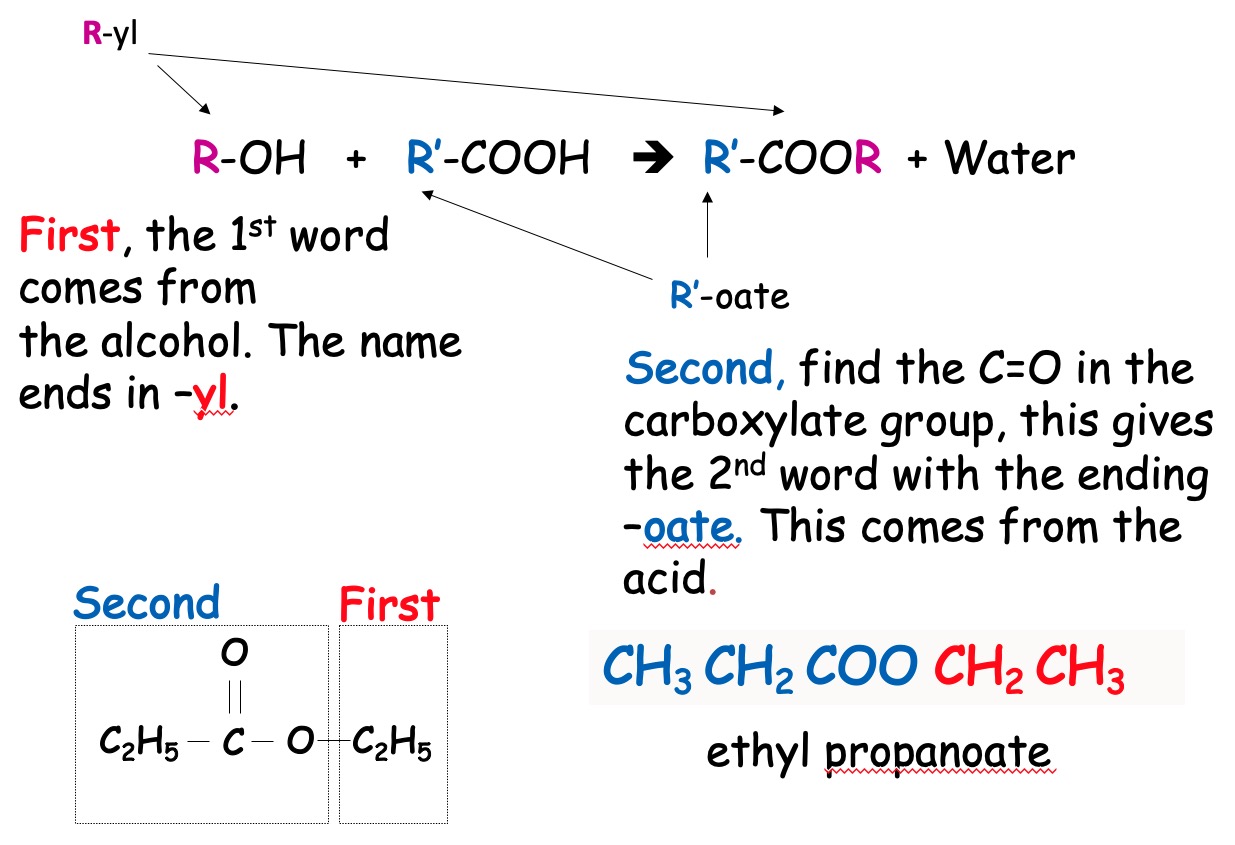
Generally (but not always) the acid part of the ester is drawn first and the alkanol part second. For example, propyl butanoate:
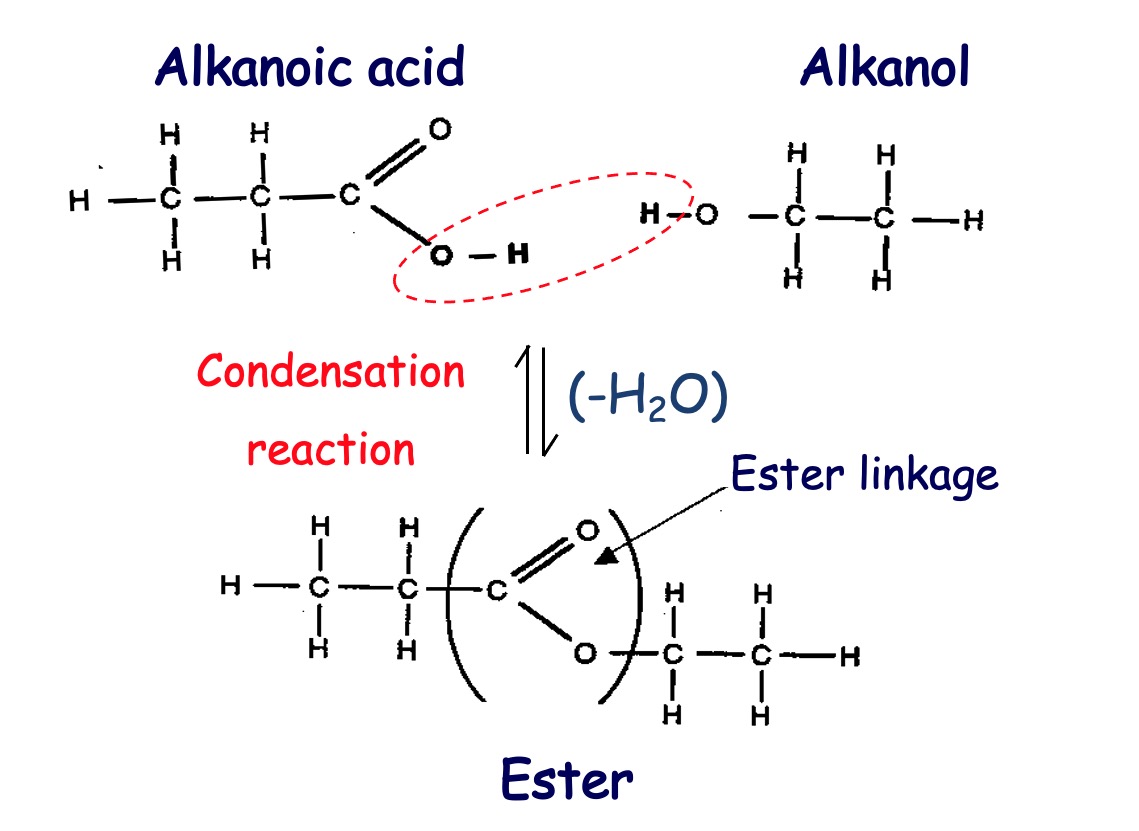
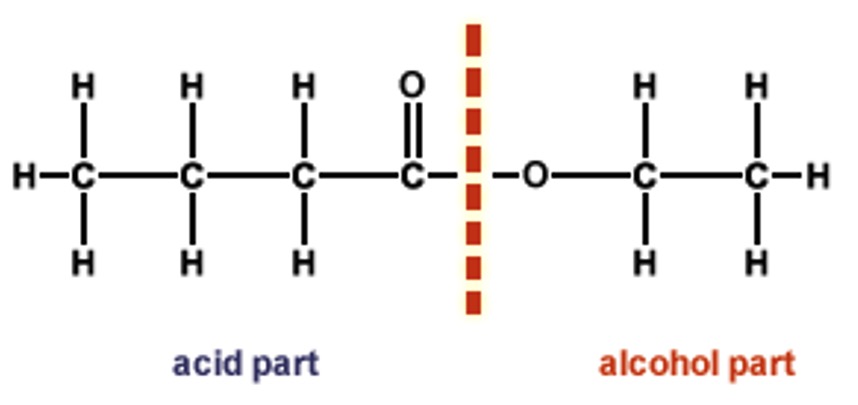
The OH from the acid and the H from the alcohol form water.
Naming Esters
The alkanol part of the ester is named first. The “anol” ending is replaced by “yl”
e.g.
Propanol → propyl
Methanol → methyl
The acid part of the ester is named second. The “oic” acid is replaced by “oate”
e.g.
Butanoic acid → butanoate
Ethanoic acid → ethanoate
propanol + butanoic acid → propyl butanoate
methanol + ethanoic acid → methyl ethanoate
e.g.
Making Esters
One way of preparing esters is to condense an alcohol with a carboxylic acid:
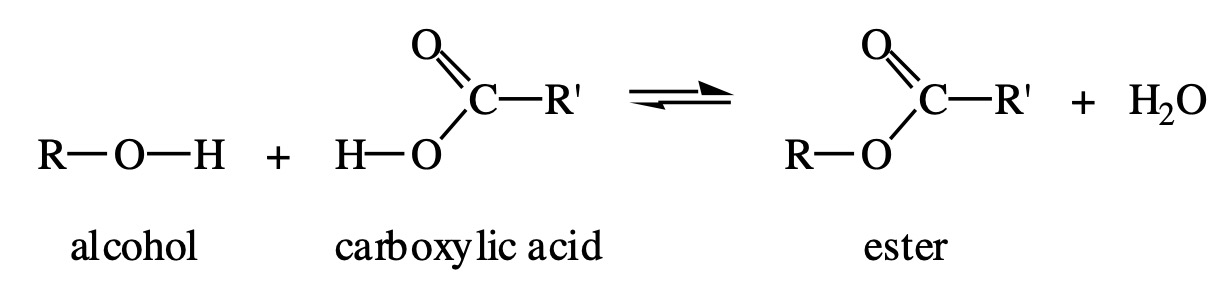
The reaction is slow at room temperature and the yield of ester is low. The rate can be increased by heating the reaction mixture and by using concentrated sulfuric acid as a catalyst. The presence of the concentrated sulfuric acid also increases the yield of ester.
Condensation Reaction
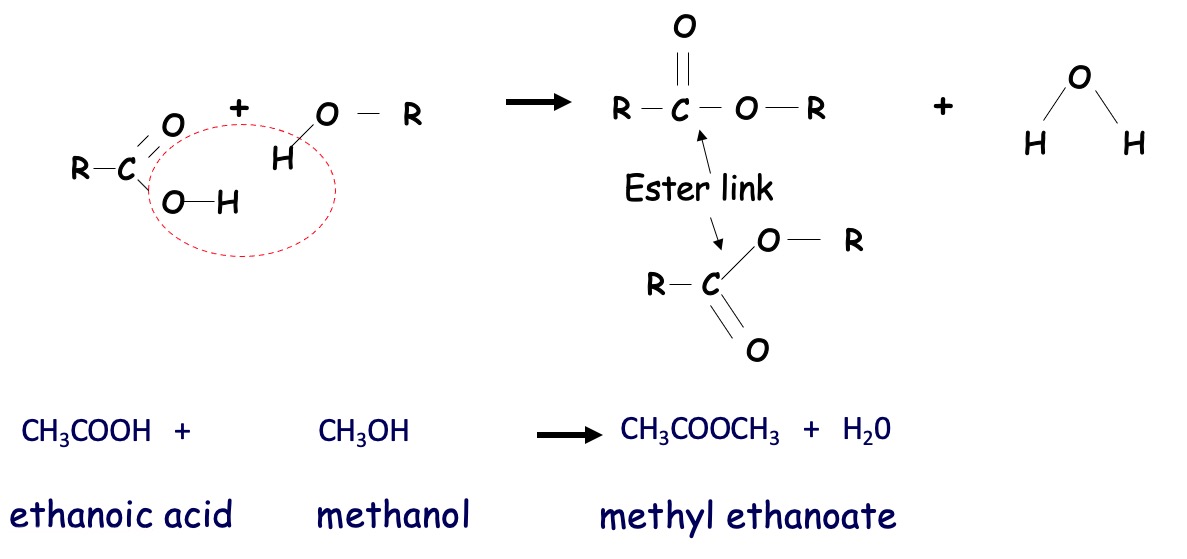
The reaction is brought about by heating a mixture of a carboxylic acid and an alcohol with a little concentrated sulfuric acid. (which acts as a catalyst and absorbs the water produced).
Making Esters - Practical
The aim of this experiment is to prepare an ester and to identify some of the characteristic properties of esters.
- Add a few cm3 of an alcohol and a carboxylic acid to a test tube.
- Your teacher will add a few drops of concentrated sulfuric acid (the catalyst). It is very corrosive, so wear eye protection and gloves.
- Heat the test tube in a hot water bath for about 10 minutes. Alcohols are flammable, so no naked flames.
- Pour the mixture into a beaker of sodium hydrogencarbonate solution to neutralise the acids.
- An oily layer of ester forms on the surface. Carefully waft the smell towards your nose.
Esters are insoluble in water, float on it, and have fruity smells.
Uses of Esters
Many esters have pleasant, fruity smells, so they are used as flavourings and fragrances.
Esters are also used as solvents for non-polar compounds that do not dissolve in water, e.g. in car body paints, radiator enamels, adhesives and cosmetic preparations such as nail varnish.
The smaller esters, like ethyl ethanoate, are also very volatile, so they evaporate very quickly.
Ethyl ethanoate is one of a number of solvents used to extract caffeine from coffee and tea.
De-caffeinated products produced with ethyl ethanoate are often described on the packaging as "naturally decaffeinated" because ethyl ethanoate is a chemical found naturally in many fruits.
Some medicines, such as aspirin, contain an ester group.
Hydrolysis of Esters
In a hydrolysis reaction, a molecule reacts with water to break down into smaller molecules. Esters can be hydrolysed to produce the parent alkanoic acid and the parent alkanol.
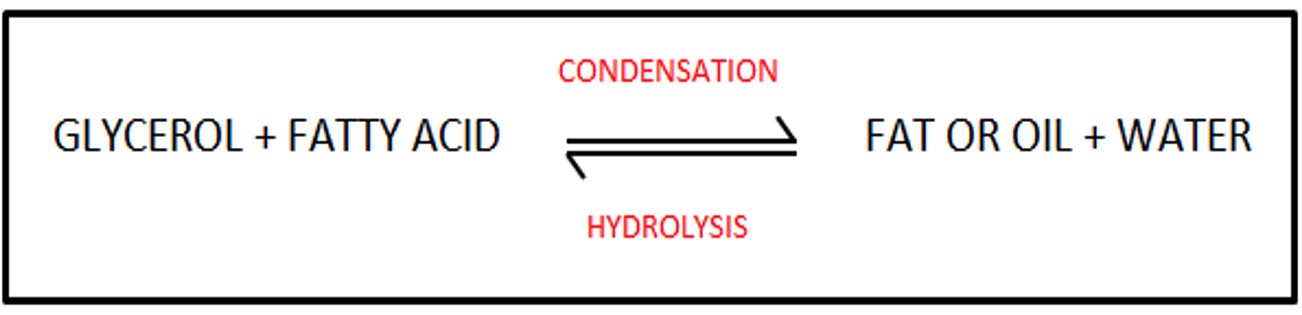
The formation of esters by the condensation is a reversible reaction. This means that not only can the reactants form products but the products can change back into reactants.
Hydrolysis is the process by which water breaks down a carbon compound. In practice, water on its own is rarely successful in achieving this.
Hydrolysis of an ester is usually carried out by heating it in the presence of a dilute acid, such as HCl or H2SO4, to provide hydrogen ions to catalyse the hydrolysis.

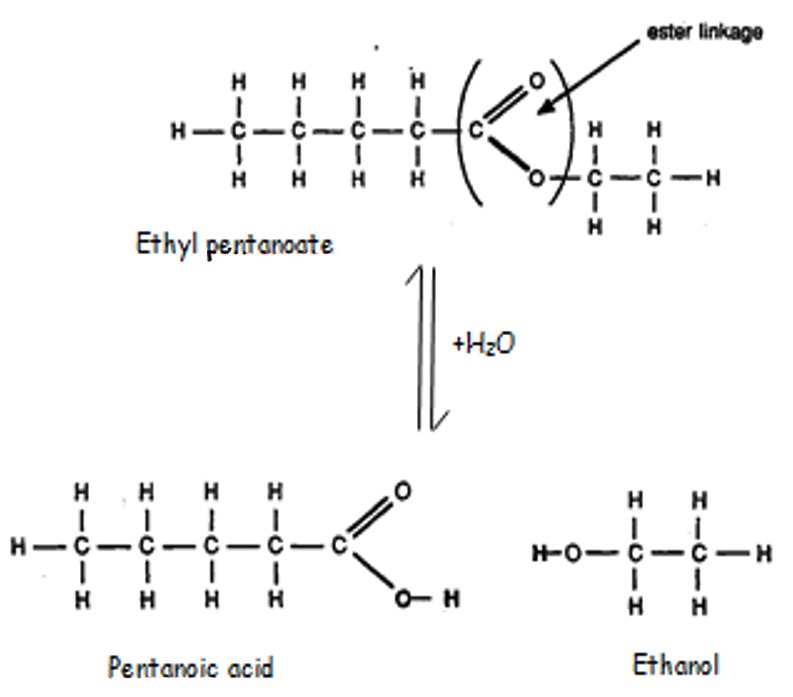
Note: during the hydrolysis water breaks down the ester by breaking the ester linkage. The -OH adds back on to the acid and the H adds back on to the alkanol.
Fats and Oils
Fats and oils are an essential part of the human diet. They are a concentrated source of energy, and they are essential for the transport and storage of fat-soluble vitamins (vitamins A, D, E and K) in the body.
Fats and oils are a more concentrated source of energy than carbohydrates.
Fats and oils help humans feel fuller for longer due to their high satiety level.
Fat molecules are insoluble, tend to group together and form a large droplet stored in tissue. We store our extra energy as fat.
Edible fats and edible oils are esters formed from the condensation of glycerol (propane-1,2,3-triol) and three long-chain carboxylic acid molecules, called fatty acids. Fatty acids can be saturated or unsaturated.
Fats and oils are formed by the condensation reaction of the two reactants.

Glycerol - structure
Glycerol (propane-1,2,3-triol) is a triol, because it contains three hydroxyl groups.
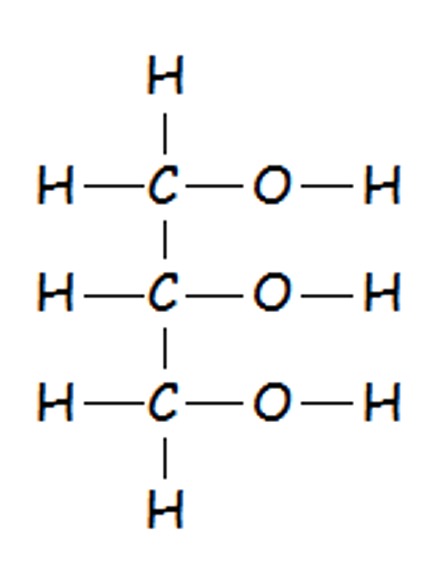
The Structure of Fats and Oils
Fats and oils are actually special forms of esters where the alcohol, glycerol (propane-1,2,3-triol) has three hydroxyl groups.
Glycerol is a triol (sometimes called a 'trihydric alcohol').
Glycerol can therefore make three ester links when reacting with three long-chain carboxylic acids (fatty acids).
1 glycerol reacts with 3 acids
The long chain alkanoic acids are often referred to as fatty acids.
Each fatty acid usually has between 4 and 24 carbon atoms.
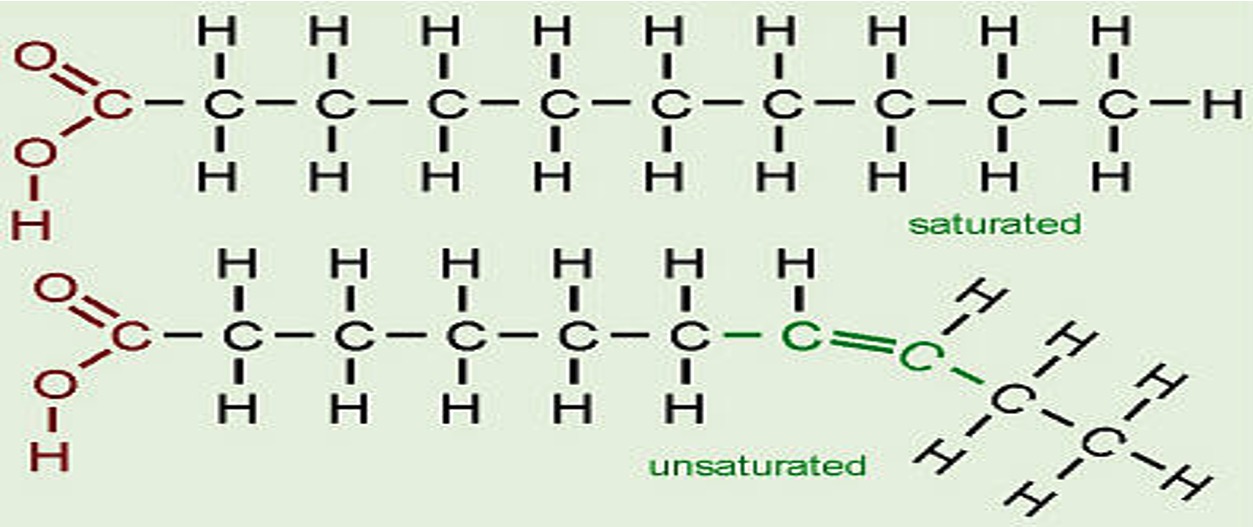
The carbon–carbon bonds can all be single (saturated) or include one or more double bonds (unsaturated).
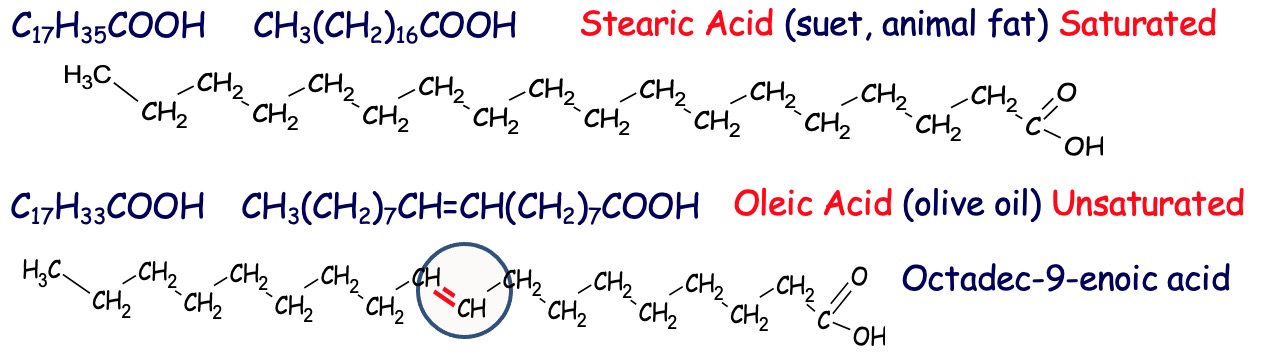
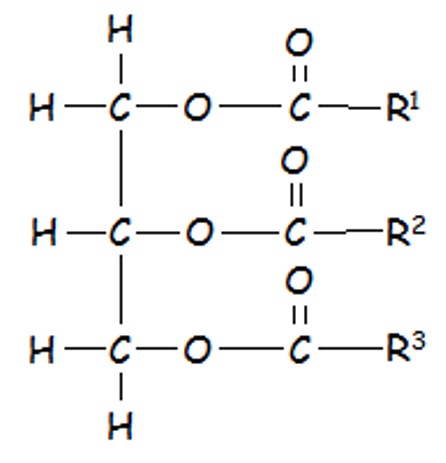
Fats and Oils are formed by combination of 3 moles of fatty acids to 1 mole of glycerol - a triglyceride. There are 3 ester linkages in the one molecule and 3 moles of water are removed.
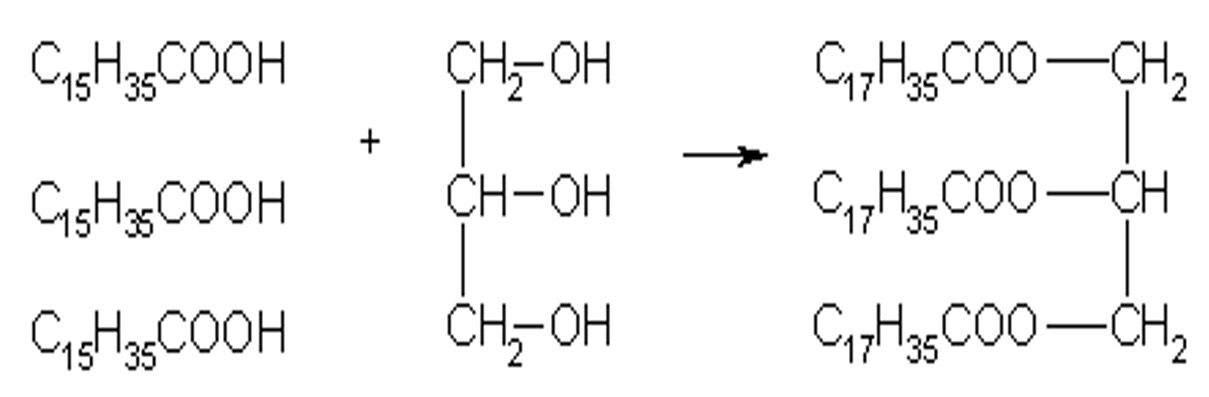
Fat or Oil?
Although fats and oils are formed by the same process and from the same reactants, fats and oils have different degrees of unsaturation.
When oil is shaken with bromine water, the brown colour of bromine water is lost rapidly.
This indicates the presence of double bonds in the oil molecules.
If a fat is dissolved in an organic solvent such as hexane and then shaken with bromine water, no decolourisation occurs with some fats and only slight or slow decolourisation with others.
This indicates that fats may contain no double bonds or fewer double bonds than oils.
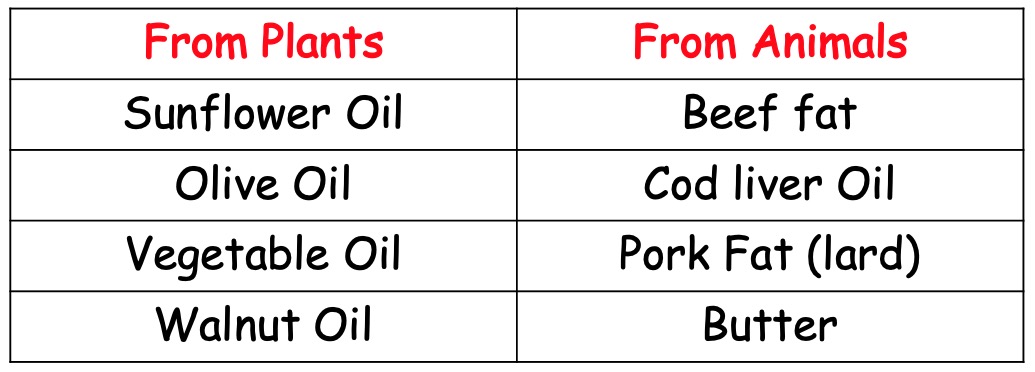
The main difference between fats and oils is that;
- Fats are normally solid at room temperature.
- Oils are normally liquid at room temperature
This is because oils have a lower melting point than their fat counterparts due to the greater amount of unsaturation within the (oil) molecules.
Experiment - Degree of unsaturation in Fats and Oils
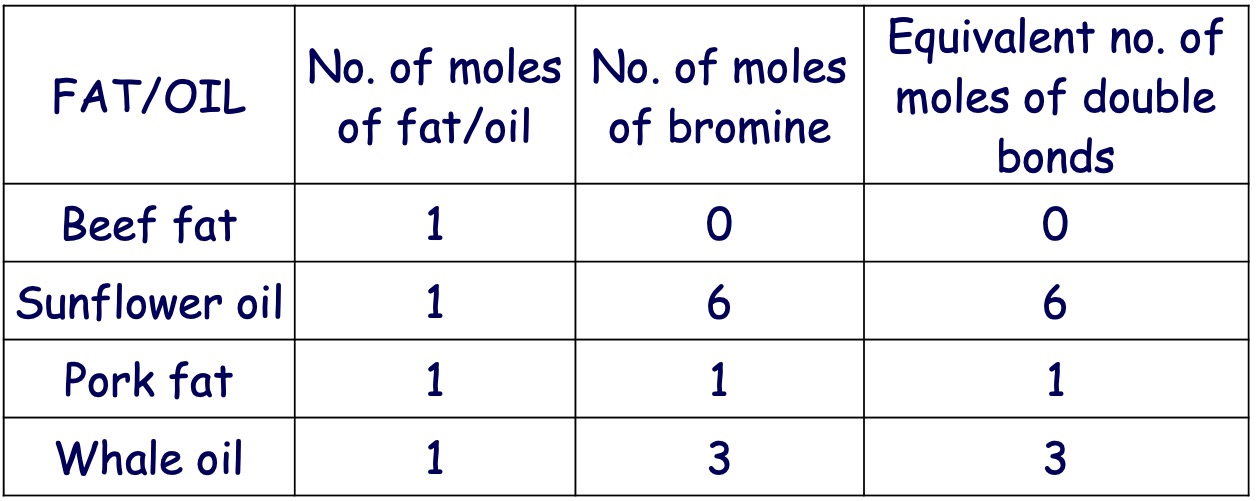
You can titrate fats/oils against bromine water to determine the volume (and hence the number of moles) of bromine needed to react with all of the double bonds in 1 mole of the fat/oil molecules.
This will establish the degree of unsaturation
The greater the number of drops, the more unsaturated the oil.
Since glycerol is constant, it is in the acid chain that we potentially find the double bond - if there is a double bond the acid is called an alkenoic acid.
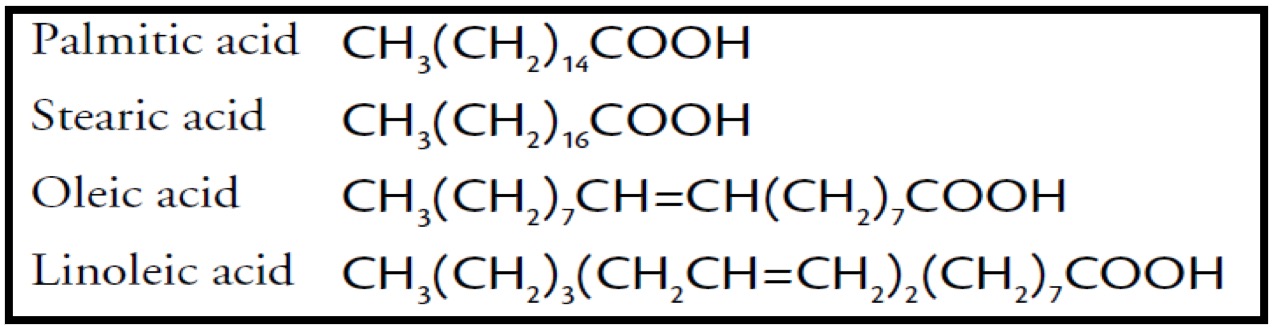
Fatty acids are saturated or unsaturated straight chain carboxylic acids with even numbers of C atoms ranging from C4 to C24, but mainly C16 to C18.
Bromine can be used to distinguish between saturated and unsaturated molecules. (unsaturated fats/oils will decolourise bromine).
The bromine molecules add across the carbon–carbon double bonds in an addition reaction. Each double bond reacts with 1 molecule of bromine, so each mole of double bonds reacts with 1 mole of bromine. The more double bonds, the more bromine solution is decolourised.
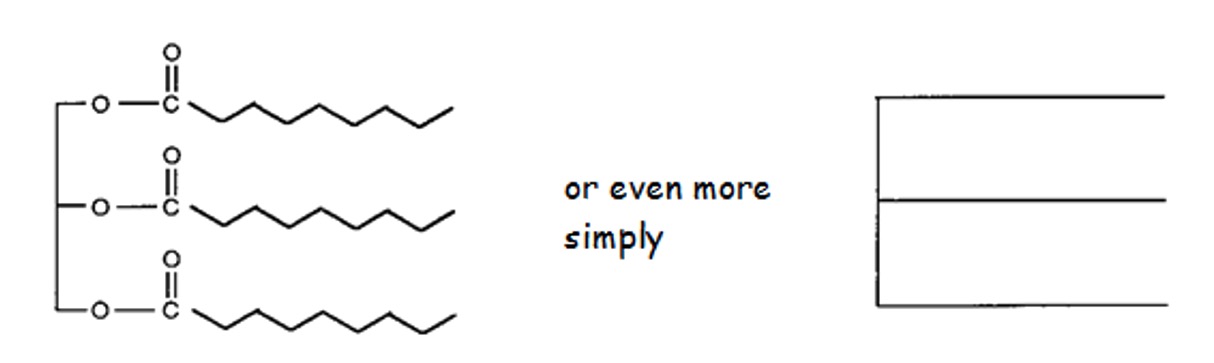
Structure of Fats Molecules
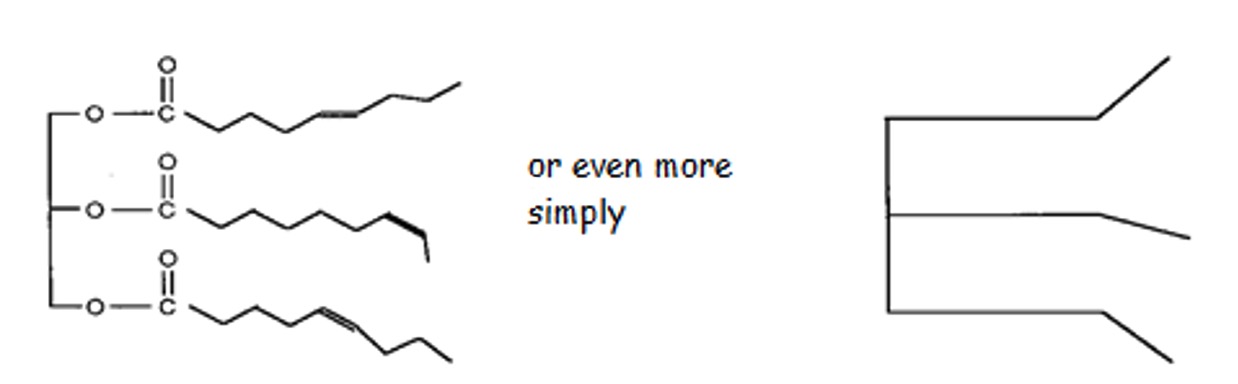
Structure of Oil Molecules
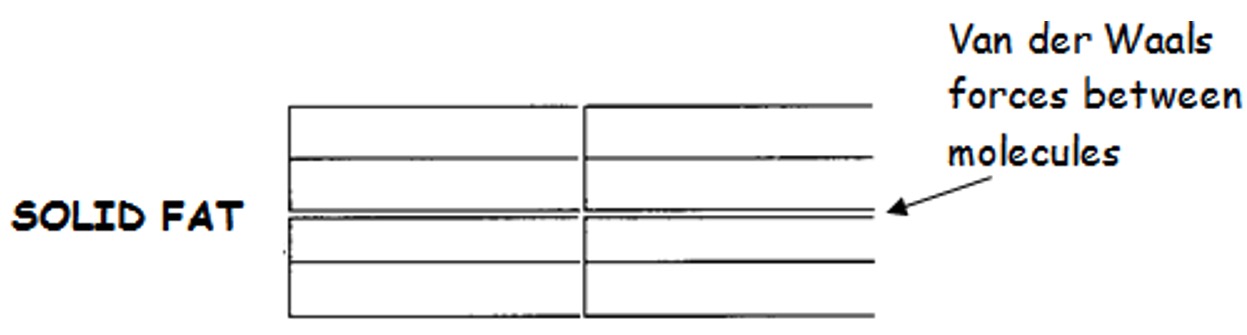
Solid Fat
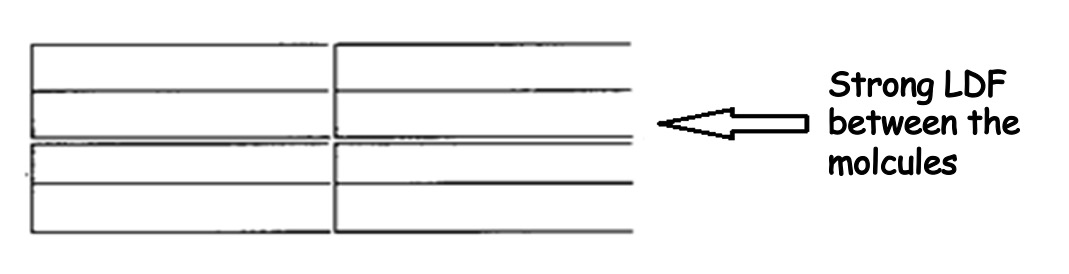
Saturated fat molecules have straight chains with no double bonds. This means that these molecules are able to stack closely together and as a result they will have strong Van der Waals forces and relatively high melting points.
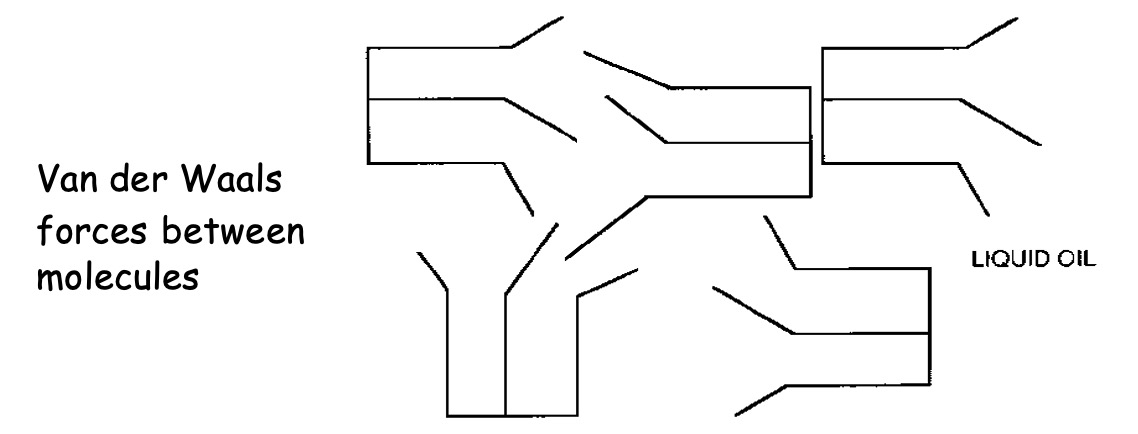
Liquid Oil
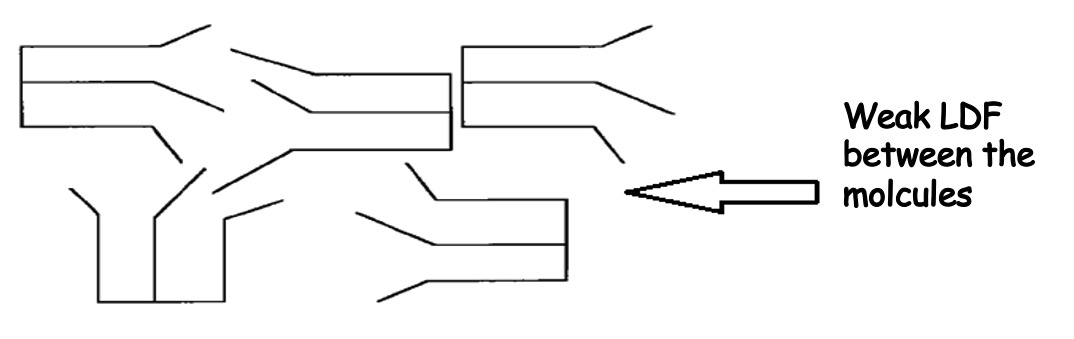
The double bonds in the unsaturated fatty acids cause "kinks" in the chain. As a result these molecules cannot pack as closely together hence the Van der Waals' forces are not as strong so oils tend to have lower melting points than fats.
Structure of Fats and Oils Explained
The absence of a double bond allows the fat molecules to be more regularly 'tuning fork' shaped and consequently the fat molecules can fit into one another.
If a double bond is present, the chain has a kink (bend) in it, so the oil (and some fat) molecules are distorted and cannot fit into one another.
Molecules which can pack closely together due to their regular structure have stronger London Dispersion forces between the molecules and thus higher melting points.
Therefore fats have higher melting points than oils, and fats are solid at room temperature. The greater the degree of unsaturation, the lower the melting point.
Arrangement of Fat Molecules
Arrangements of Oil Molecules
Hydrolysis
Fats and oils are made by a condensation reaction between glycerol and fatty acids.
Fats and oils can therefore be hydrolysed to produce these molecules.
Hydrolysis of fat or oil is similar to that of an ester.
The ester link breaks due to the addition of water and one molecule of glycerol is produced along with 3 fatty acid molecules.
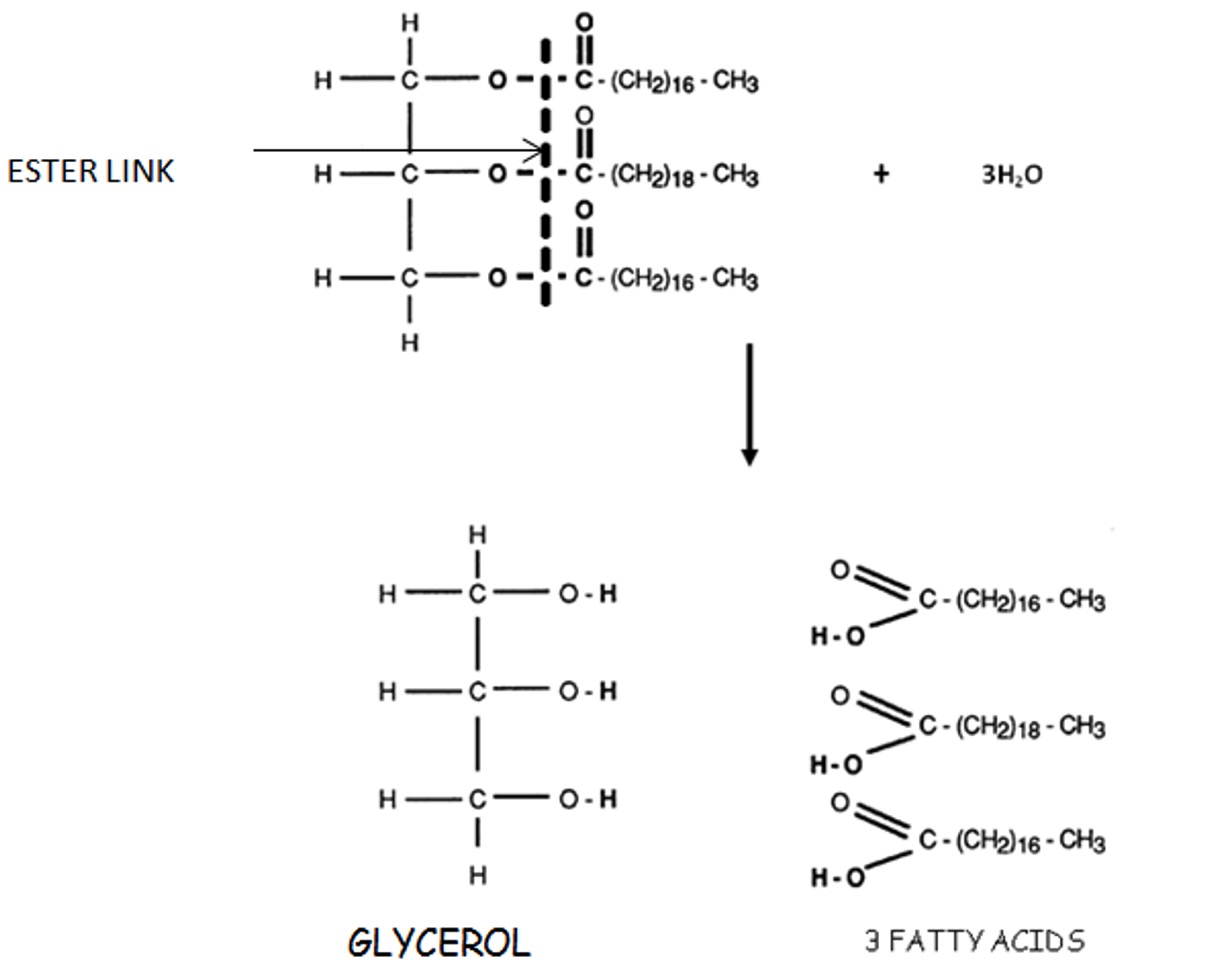
The addition of water splits the fat or oil into 1 molecule of glycerol and 3 molecules of fatty acids.
(e) Soaps, Detergents and Emulsions
What you need to know
- Making soaps by the alkaline hydrolysis of fats and oils
- How soaps and soapless detergents remove oil and grease
- Hard water and scum
- Emulsions and emulsifiers
Soaps
 Soaps are salts of fatty acids.
Alkaline hydrolysis is used to make sodium salts of fatty acids.
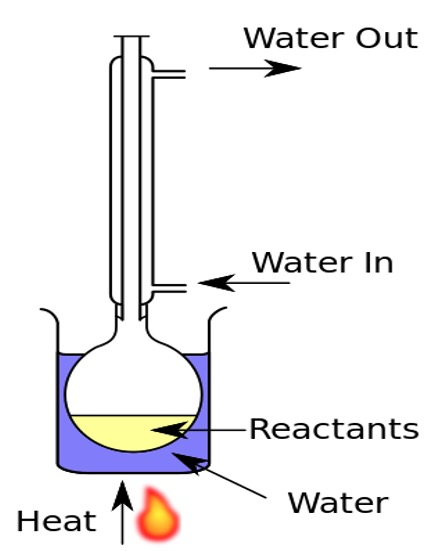
Soaps are formed by the alkaline hydrolysis of fats and oils by sodium or potassium hydroxide by boiling under reflux conditions.
Hydrolysis produces three fatty acid molecules and one glycerol molecule. The fatty acids are neutralised by the alkali, forming water-soluble, ionic salts: soaps.
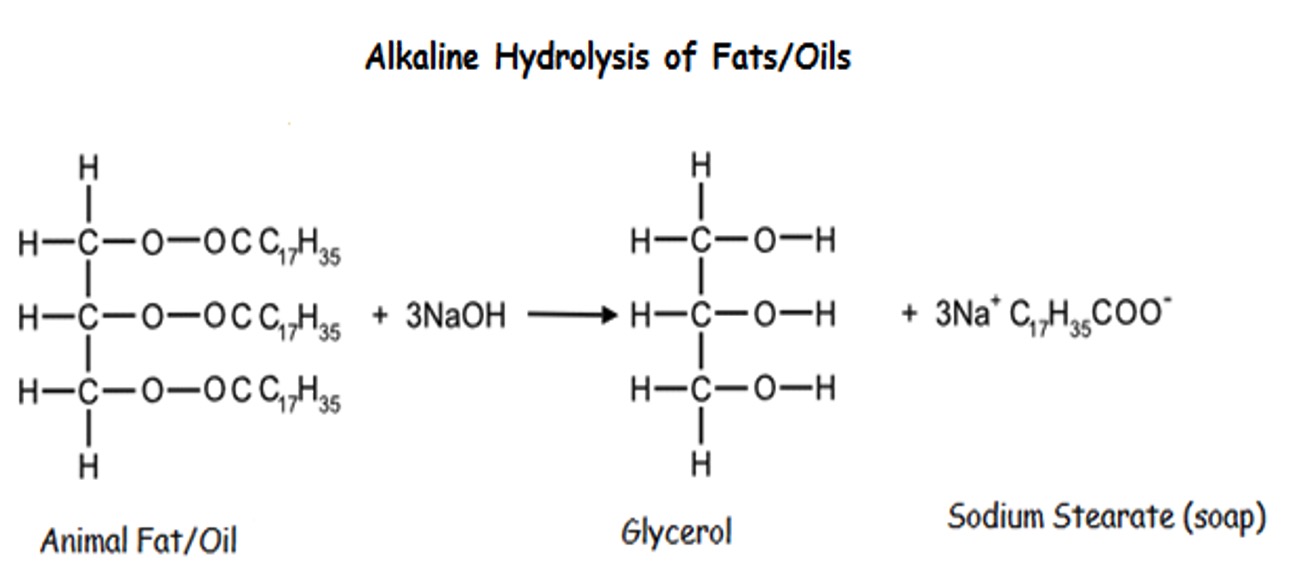
Glycerol is produced as a by-product of the hydrolysis of fat.
It is separated and used as a raw material for other processes and preparations for example antifreeze.
It can also be used to make nitroglycerine (glyceryl trinitrate), which is used in medicine to treat angina and in explosives such as dynamite.
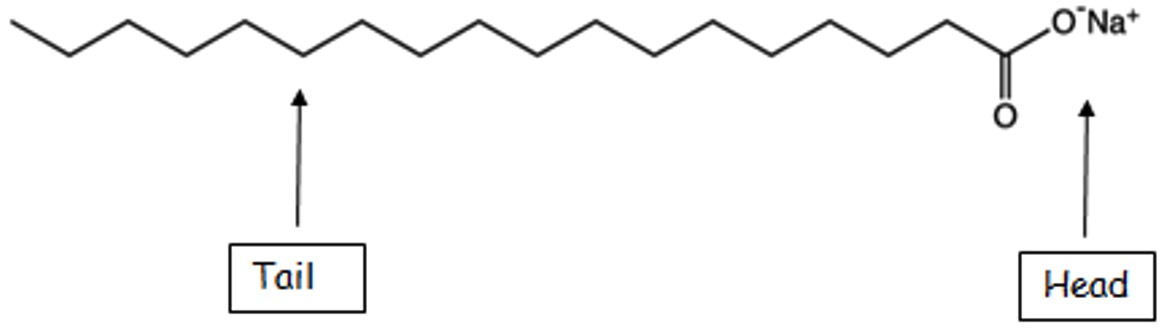
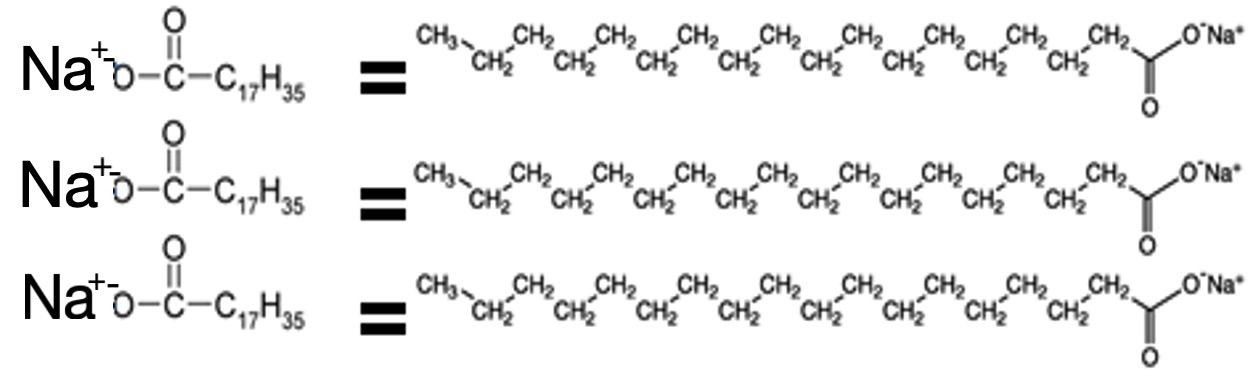
The tail of a soap is made of a long covalent hydrocarbon chain.
The charged carboxylate group represents the head section of the soap structure.
Fatty Acids
Why do we need soaps?
Cleaning with water alone has little effect when stains consist of non-polar substances, such as grease and sweat since fats do not dissolve in water.
This is because water is a polar solvent but fats and oils are non-polar.
Soap Structure
The long covalent hydrocarbon chain gives rise to the hydrophobic (water hating) and oil-soluble (non-polar) properties of the soap molecule.
The charged carboxylate group is attracted to water molecules (hydrophilic – water loving).
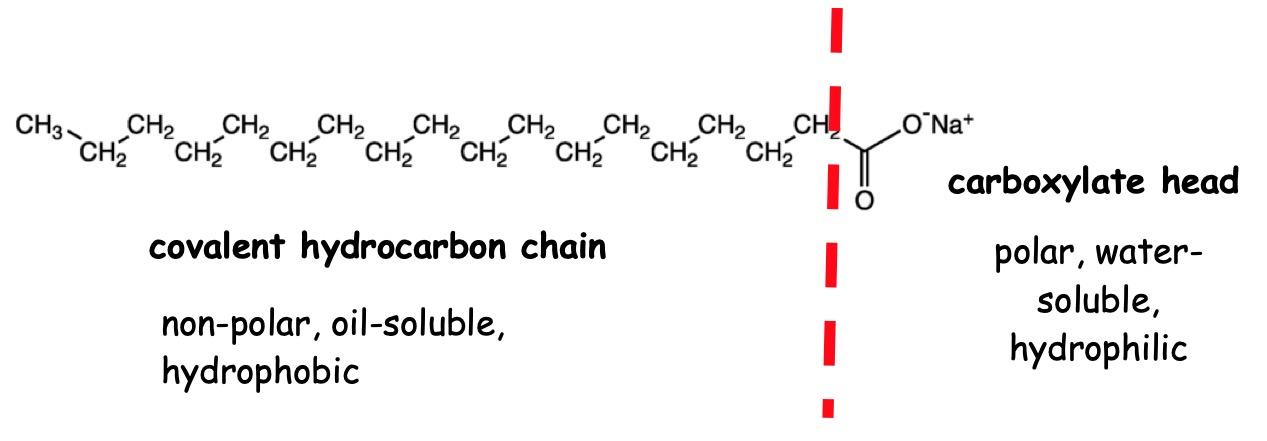
In solution a soap molecule consists of a long non-polar hydrocarbon tail (C17H35-) and a polar head (-COO-).
How Soap Works
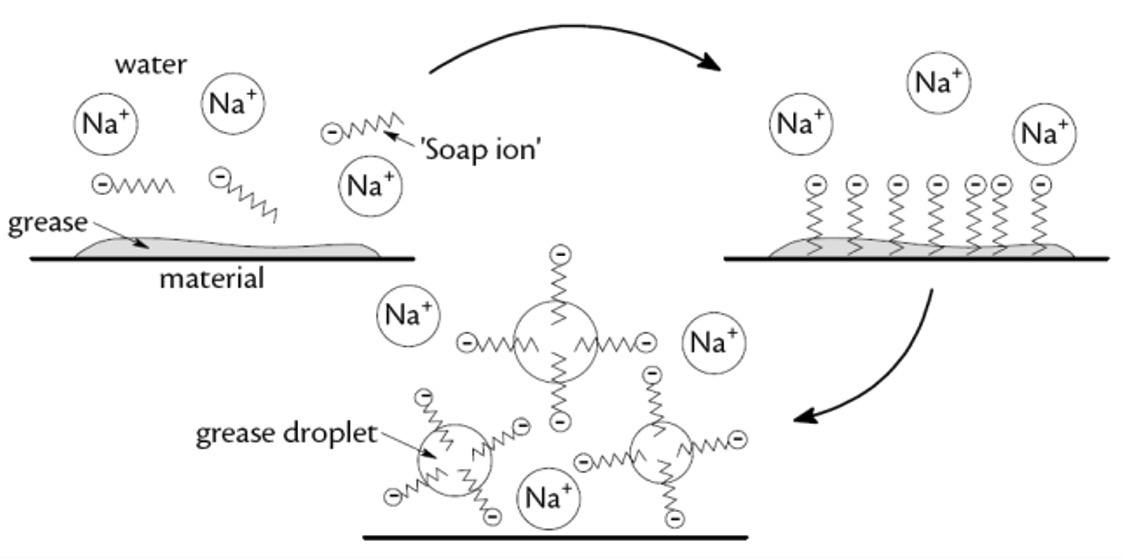
The non-polar hydrophobic tail is soluble in non-polar substances such as oil, while the hydrophilic polar head is soluble in polar substances, such as water.
Agitation produces ball-like structures called micelles, which suspend the oil droplets in the water.
The negatively-charged heads repel like charges on other oil droplets, so the oil layer does not reform.
This represents the initial interaction of soap on addition to water and material with a grease stain. This repulsion prevents the oil droplets re-joining and helps disperse the oil.
Using Soaps
When used for cleaning in combination with water, soap serves as a surfactant. Surfactants are the main contributors to detergents' cleaning power.
A broad definition of a surfactant is:
a substance, such as soap, that possesses a hydrophobic tail and a hydrophilic head and which, on being made into a solution with water, reduces the surface tension of water and also reduces the interfacial tension between oil and water.
The bulk components of detergents are surfactants; other key ingredients include:
- bleach, to enhance the appearance and effect of whiteness
- polymers, for binding to and removing certain types of dirt
- builders, which soften the water (by removing calcium and magnesium ions) so the surfactants work better
- enzymes, to remove biological stains, including blood, wine, chocolate and coffee
Stain Remover
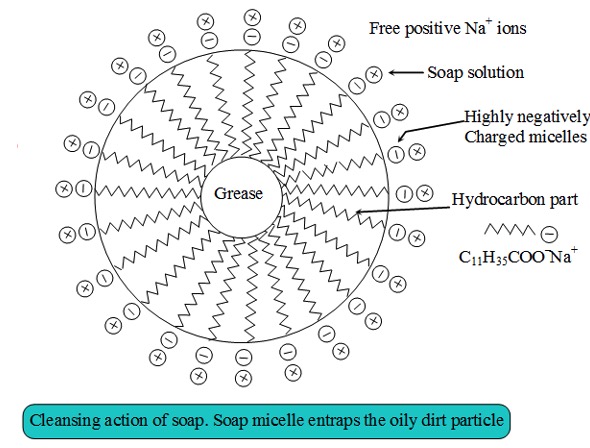
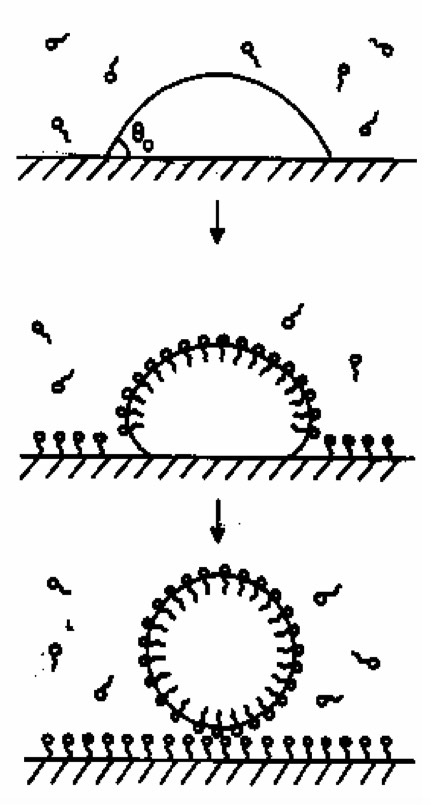
The hydrophobic tails 'burrow' into the droplet of oil or grease. The hydrophilic heads are left to face the surrounding water.
This results in the formation of a ball-like structure (a micelle).
The non-polar substances, such as oil or grease, are held inside the ball and suspended in water, to be washed away.
Detergents
Soapless detergents are substances with non-polar hydrophobic tails and ionic hydrophilic heads.
These remove oil and grease in the same way as soap. Soapless detergents do not form scum with hard water.
Hard water is a term used to describe water containing high levels of dissolved metal ions. When soap is used in hard water, scum, an insoluble precipitate, is formed.
Emulsions
An emulsion contains small droplets of one liquid dispersed in another liquid.
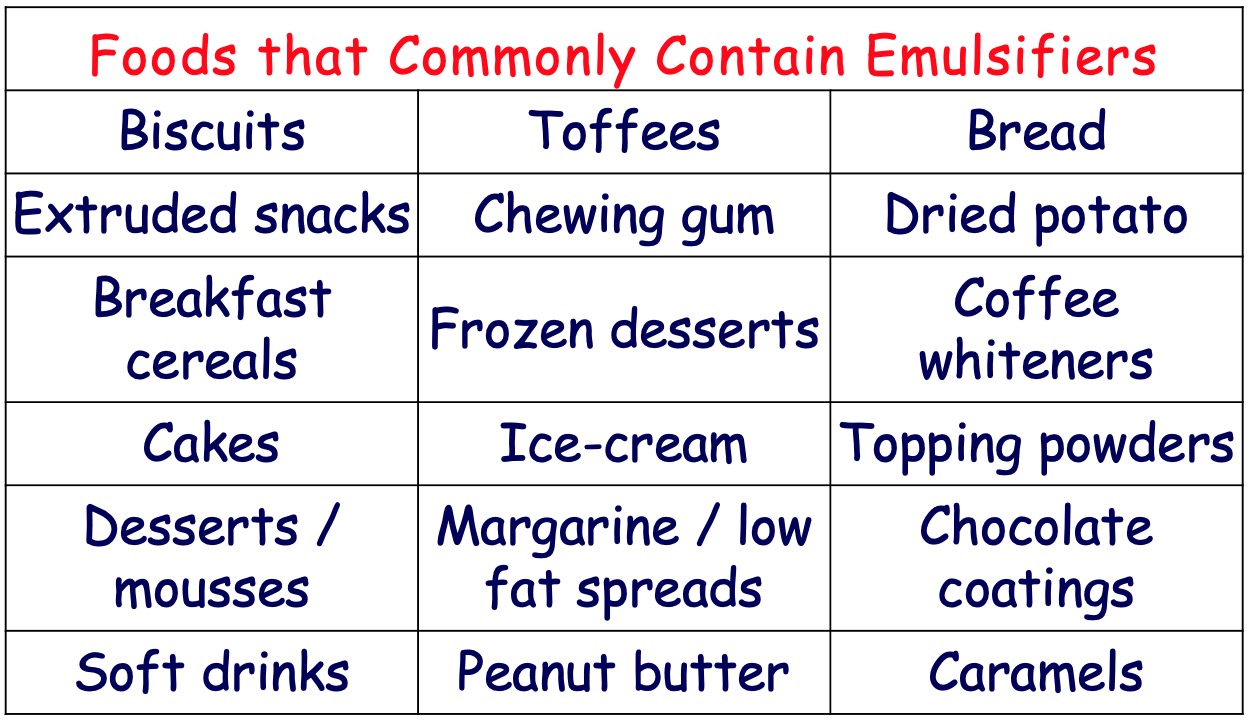
Emulsions in food are mixtures of oil and water. To prevent oil and water components separating into layers, a soap-like molecule known as an emulsifier is added.
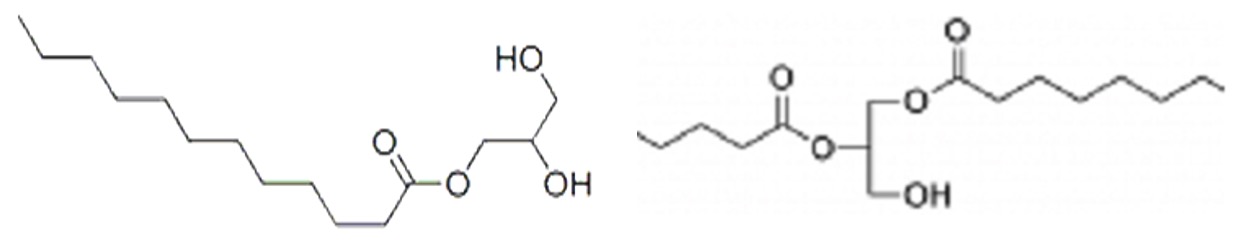
Emulsifiers for use in food are commonly made by reacting edible oils with glycerol to form molecules in which either one or two fatty acid groups are linked to a glycerol backbone rather than the three normally found in edible oils.
The one or two hydroxyl groups present in these molecules are hydrophilic whilst the fatty acid chains are hydrophobic.
The hydrophobic fatty acid chains dissolve in the oil whilst the hydrophilic hydroxyl groups dissolve in the water, forming a stable emulsion.
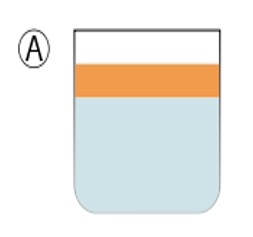 Two liquids not yet emulsified form two separate phases, a layer of oil on top of a layer of water.
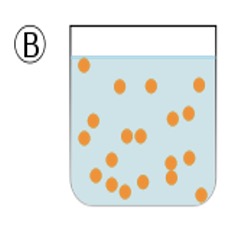 The liquids have been agitated (stirred vigorously), initially the water layer and oil layers have formed an emulsion.
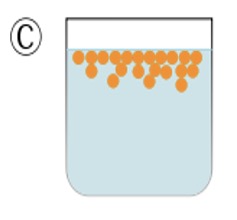 In diagram C the unstable emulsion progressively separates back into two distinct layers (phases).
Diagram C shows the result after a few minutes, the two liquids return to form two separate phases, a layer of oil on top of a layer of water.
However some substances are able to stabilise an emulsion and prevent two separate layers forming again.
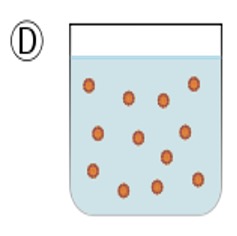 This shows the addition of an emulsifier. This allows the two immiscible layers to be mixed uniformly.
 The presence of this emulsifier is shown on packaging by E-numbers, E471 and is one of the most common on food packaging.
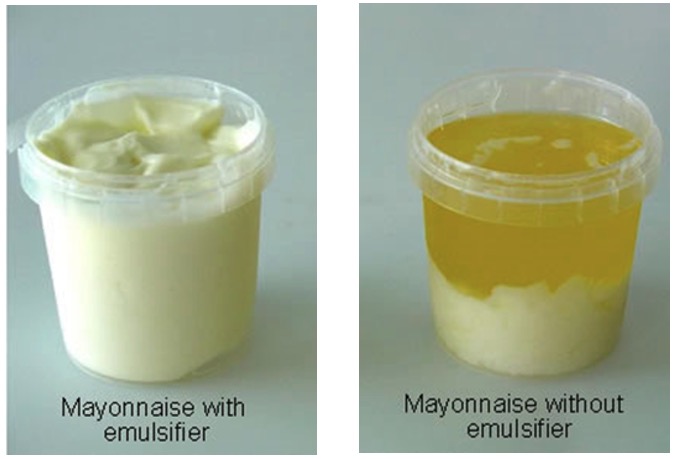
Mayonnaise contains oil and water. The emulsifier keeps these mixed and without it the oil and water separate.
(f) Proteins
What you need to know
- What proteins and enzymes do
- Amino acids: the amino and carboxyl groups
- Condensation reactions that form peptide (amide) links, and drawing a section of protein
- Essential amino acids
- Hydrolysis of proteins during digestion, and drawing the amino acids produced
- Protein shape and denaturing
What Are Proteins?
Proteins are the major structural materials of animal tissue, e.g. keratin in hair and nails, collagen in skin and tendons, and the proteins in muscle.
Proteins are also involved in the maintenance and regulation of life processes, e.g. haemoglobin carries oxygen in the blood and insulin is a hormone that controls blood sugar.
Enzymes are proteins which act as biological catalysts, e.g. amylase speeds up the breakdown of starch during digestion.
Amino Acids
Proteins are built from amino acids. These are relatively small molecules which all contain an amino group, -NH2, and a carboxyl group, -COOH.
The simplest amino acid is glycine:
    H   H   O
    |   |   ||
H - N - C - C - O - H
        |
        H
Other amino acids have a different group in place of one of the hydrogens on the central carbon. For example, alanine has a -CH3 group:
    H   H   O
    |   |   ||
H - N - C - C - O - H
        |
        CH3
The body cannot make all of the amino acids it needs to build proteins. The ones that must come from our diet are called essential amino acids.
Making Proteins: Condensation
Amino acids join together by condensation reactions. The amino group of one amino acid joins to the carboxyl group of another, and water is eliminated.
The link formed is called a peptide link (or amide link): -CONH-.
Glycine + alanine → dipeptide + water:
    H   H   O   H   H   O
    |   |   ||  |   |   ||
H - N - C - C - N - C - C - O - H
        |           |
        H           CH3       + H2O
The peptide link is the C=O bonded to the N-H in the middle of the molecule. The -OH from the carboxyl group of glycine and an H from the amino group of alanine form the water.
Proteins are made of many amino acids joined in this way. Proteins that do different jobs in the body are made by linking together different sequences of amino acids.
Digesting Proteins: Hydrolysis
During digestion, enzyme hydrolysis of proteins produces amino acids. Water breaks each peptide link.
To work out the amino acids from a section of protein:
- Find each peptide link, -CO-NH-, and break the bond between the C and the N.
- Add -OH to the C=O to make a -COOH group.
- Add -H to the N-H to make an -NH2 group.
e.g. this section of protein:
-NH-CH2-CO-NH-CH(CH3)-CO-NH-CH(CH2OH)-CO-
is hydrolysed to:
H2N-CH2-COOH        (glycine)
H2N-CH(CH3)-COOH    (alanine)
H2N-CH(CH2OH)-COOH  (serine)
Working backwards, you can draw a section of protein from the amino acids by joining the -COOH of one to the -NH2 of the next and removing water each time.
Protein Shape and Denaturing
Within proteins, the long-chain molecules form spirals, sheets or other complex shapes. The chains are held in these shapes by intermolecular bonds between the side chains of the amino acids.
When proteins are heated, these intermolecular bonds are broken and the protein changes shape. This is called denaturing.
Denaturing is why the texture of food changes when it is cooked. For example, egg white turns from a clear liquid into a white solid.
Check Your Understanding
- Name the two functional groups found in every amino acid.
Show answer
The amino group (-NH2) and the carboxyl group (-COOH).
- What type of reaction joins amino acids together, and what small molecule is eliminated?
Show answer
A condensation reaction. Water is eliminated.
- Give the name and structure of the link that joins amino acids in a protein.
Show answer
A peptide (amide) link, -CONH-.
- Why must some amino acids be part of our diet?
Show answer
They are essential amino acids: the body cannot make them.
- Explain why the texture of egg white changes when it is cooked.
Show answer
Heat breaks the intermolecular bonds that hold the protein chains in their shape, so the protein changes shape (denatures).
(g) Oxidation of Food
What you need to know
- Oxidation and reduction of carbon compounds (the oxygen to hydrogen ratio)
- Oxidising primary and secondary alcohols, and why tertiary alcohols are not oxidised
- Aldehydes and ketones: the carbonyl group, naming and drawing
- Telling aldehydes and ketones apart
- Oxidation of food and antioxidants
Oxidation and Reduction of Carbon Compounds
For carbon compounds:
- Oxidation is an increase in the oxygen to hydrogen ratio.
- Reduction is a decrease in the oxygen to hydrogen ratio.
| Compound | Formula | O : H ratio |
|---|---|---|
| ethanol | C2H6O | 1 : 6 |
| ethanal | C2H4O | 1 : 4 |
| ethanoic acid | C2H4O2 | 1 : 2 |
The ratio increases from ethanol to ethanal to ethanoic acid, so each step is an oxidation.
Oxidising Alcohols
Hot copper(II) oxide or acidified dichromate(VI) solution can be used to oxidise alcohols:
- Primary alcohols are oxidised to aldehydes, and then to carboxylic acids.
e.g. ethanol → ethanal → ethanoic acid
CH3CH2OH → CH3CHO → CH3COOH - Secondary alcohols are oxidised to ketones.
e.g. propan-2-ol → propanone
CH3CH(OH)CH3 → CH3COCH3 - Tertiary alcohols cannot be oxidised by these oxidising agents. (The carbon attached to the -OH group has no hydrogen atom to lose.)
Colour changes when an alcohol is oxidised:
- black copper(II) oxide forms a brown solid (copper)
- orange dichromate solution turns green
Aldehydes and Ketones
Aldehydes and ketones both contain the carbonyl functional group, C=O.
- In an aldehyde, the carbonyl group is at the end of the chain (-CHO). Names end in -al, e.g. ethanal CH3CHO, propanal CH3CH2CHO.
- In a ketone, the carbonyl group is within the chain, bonded to two other carbons. Names end in -one, e.g. propanone CH3COCH3, butanone CH3COCH2CH3.
Naming: find the longest chain containing the carbonyl group.
- Aldehydes: the carbon of the -CHO group is always carbon 1, e.g. 3-methylbutanal, CH3CH(CH3)CH2CHO.
- Ketones: number the chain to give the carbonyl group the lowest number, e.g. 4-methylpentan-2-one, CH3COCH2CH(CH3)CH3.
You need to name and draw straight-chain and branched aldehydes and ketones with up to eight carbons in the longest chain.
Many flavour and aroma molecules are aldehydes, e.g. vanillin (vanilla), cinnamaldehyde (cinnamon) and benzaldehyde (almonds).
Telling Aldehydes and Ketones Apart
Aldehydes, but not ketones, can be oxidised to carboxylic acids. Mild oxidising agents can therefore tell them apart. With an aldehyde:
| Oxidising agent | Colour change with an aldehyde | With a ketone |
|---|---|---|
| Fehling's solution | blue solution → brick-red precipitate | no change |
| Tollens' reagent | clear, colourless → silver mirror | no change |
| Acidified dichromate | orange → green | no change |
These tests are carried out by warming the mixture in a hot water bath.
Oxidation of Food and Antioxidants
Oxygen from the air causes the oxidation of food. The oxidation of edible oils gives food a rancid flavour. This is why crisps are often packed in nitrogen rather than air.
Antioxidants:
- are molecules that prevent unwanted oxidation reactions occurring
- are substances that are easily oxidised, and oxidise in place of the compounds they have been added to protect
- can be identified as the substance being oxidised in a redox equation
e.g. vitamin C (ascorbic acid) is an antioxidant. It loses electrons, so it is being oxidised:
C6H8O6 → C6H6O6 + 2H+ + 2e-
Check Your Understanding
- Butan-1-ol is warmed with acidified dichromate. Name the first product, and the product of further oxidation.
Show answer
Butanal, then butanoic acid.
- Explain why 2-methylpropan-2-ol is not oxidised by acidified dichromate.
Show answer
It is a tertiary alcohol: the carbon attached to the -OH group has no hydrogen atom.
- Name CH3COCH2CH3 and say whether it is an aldehyde or a ketone.
Show answer
Butanone (butan-2-one). It is a ketone, because the carbonyl group is within the chain.
- A compound gives a silver mirror with Tollens' reagent. Is it an aldehyde or a ketone?
Show answer
An aldehyde.
- Use the equation above to explain how vitamin C acts as an antioxidant.
Show answer
Vitamin C loses electrons, so it is oxidised in place of the food it protects.
(h) Fragrances
What you need to know
- Essential oils: what they are and what they are used for
- Terpenes and isoprene
- Finding the isoprene units in a terpene, and counting them
- Oxidation of terpenes in plants
Essential Oils
Essential oils are concentrated extracts of the volatile, non-water-soluble aroma compounds from plants.
- They are mixtures of many different compounds.
- They are widely used in perfumes, cosmetic products, cleaning products and as flavourings in foods.
- Examples include lavender oil, peppermint oil and orange oil.
Essential oils can be extracted from plants by steam distillation, e.g. limonene from orange peel.
Terpenes
Terpenes are key components in most essential oils. They are unsaturated compounds formed by joining together isoprene units.
Isoprene's systematic name is 2-methylbuta-1,3-diene (C5H8):
      CH3
      |
CH2 = C - CH = CH2
Each isoprene unit has a chain of 4 carbons with a methyl branch on the second carbon: 5 carbons in total.
Terpenes contain multiples of 5 carbons. For example, limonene (oranges and lemons) and myrcene (hops and bay leaves) are both C10H16: 2 isoprene units joined together.
Finding Isoprene Units
Given the structural formula of a terpene, you need to be able to identify an isoprene unit and state how many units are joined together.
e.g. myrcene:
CH2=CH-C(=CH2)-CH2-CH2-CH=C(CH3)-CH3
This splits into two isoprene units:
CH2=CH-C(=CH2)-CH2 | CH2-CH=C(CH3)-CH3
Each part is a 4-carbon chain with a one-carbon branch on the second carbon from one end. So myrcene is made of 2 isoprene units.
Quick check: a hydrocarbon terpene with 10 carbons has 10 ÷ 5 = 2 units; one with 15 carbons has 3 units.
Oxidation of Terpenes
Terpenes can be oxidised within plants to produce some of the compounds responsible for the distinctive aromas of spices. For example, carvone, which gives caraway seeds their smell, is an oxidised terpene.
Check Your Understanding
- What is meant by the word 'volatile' in the description of essential oils?
Show answer
They evaporate easily, which is why we can smell them.
- Give the systematic name and molecular formula of isoprene.
Show answer
2-methylbuta-1,3-diene, C5H8.
- A terpene has the formula C15H24. How many isoprene units does it contain?
Show answer
3 (15 carbons ÷ 5 = 3).
- Would a terpene decolourise bromine solution? Explain.
Show answer
Yes. Terpenes are unsaturated (they contain C=C double bonds).
(i) Skin Care
What you need to know
- How ultraviolet (UV) light damages skin, and sun-block
- Free radicals
- Free radical chain reactions: initiation, propagation and termination
- Free radical scavengers
UV Light and Skin
Ultraviolet (UV) radiation is a high-energy form of light, present in sunlight.
UV light can provide enough energy to break bonds within molecules. This causes sunburn and accelerates ageing of the skin.
Sun-block products prevent UV light reaching the skin.
Free Radicals
When UV light breaks a covalent bond, each atom can keep one of the two bonding electrons. This forms free radicals.
Free radicals are atoms or molecules that are highly reactive due to the presence of unpaired electrons. An unpaired electron is shown with a dot, e.g. Cl•.
Free Radical Chain Reactions
Free radical chain reactions have three steps. The reaction of hydrogen with chlorine in UV light is an example:
1. Initiation: UV light breaks a bond to form free radicals.
Cl2 → 2Cl•
2. Propagation: a free radical reacts with a molecule to make a new molecule and a new free radical, so the reaction keeps going.
Cl• + H2 → HCl + H•
H• + Cl2 → HCl + Cl•
3. Termination: two free radicals join to form a stable molecule, so the chain stops.
H• + Cl• → HCl
Cl• + Cl• → Cl2
H• + H• → H2
How to recognise each step:
- Initiation: no free radicals on the left, free radicals on the right.
- Propagation: one free radical on each side.
- Termination: free radicals on the left, none on the right.
Free Radical Scavengers
Free radical scavengers are molecules that react with free radicals to form stable molecules and prevent chain reactions from occurring.
Free radical scavengers are added to many products, including cosmetics (e.g. vitamin E in skin creams), food products and plastics.
Check Your Understanding
- Why can UV light cause sunburn?
Show answer
UV light is high-energy, so it can break bonds in molecules in the skin, forming free radicals.
- Which step is shown: Cl2 → 2Cl•?
Show answer
Initiation.
- Which step is shown: CH4 + Cl• → CH3• + HCl?
Show answer
Propagation (one free radical on each side).
- Which step is shown: CH3• + Cl• → CH3Cl?
Show answer
Termination (two free radicals form a stable molecule).
- What does a free radical scavenger do?
Show answer
It reacts with free radicals to form stable molecules, so chain reactions cannot continue.