Higher Chemistry: Chemical Changes and Structure
Notes, worked examples and quizzes for Higher Chemistry Chemical Changes and Structure. Tap a topic to open it.
These notes follow the Higher Chemistry course specification (version 4.0, valid from session 2026–27).
(a) Periodicity
What you need to know
- How the periodic table is arranged: groups and periods
- The bonding and structure of the first 20 elements: metallic, covalent molecular, covalent network and monatomic
- Covalent radius and its trends across periods and down groups
- First and subsequent ionisation energies and their trends
- Electronegativity and its trends
The Periodic Table
Elements are arranged in the periodic table in order of increasing atomic number.
- Groups are the vertical columns. Elements in the same group have similar chemical properties because they have the same number of electrons in their outer shell.
- Periods are the horizontal rows. Across a period the atomic number and the number of outer electrons increase, and the elements change from metallic to non-metallic.
This means chemists can predict the physical properties and chemical behaviour of any element from its position in the table.
Bonding and structure in the first 20 elements
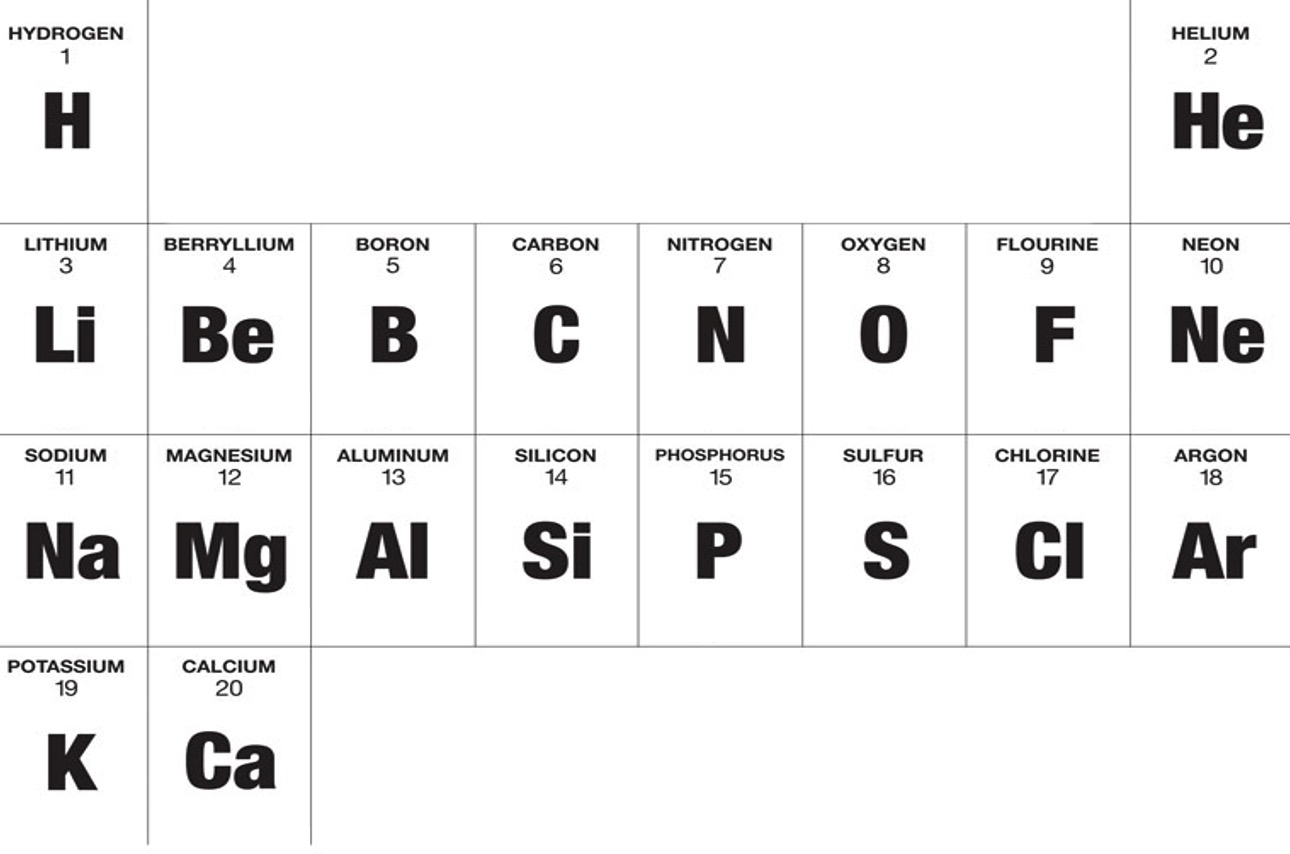
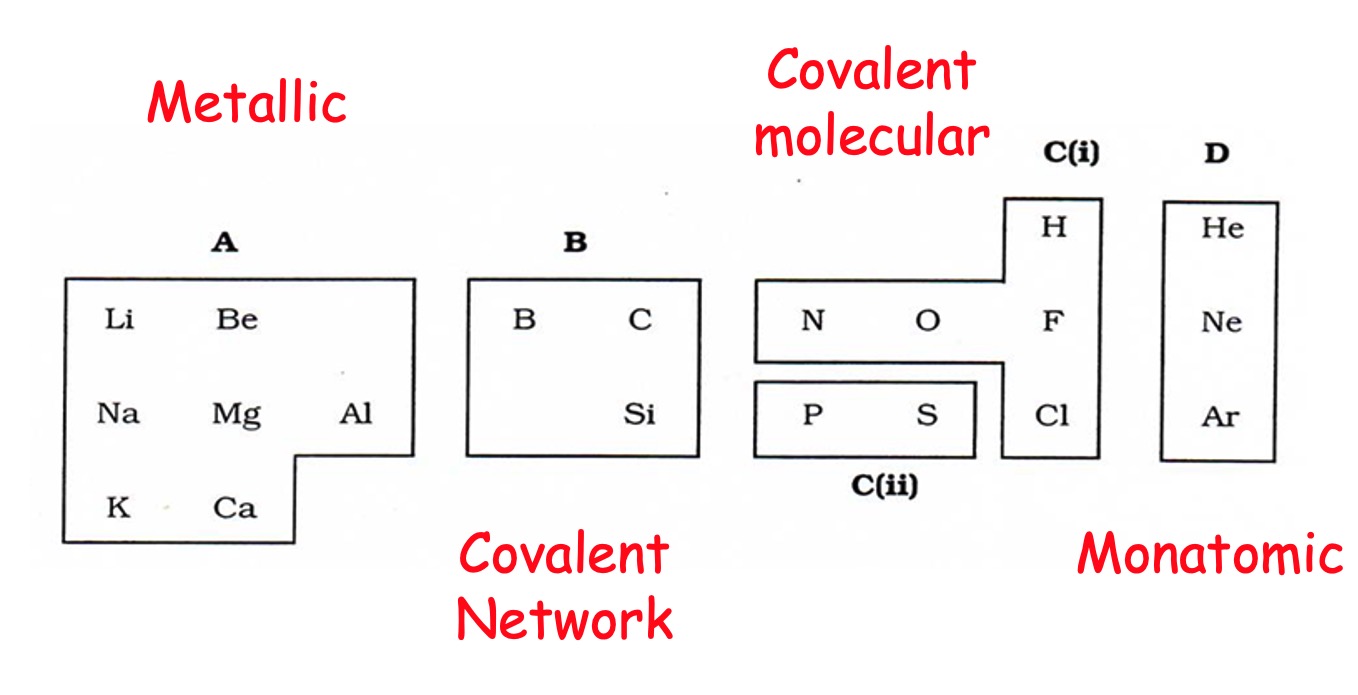
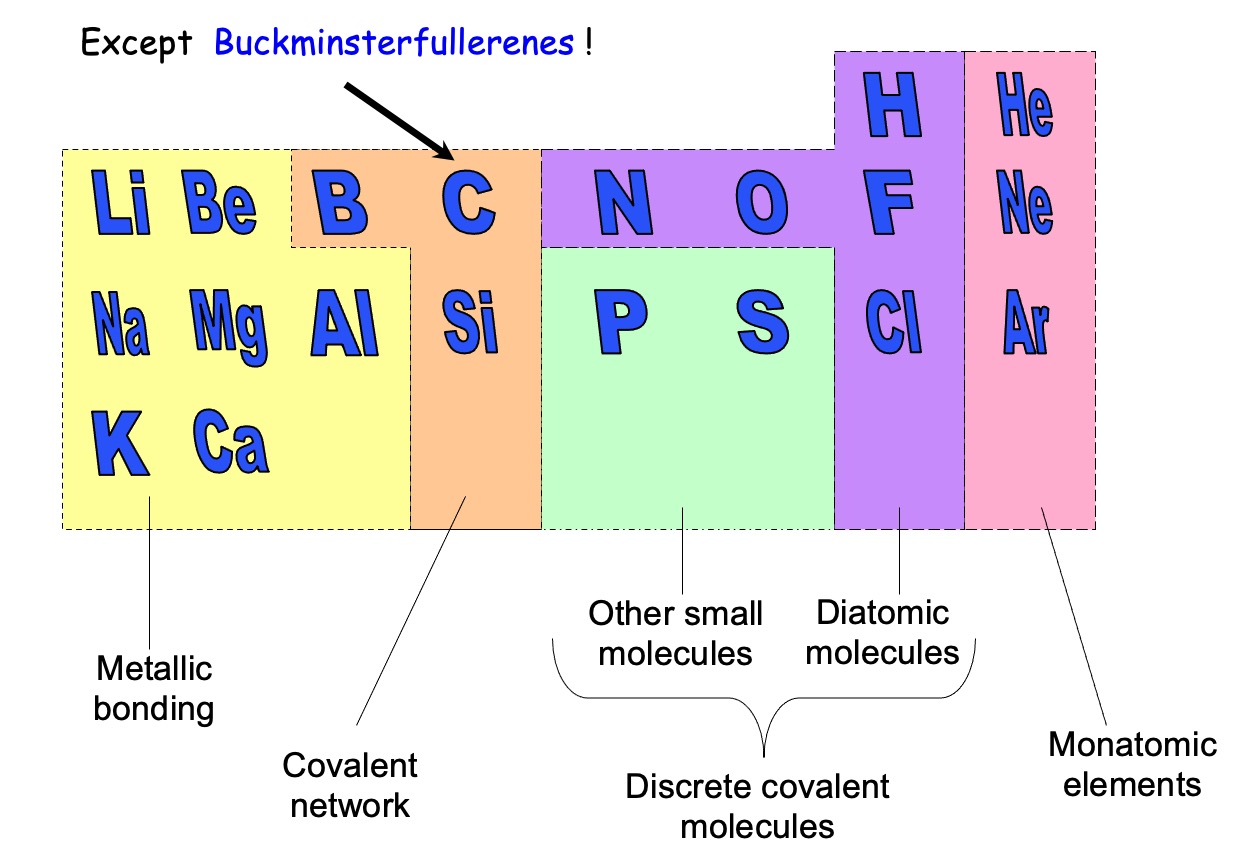
The first 20 elements can be sorted into four types by their bonding and structure:
- Metallic: Li, Be, Na, Mg, Al, K, Ca
- Covalent molecular: H2, N2, O2, F2, Cl2, P4, S8 and fullerenes (e.g. C60)
- Covalent network: B, C (diamond and graphite), Si
- Monatomic: the noble gases (He, Ne, Ar)
Intra means within. Intramolecular bonds are the strong covalent bonds within a molecule. Metallic bonds and covalent network bonds are also strong bonds, holding atoms together in a giant structure.
Inter means between. Intermolecular forces are the much weaker forces of attraction between molecules (or between the separate atoms of the noble gases). They are called van der Waals forces, and you will meet them in Structure and Bonding.
Bonding in elements
Metallic Bonding
Metallic bonding - unsurprisingly - only appears in metal elements.
Metallic bonding occurs between (positively charged) metal ions and delocalised outer shell electrons.
'delocalised' means the electrons are common to all of the ions (i.e. they move from one to another).
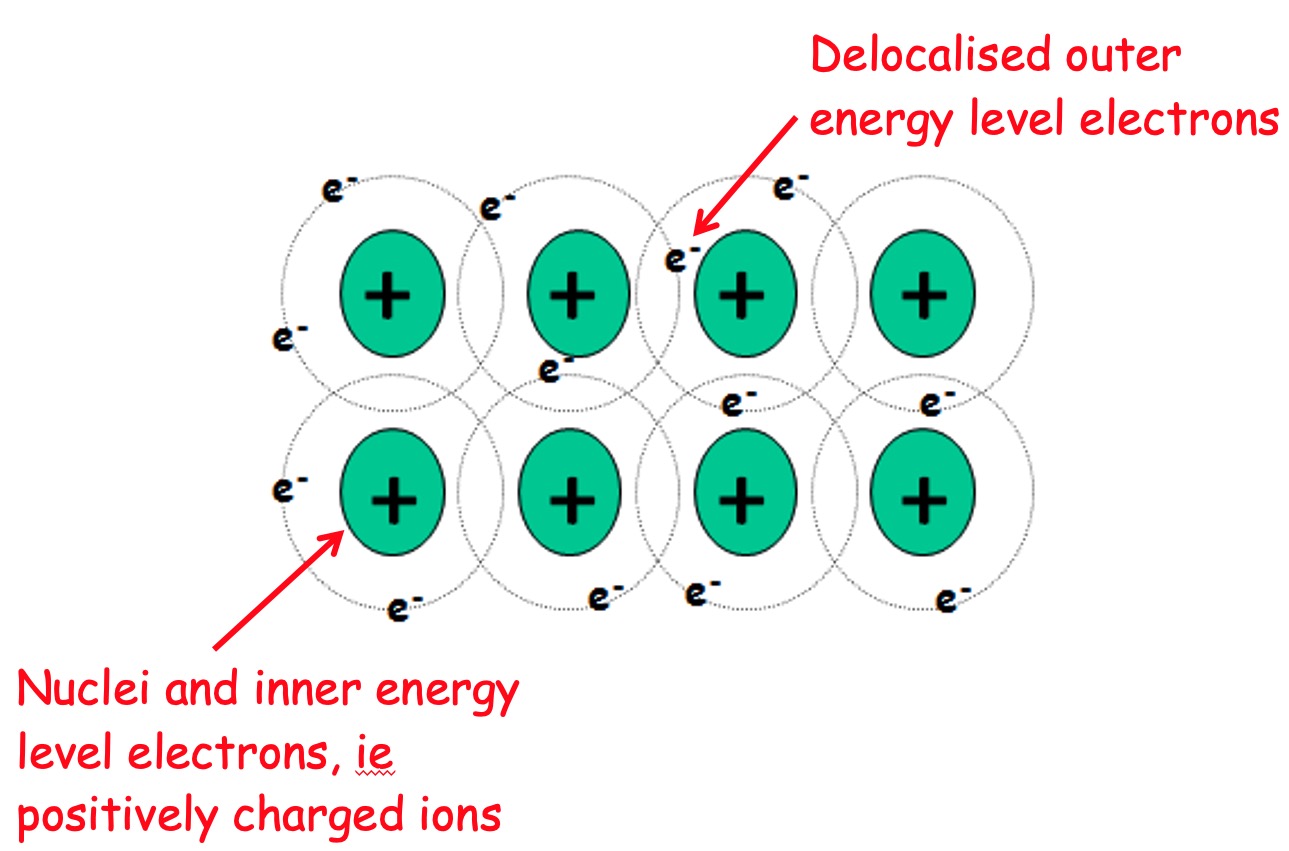
Atoms in a metal contribute the electrons in their outermost energy levels to a common 'pool' of free or delocalised electrons.
The structure of metals can be regarded as a regular array of positive charged ions in a sea of delocalised electrons.
Each positively charged ion is attracted to the pool of negative electrons and vice versa.
These electrostatic attractions, which constitute the metallic bond, hold the entire metal crystal together as a single unit.
Metallic bonds are generally strong.
The strength of the bond will largely depend on the number of electrons that each atom contributes to the delocalised pool and the charge on the ions in the array.
The greater the number of delocalised electrons and consequently the charge on the ions, the stronger the bond will be.
Covalent Bonding
Covalent bonding occurs between two non metal atoms.
The covalent bond is the result of two positive nuclei being held together by their common attraction for a shared pair of electrons.
Outer electrons are shared in covalent bonding.
Covalent Molecular
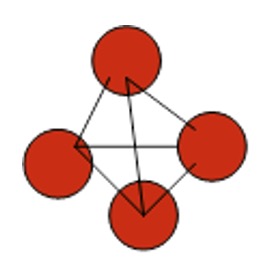 Phosphorus - forms tetrahedral P4 molecules. It has a low melting point and is solid at room temperature
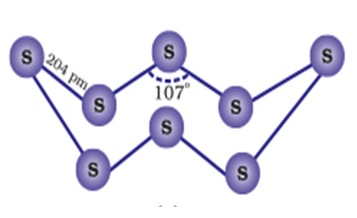 Sulfur - each atom forms two covalent bonds, giving S8 molecules: puckered (crown-shaped) rings of 8 atoms.
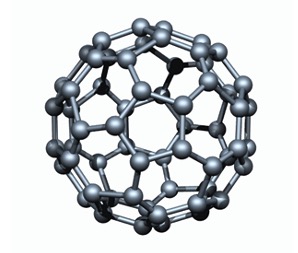 Fullerenes - a family of ball- and tube-shaped carbon molecules, e.g. C60. Unlike diamond and graphite, they are discrete molecules.
Buckminsterfullerene (aka 'Bucky Ball')
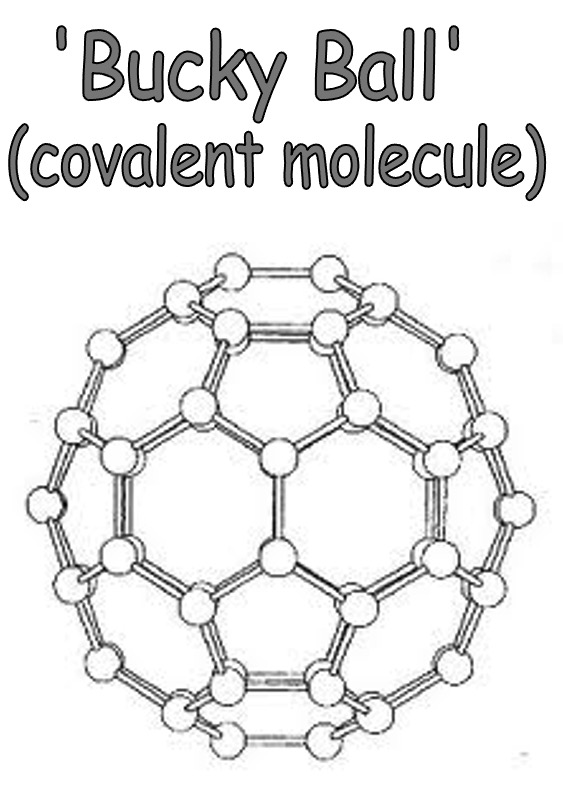 The fullerenes, despite being large molecules, are discrete covalent molecules.
The best-known fullerene is buckminsterfullerene (C60).
This is a spherical molecule containing 5 and 6 membered carbon rings.
Their properties are still being researched, so their full range of uses is not yet known.
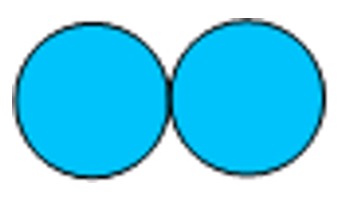 Diatomic- hydrogen, nitrogen, oxygen, fluorine and chlorine exist as diatomic gases at room temperature. They are examples of discrete covalent molecular substances.
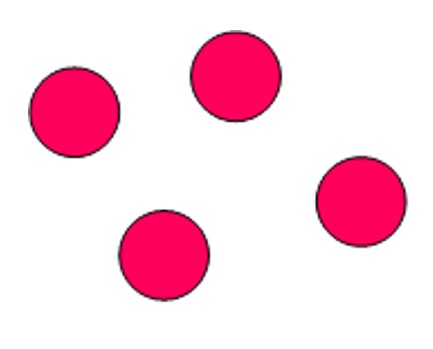 Monatomic - group 0 elements are called the 'noble gases'. The noble gases have full outer energy levels and are highly stable. As a result of their stability they do not normally form bonds. They exist as single atoms, attracted to each other only by weak London dispersion forces.
Covalent Network
A giant 3D lattice of covalently bonded atoms.
Boron (group 3)
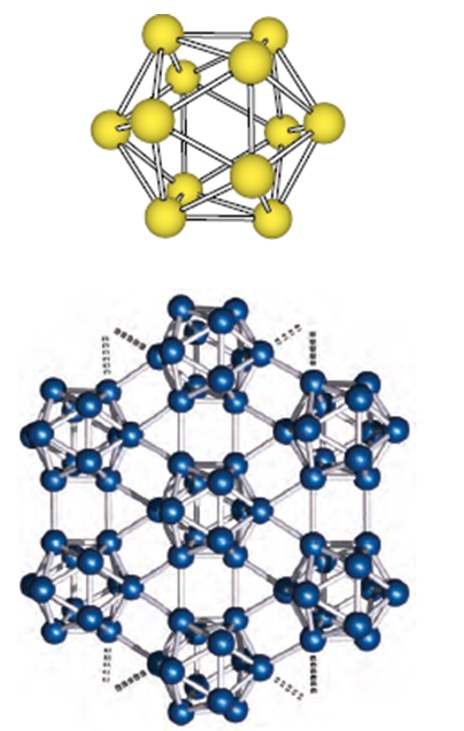 Boron atoms are covalently bonded in groups of 12 (B12 icosahedra), and these groups are bonded together into a giant 3D network.
This means covalent bonds must be broken to melt/ boil = very high m.pt/b.pt values.
No free electrons = no conduction.
Structure is almost as hard as diamond.
Carbon (group 4)
Carbon has more than one allotrope (physical form).
Diamond
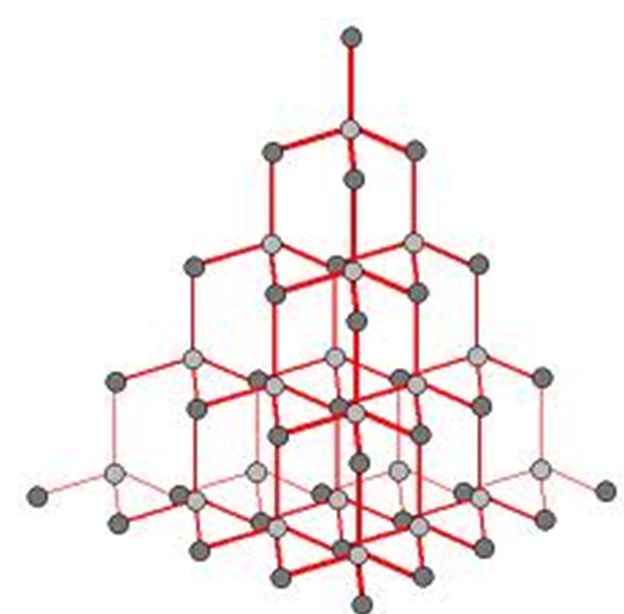 Each atom covalently bonds to 4 other atoms (tetrahedral shape).
This means covalent bonds must be broken to melt/ boil = very high m.pt/b.pt values.
No free electrons = no conduction.
Every atom is held in place by 4 strong covalent bonds, which makes diamond extremely hard.
Graphite
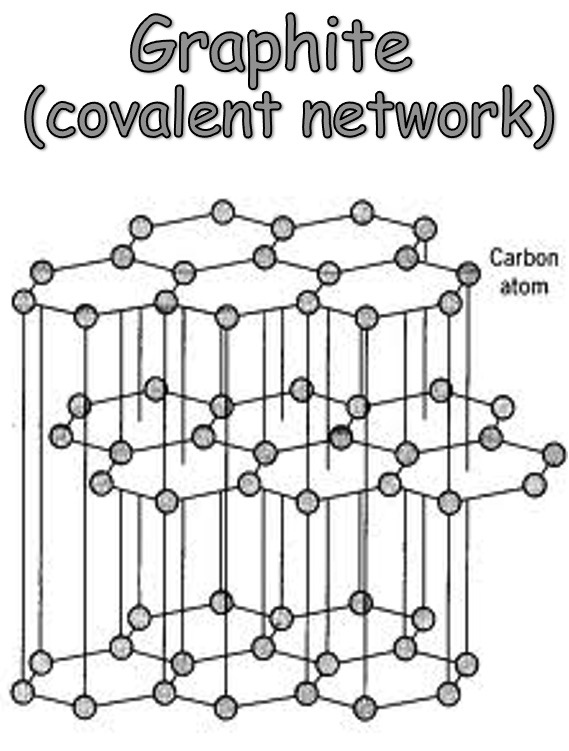 Each atom forms 3 covalent bonds and its last valence electron becomes delocalised.
As the delocalised electrons are only held weakly they can flow i.e. graphite conducts electricity.
There are strong covalent bonds WITHIN each layer but only weak London dispersion forces BETWEEN the layers.
Due to these weak interactions, graphite is flaky as the layers can be easily separated.
Graphite is black and shiny, not transparent like diamond.
Silicon (group 4)
Silicon has a diamond-like structure. Each atom covalently bonds to 4 other atoms in a giant 3D network, so silicon has a very high melting point.
Summary of Bonding types in first 20 elements
Trends - Melting and Boiling Points
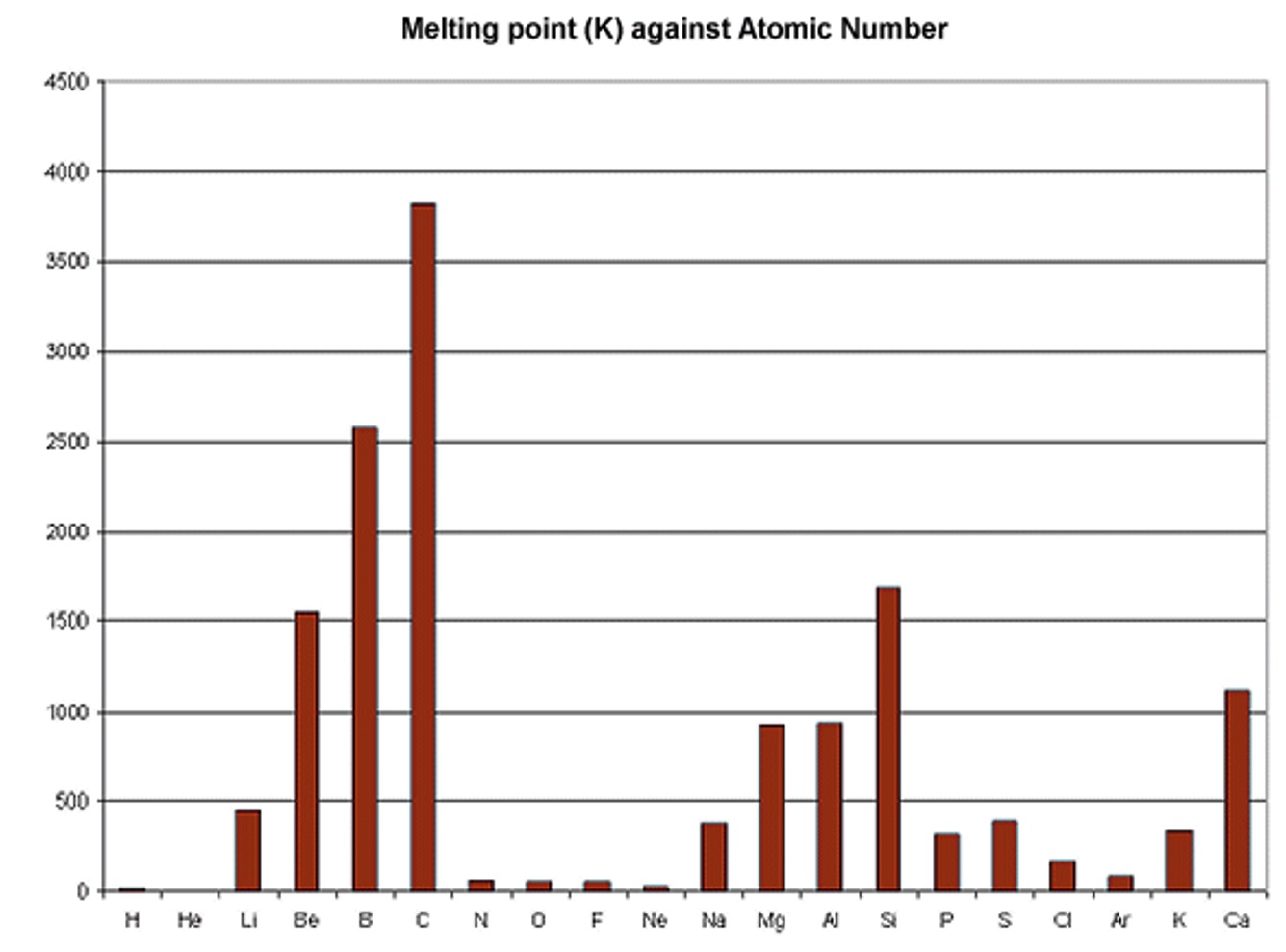
Generally, the stronger the bond between atoms, the higher the energy required to break that bond. Melting/boiling points are varied and don't generally form a trend across a period however;
- Metals generally possess a high melting point.
- Most non-metals possess low melting points.
- In periods 2 and 3, the group 4 elements (carbon and silicon, which are covalent networks) have the highest values.
Metal group example:
In group 1 (alkali metals), the melting/boiling pts decrease as the atomic number increases. This is because the atoms get bigger, so the delocalised electrons are further from the positive ions and the metallic bonding gets weaker.
Non-metal group example:
In group 7 (halogens) the melting/boiling pts increase as the atomic number increases. This is because the molecules have more electrons, so the London dispersion forces between them get stronger.
Trends - Atomic Size
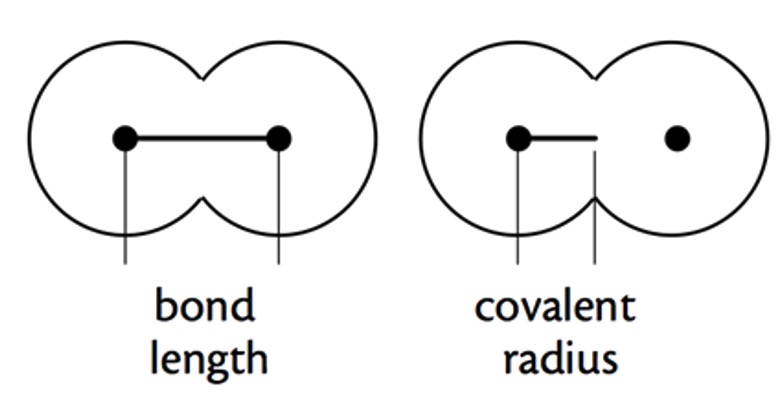
The covalent radius of an element is used to give an indication of its atomic size.
Covalent radius is half the distance between the nuclei of two covalently bonded atoms.
 Covalent radii of selected elements can be found in the data booklet.
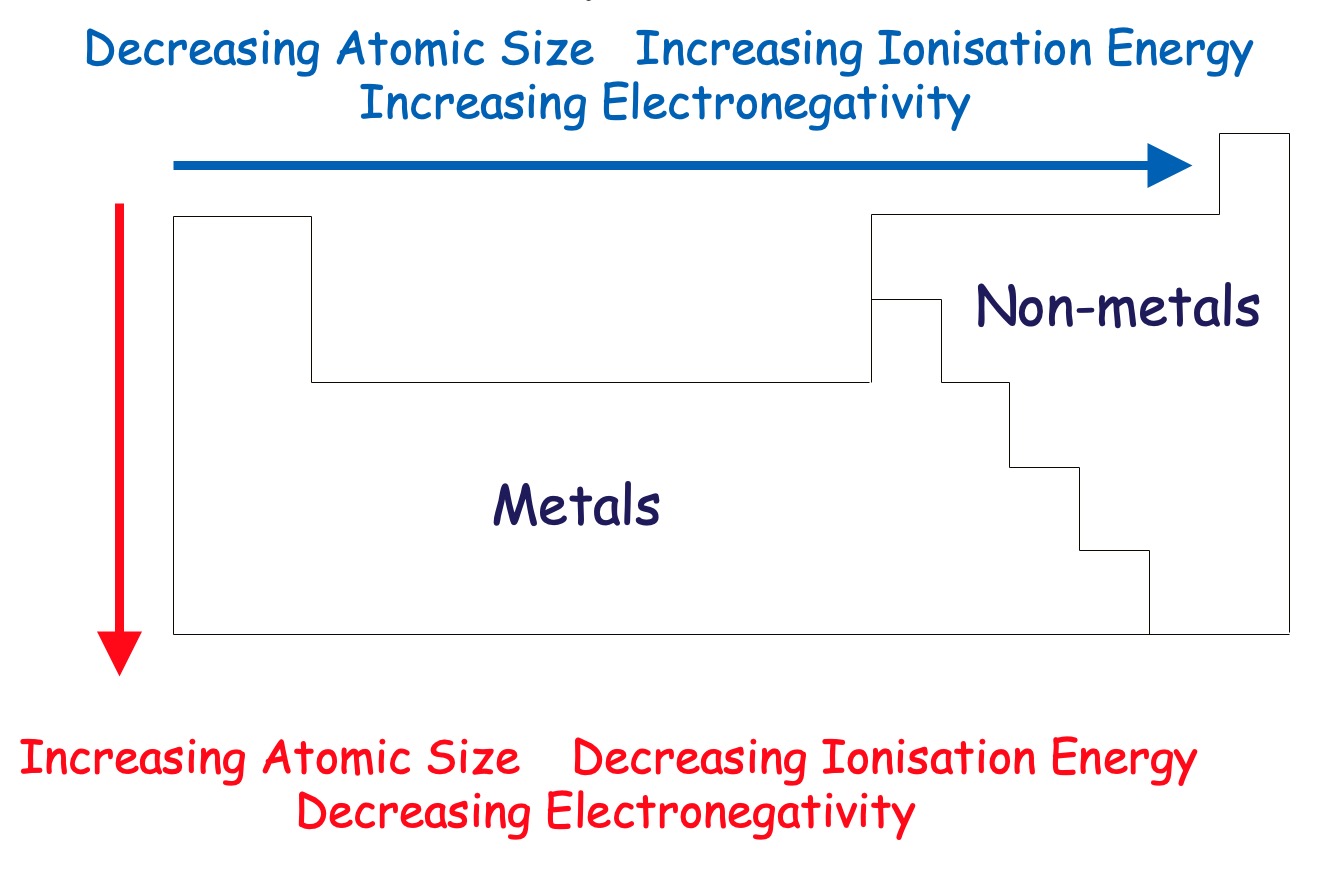
Across a period (left to right) - Atomic Size decreases
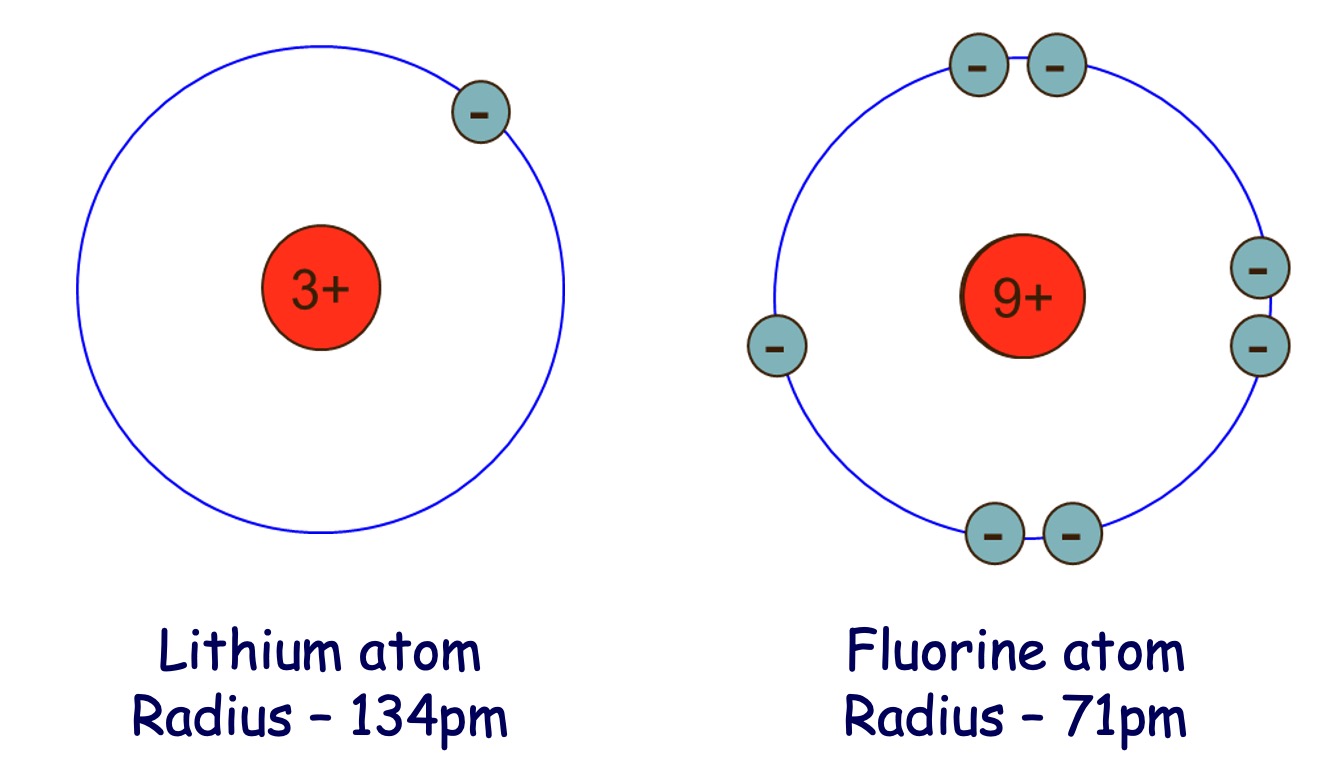
- Electrons are being added to the same energy level and protons are being added to the nucleus / increasing nuclear charge.
- The electrons in the outer energy level are therefore attracted more strongly to the nucleus making the atom smaller.
Down a group - Atomic Size increases.
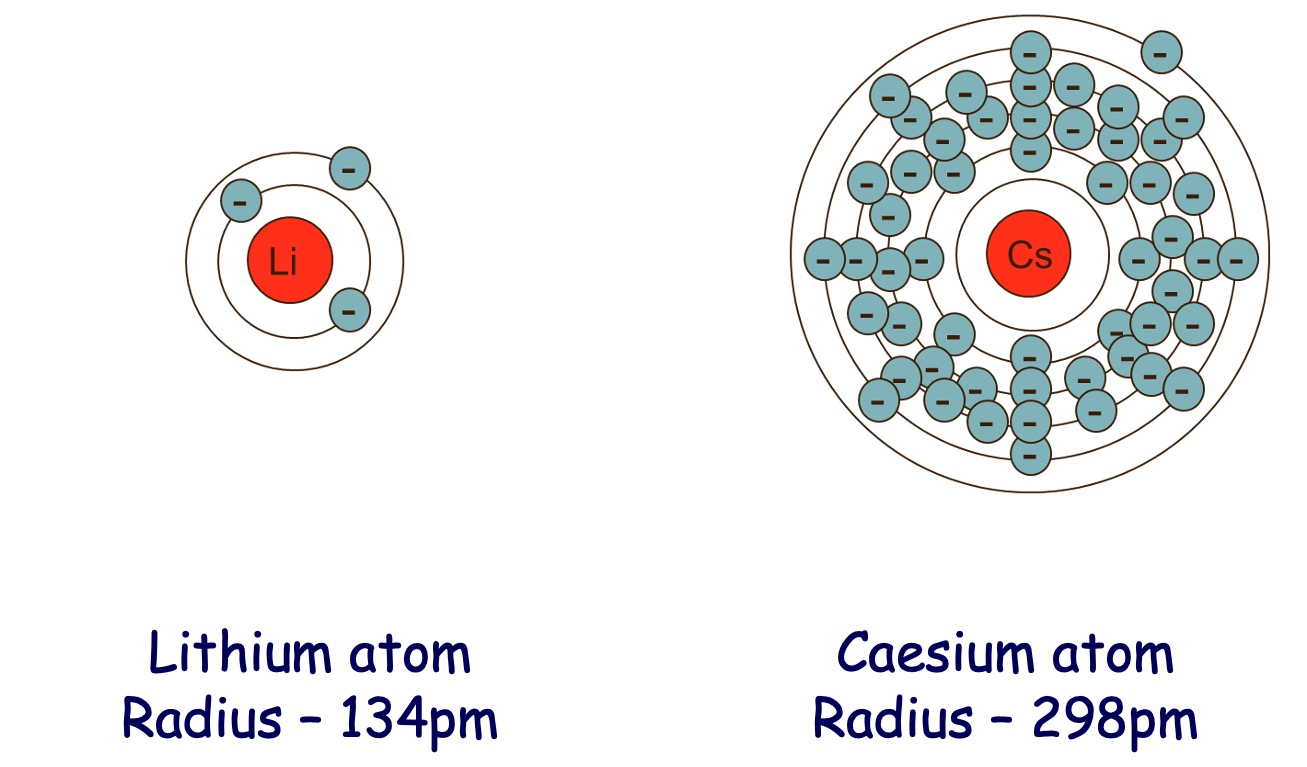
- The number of occupied electron energy levels (shells) increases making atoms bigger. This outweighs the increase in nuclear charge.
- There are no values for the covalent radii of monatomic gases as they do not form covalent bonds.
Question 1
Identify how atomic size is measured by analytical chemists.
Question 2
The elements lithium to neon make up the second period of the Periodic Table. Identify the correct trend and explanation for the change in atomic size from lithium to fluorine.
Question 3
Explain the difference in atomic size between potassium and chlorine atoms.
Question 4
The covalent radii of elements are listed in the data booklet. Suggest why there are no values provided for the Noble Gases (Group 0).
Trends - Ionisation Energy
The first ionisation energy is the energy required to remove one mole of electrons from one mole of gaseous atoms.
More than one electron can be removed from an atom. The second and subsequent ionisation energies are the energies required to remove further moles of electrons.
Ionisation energies of selected elements are listed in the data booklet.
The following equation shows the first ionisation for an element, E:
E (g) → E+(g) + e-
When writing equations to show ionisation you must show state symbols. The element must be in the gaseous state.
Metals and non-metals both undergo ionisation to form positively charged ions.
E.g.
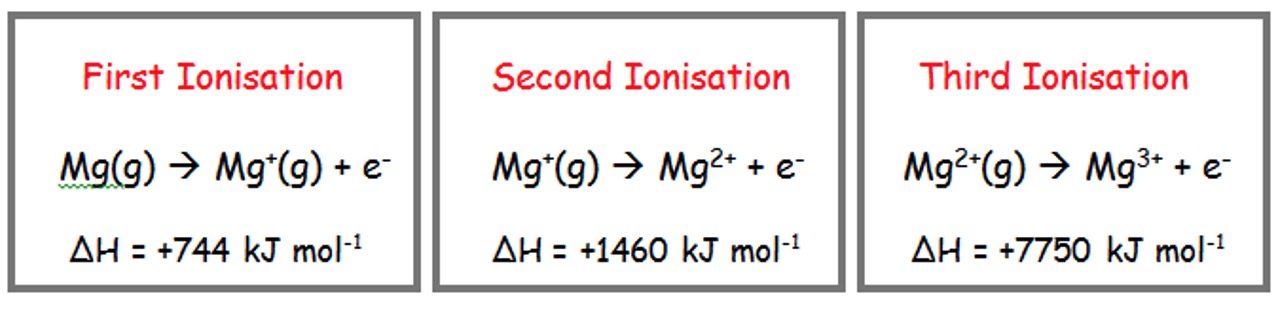
The total energy required to remove the three electrons above is:
744 + 1460 + 7750 = 9954 kJ mol-1.
Why is the third ionisation energy of Mg so much bigger than the second?
Across a Period (left to right) - Ionisation Energy increases.
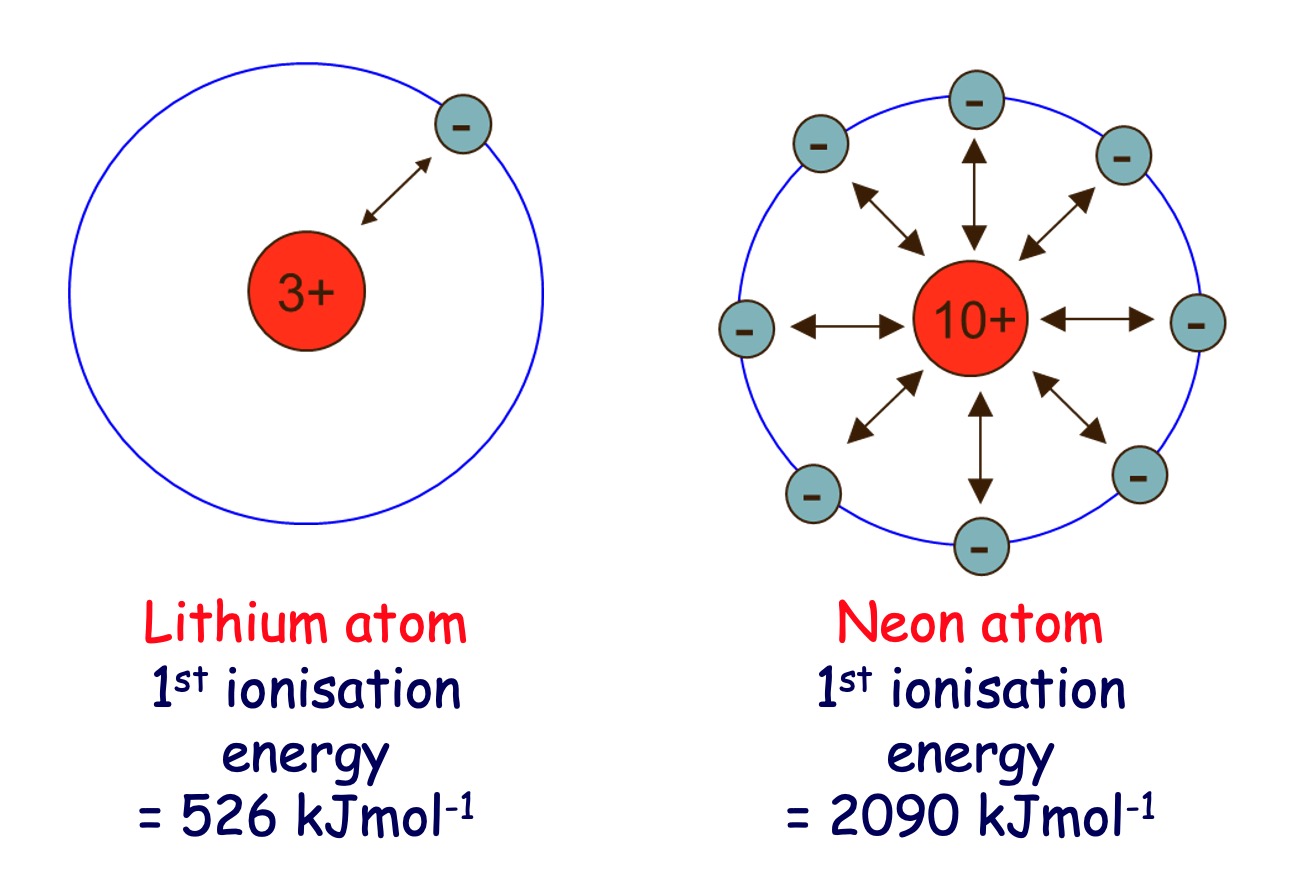
More protons are being added to the nuclei of the atoms. This results in an increase in nuclear charge.
The electrons in the outer energy level are attracted more strongly to the nucleus and therefore will be held more tightly, and more difficult to remove.
Down a Group - Ionisation energy decreases.
As you move down a group there are more energy levels.
Electron removed from the outer energy level is increasingly distant from the nucleus as a result of the increasing atomic size.
Electrons in the inner energy levels shield (screen) the outer electrons from the nuclear charge. This is the screening effect.
Therefore they are not attracted as strongly resulting in less energy required to remove electron.
Question 5
Identify the correct term for the equation:
Al2+(g) → Al3+(g) + e-
Question 6
Identify the correct definition for first ionisation energy
Question 7
On crossing the third period from left to right there is a general increase in the first ionisation energy of the elements. Identify the correct explanation for increase in first ionisation energy increase across the period.
Question 8
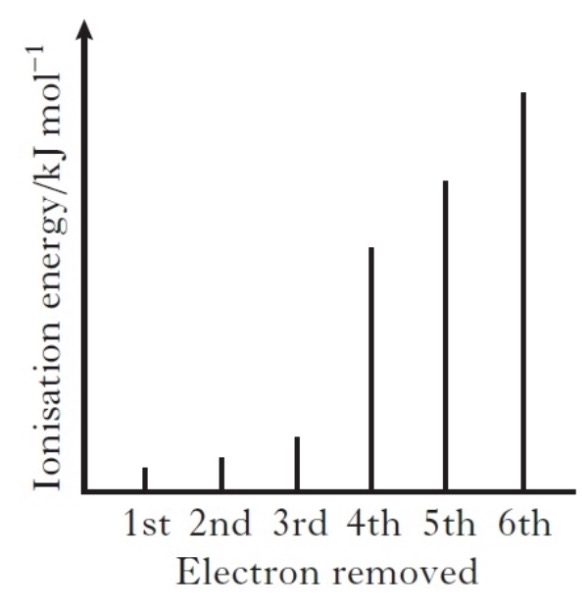
The spike graph shows the variation in successive ionisation energies of an element, Z. Identify the group of the Periodic Table which would contain element Z.
Question 9
Identify which of the following elements would require the most energy to convert one mole of gaseous atoms into gaseous ions each carrying two positive charges.
Trends - Electronegativity
Electronegativity is a measure of the attraction an atom involved in a bond has for the electrons of the bond.
Electronegativity values are based on the Pauling Scale, devised by Linus Pauling.
Values on the Pauling Scale range from 0 to 4.
Electronegativity values of selected elements are listed in the data booklet.
The higher the number on the Pauling scale is, the greater the attraction an atom has for the bonding electrons.
Electronegativity values can be useful in predicting which type of bonding is most likely between two elements.
There are no electronegativity values for the noble gases, because they do not normally form bonds.

Fluorine is the most electronegative atom in the periodic table. It has a value of 4.
Across a period (left to right) - Electronegativity increases.
This is caused by an increase in nuclear charge (more protons) and a decrease in covalent radius as you move across a period from left to right.
Therefore it has a greater attraction for the bonding electrons.
Down a Group - Electronegativity decreases.
This is caused by the addition of another energy level of electrons as you go down a group, so the covalent radius increases and the bonding electrons are further from the nucleus.
The inner energy levels screen the bonding electrons from the nucleus, so they are not as strongly attracted.
Question 10
Identify the correct definition of electronegativity.
Question 11
On descending Group 1 from lithium to caesium, the electronegativity of the elements decreases. Identify the correct explanation for the decrease in electronegativity.
Question 12
The electronegativities of elements are listed in the data booklet. Suggest why there are no electronegativity values provided for the Noble Gases (Group 0).
Question 13
Atoms of nitrogen and element X form a bond in which the electrons are shared equally. Element X could be
Summary of Trends
(b) Structure and Bonding
What you need to know
- Pure covalent, polar covalent and ionic bonding, and the bonding continuum
- Using electronegativity differences and physical properties to work out bonding and structure
- Van der Waals forces: London dispersion forces, permanent dipole-permanent dipole interactions and hydrogen bonding
- How intermolecular forces explain melting and boiling points, viscosity, solubility and the density of ice
Types of Bonding in Compounds
Strong bonds hold atoms or ions together:
- Ionic bonding
- Pure (non-polar) covalent bonding
- Polar covalent bonding
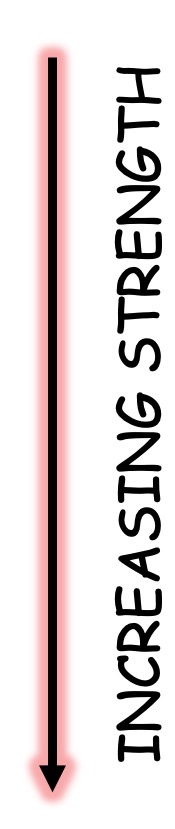
Intermolecular forces (van der Waals forces) are much weaker forces of attraction between molecules. From strongest to weakest:
- Hydrogen bonding (e.g. in H2O, NH3 and HF), which is a particularly strong type of permanent dipole-permanent dipole interaction
- Permanent dipole-permanent dipole interactions
- London dispersion forces (LDF), caused by temporary dipoles
This order is true for molecules with similar numbers of electrons. A large non-polar molecule can have stronger London dispersion forces than the permanent dipole interactions of a small polar molecule.
Covalent Compounds
There are three types of covalent bonding in compounds:
- Covalent Network Structures
- Non-Polar (pure) Covalent Molecules
- Polar Covalent Molecules
Covalent Networks

These covalent network compounds have the same properties as covalent network elements. Both SiC and SiO2 have very high melting points as melting requires breaking strong covalent bonds. Silicon carbide (structurally similar to diamond) has many uses due to its strength, durability and low cost. Silicon carbide is often referred to as 'carborundum'
Covalent Molecules
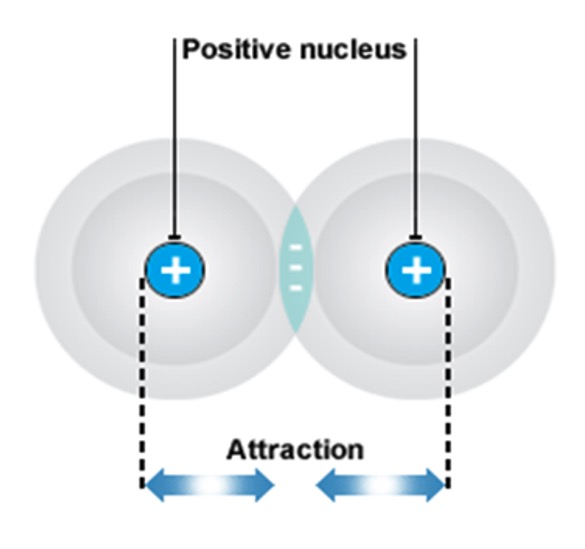
A covalent bond is formed when atoms share a pair of electrons. The two positive nuclei are held together by their common attraction for the shared pair of electrons.
There are two types of covalent bond:
- Pure or non-polar covalent
- Polar covalent
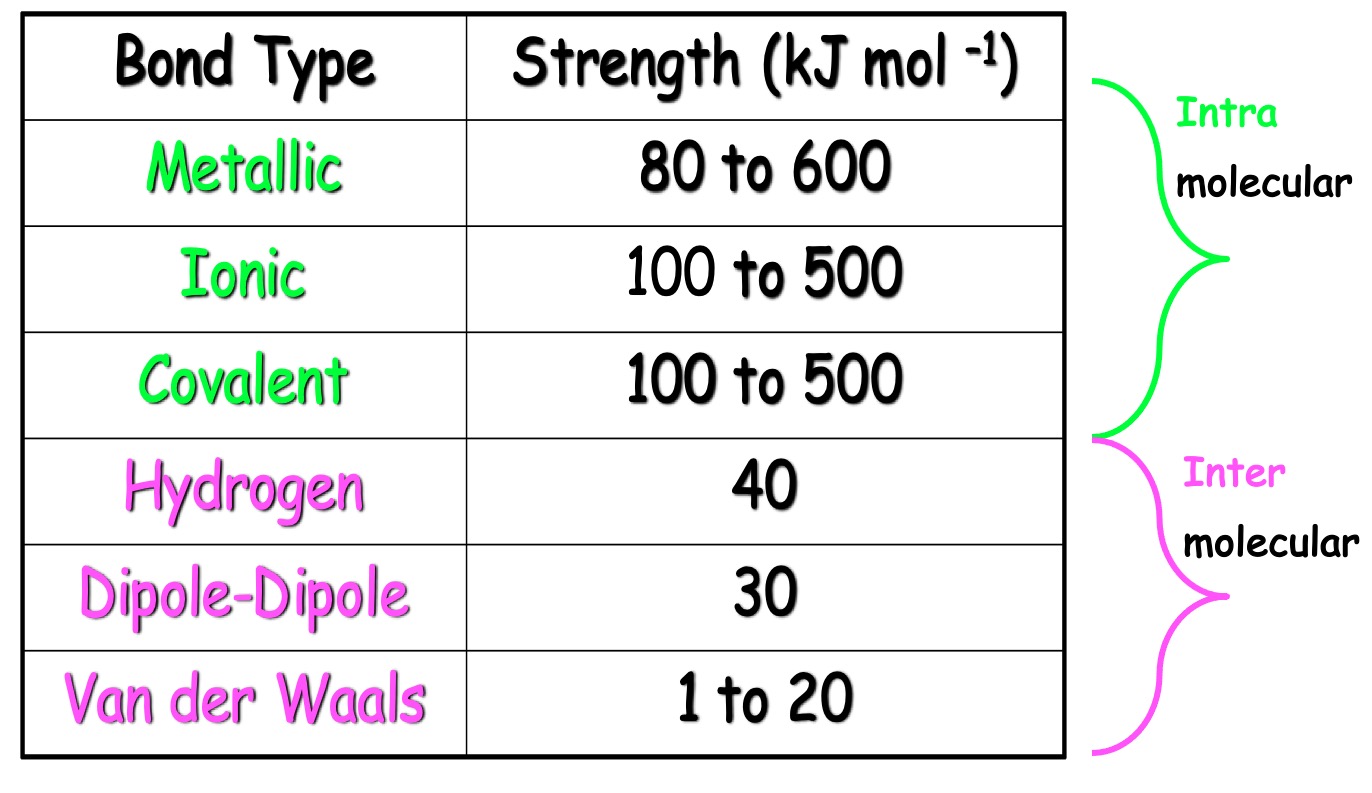
Covalent bonds are strong (100 to 500 kJ mol-1).
Non-Polar Covalent
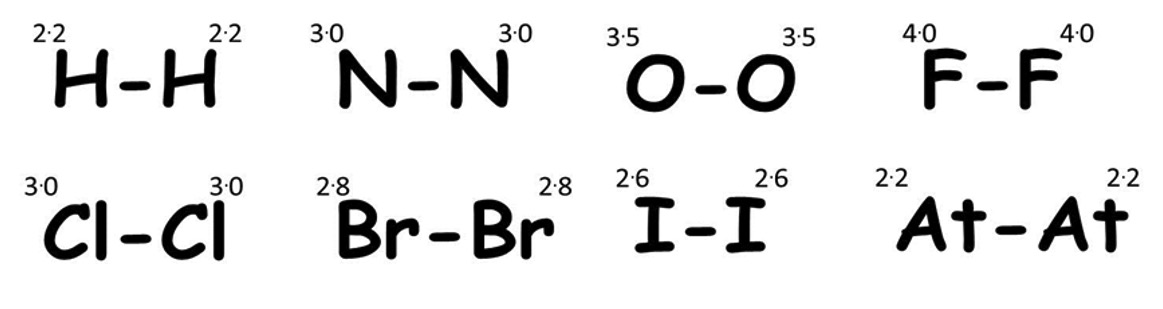
A pure covalent bond is formed when the atoms involved in the bond have an equal share of the bonding electrons ie. equal electronegativity.
All diatomic elements contain pure covalent bonds as both atoms have the same electronegativity value.
Polar Covalent
When atoms with different electronegativity values (a difference of roughly 0.5 to 1.6) join together, a polar covalent bond is formed.
In a polar covalent bond the electrons are not shared equally, one atom in the bond has a greater attraction than the other for the bonded electrons.
Example: HBr
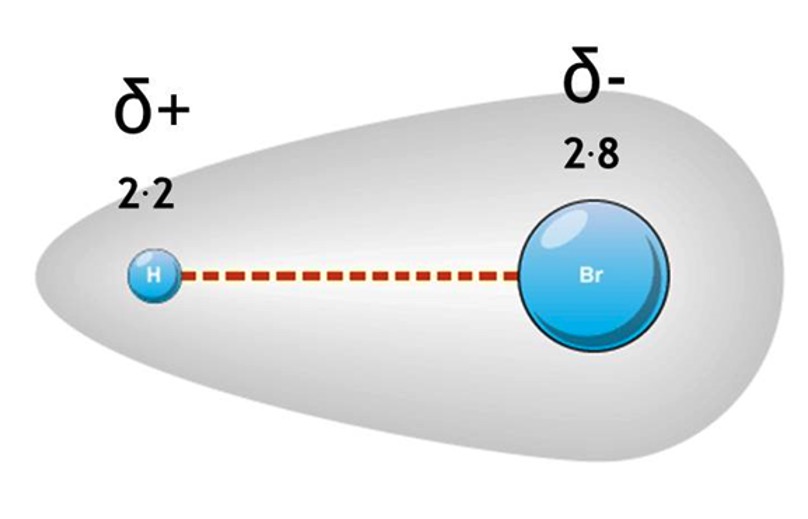 Hydrogen electronegativity - 2.2
Bromine electronegativity - 2.8
Br end becomes slightly negatively charged δ-
H end becomes slightly positively charged δ+
A polar covalent bond is a bond in which the atoms have different electronegativity values.
This means that one atom has a greater attraction for the bonded electrons than the other.
δ- means slightly negative (most electronegative atom)
δ+ means slightly positive (least electronegative atom)
These partial charges give the bond a dipole.
Ionic Bonding
Ionic bonding is the electrostatic attraction between the positive ions of one element and the negative ions of another element.
The greater the electronegativity difference is between the two elements, the more likely they are to form an ionic bond (difference in ΔEN is greater than 2.0).
The element with the larger electronegativity will gain electrons to form a negatively charged ion, whilst the less electronegative element will lose electrons to form a positively charged ion.
Elements far apart in the Periodic Table are most likely to form ionic compounds.
This means that ionic compounds typically arise from metals combining with non-metals.
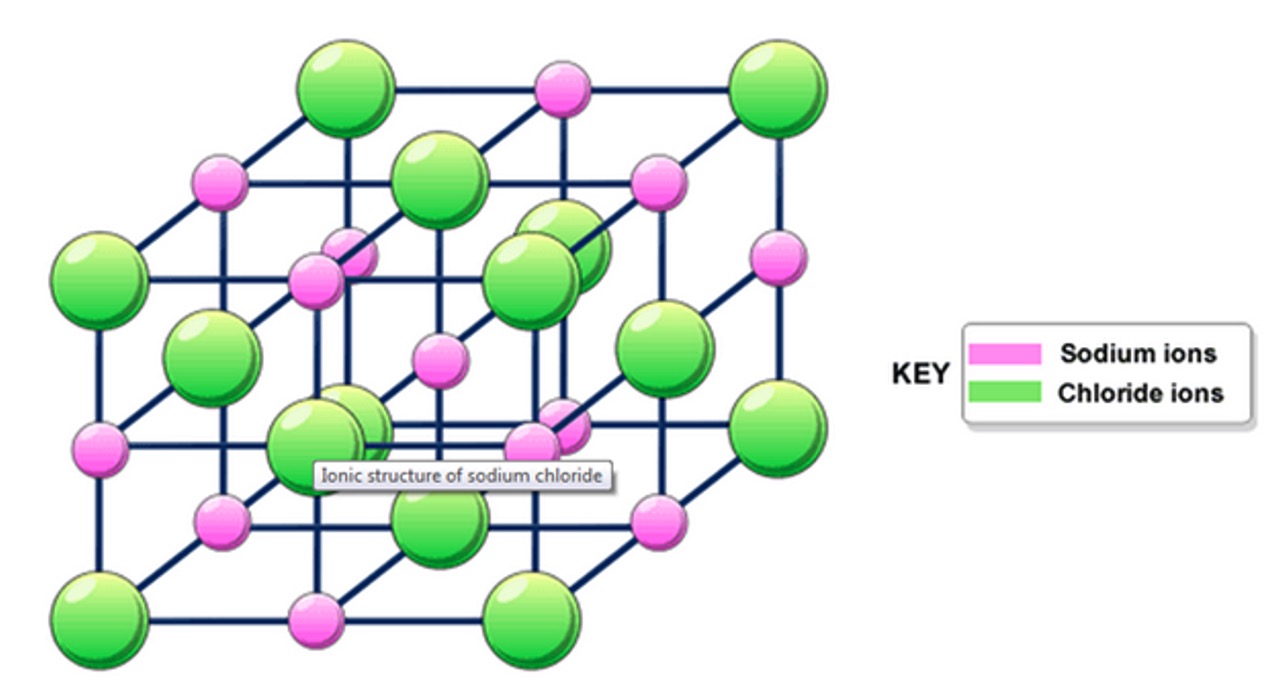
Ionic bonds are strong, and ionic compounds exist as lattice structures in which each ion is attracted to a number of oppositely charged ions.
The formula of an ionic compound gives the simplest ratio of each type of ion, e.g. sodium chloride Na+Cl- (1:1) and magnesium chloride Mg2+(Cl-)2 (1:2).
The Bonding Continuum
A bonding continuum can be used to help us understand the differences in bonding as it is not as simple as labelling compounds as ionic, pure covalent or polar covalent.
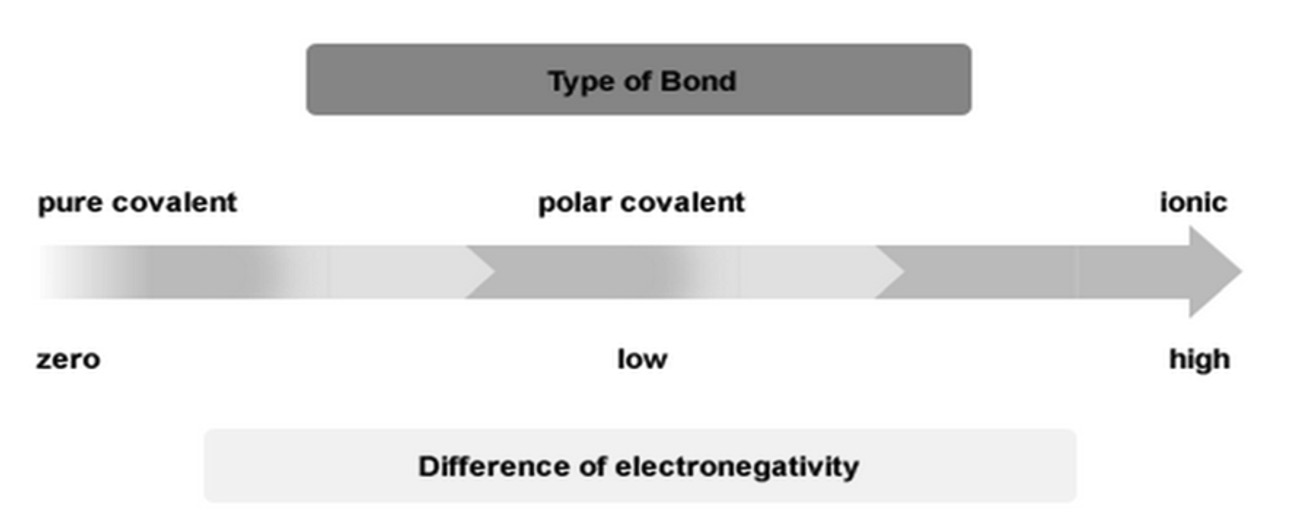
Summary of electronegativity values and bonding
In general:
- If the electronegativity difference (usually called ΔEN) is less than 0.5, then the bond is non polar (pure) covalent.
- If the ΔEN is between 0.5 and 1.6, the bond is considered polar covalent.
- If the ΔEN is greater than 2.0, then the bond is ionic.
These numbers are only a rough guide. The larger the electronegativity difference, the more polar (more ionic in character) the bond. Between about 1.6 and 2.0 the bond has a lot of ionic character, and the compound's properties are the best way to decide.
Compounds formed between metals and non-metals are often, but not always, ionic. For example, tin(IV) chloride, SnCl4, is a liquid at room temperature, so it must be covalent molecular.
Using Properties to Work Out Bonding and Structure
The physical properties of a compound (its state at room temperature, melting and boiling points, solubility and electrical conductivity) tell you its bonding and structure.
| Bonding and structure | Melting and boiling points | State at room temperature | Conducts electricity? | Solubility |
|---|---|---|---|---|
| Ionic lattice | High | Solid | Only when molten or dissolved (the ions are free to move) | Often soluble in water; insoluble in non-polar solvents |
| Covalent molecular | Low | Gas, liquid or low-melting solid | No | Polar: often soluble in water. Non-polar: soluble in non-polar solvents |
| Covalent network | Very high | Solid | No (except graphite) | Insoluble |
1. Identify which of the following chlorides is likely to have the most ionic character
Intermolecular Bonding
Intermolecular bonds are bonds which occur between molecules. Intermolecular bonds are called van der Waals' forces.
There are three types of van der Waals' forces:
- London dispersion forces
- Permanent dipole - permanent dipole interactions
- Hydrogen bonding
London Dispersion Forces
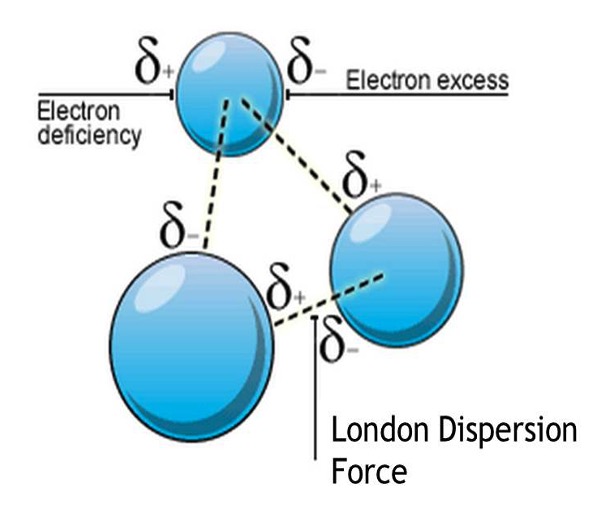 London dispersion forces are the weakest type of van der Waals' force. London dispersion forces occur between all atoms and molecules.
London dispersion forces are formed as a result of electrostatic attraction between temporary dipoles and induced dipoles caused by movement of electrons.
There is an uneven distribution of the constantly moving electrons around the nuclei of atoms.
This movement causes the formation of temporary dipoles on the atoms.
The temporary dipole formed means that atoms then attract each other.
These temporary dipoles constantly change, but always exist.
London dispersion forces are much weaker than all other types of bonding.
The strength of the London dispersion force is related to the number of electrons within an atom or molecule.
Permanent dipole - permanent dipole interactions
Permanent Dipole- permanent dipole interactions occur between polar molecules. Dipole-dipole interactions are stronger than London dispersion forces for molecules with similar numbers of electrons.
A dipole-dipole interaction is the electrostatic attraction between the oppositely charged areas of two or more polar molecules. Think of the electrons pulled to one side of the molecule where one side is slightly positive and the other slightly negative.
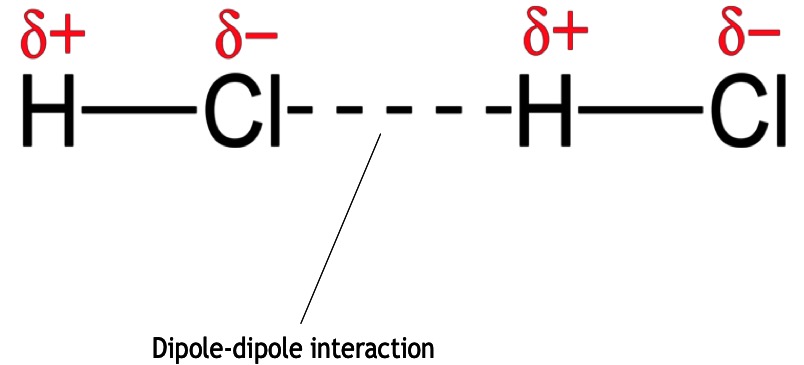
Permanent dipole to dipole interaction is caused via the constant attraction between the δ+ atoms and δ- atoms of neighbouring molecules. A molecule is described as polar if it has a permanent dipole.
Due to dipole - dipole interactions being stronger than London dispersion forces, polar molecules have higher melting and boiling points than non-polar molecules with similar numbers of electrons.
Polar or Non-Polar?
Some molecules contain polar covalent bonds and are described as polar molecules as they are not arranged symmetrically and negative poles and positive poles exist in the molecule.
e.g. water
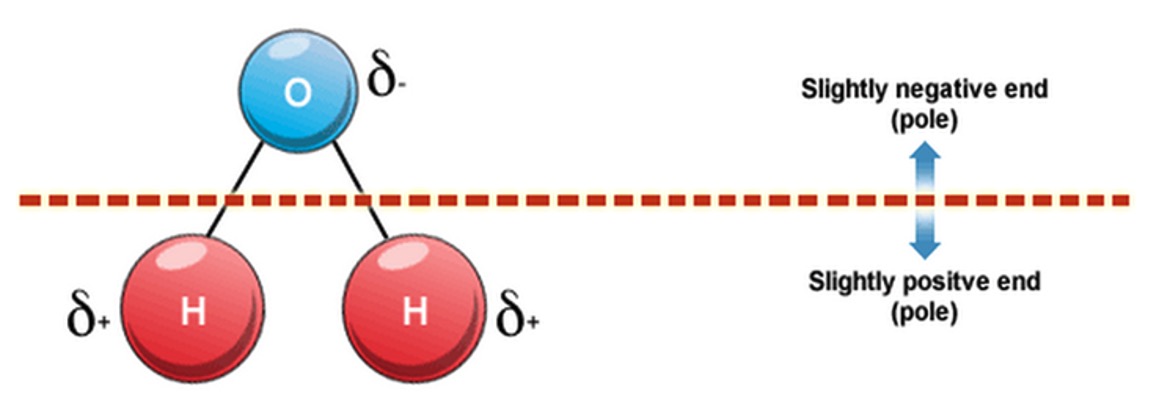
Other molecules are non-polar even though they contain polar covalent bonds, as they are symmetrical so there are no positive or negative poles in the molecule.
e.g. Tetrachloromethane CCl4
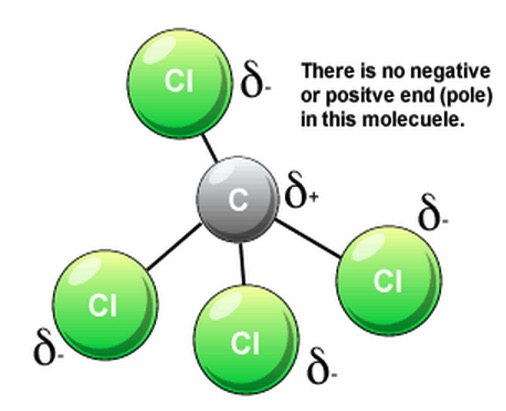 In this molecule the symmetry causes the polarity to cancel out over the molecule as a whole.
REMEMBER:
Symmetrical: Non-polar molecule
Asymmetric: Polar molecule
Polar or Non-Polar?
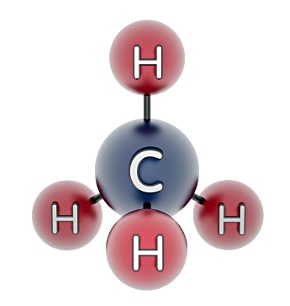
2. Methane
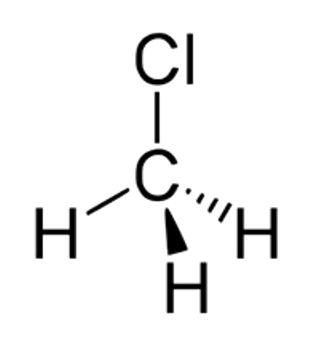
3. Chloromethane
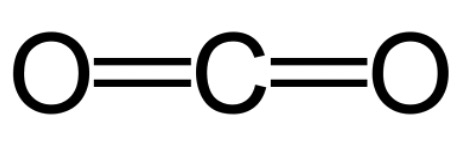
4. Carbon dioxide
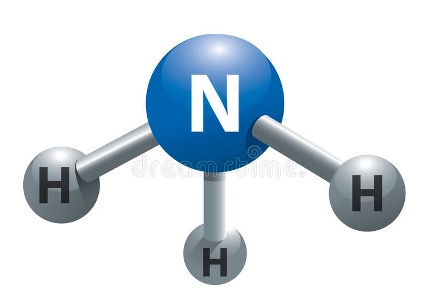
5. Ammonia
6. Butane
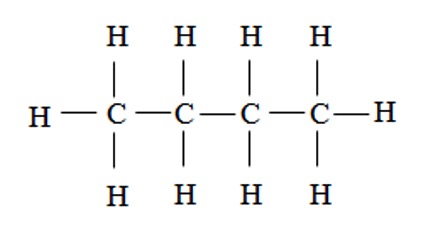
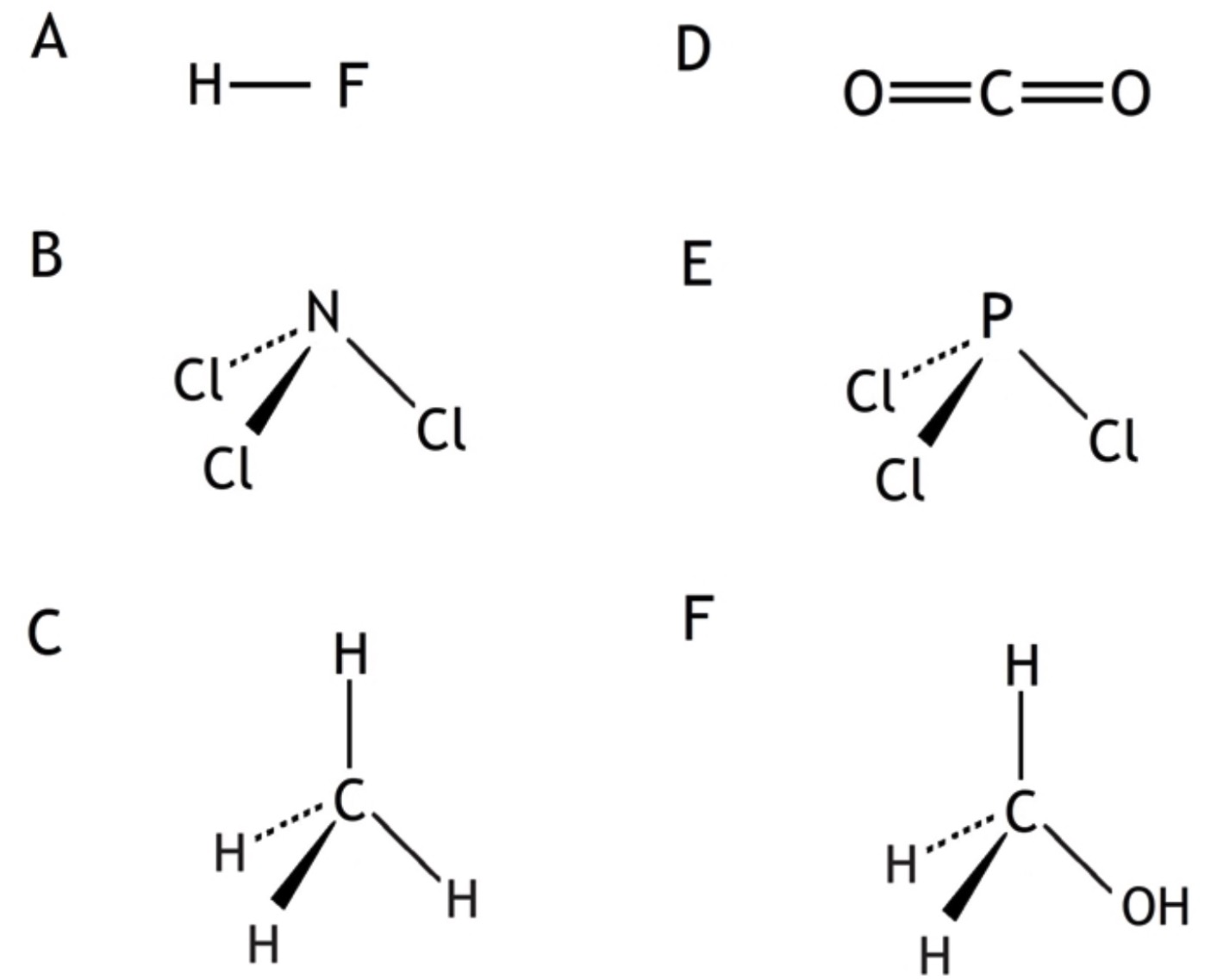
7. Identify the three compounds which contain polar molecules. (Tick three.)
8. Atoms of nitrogen and element X form a bond in which the electrons are shared equally. Element X could be
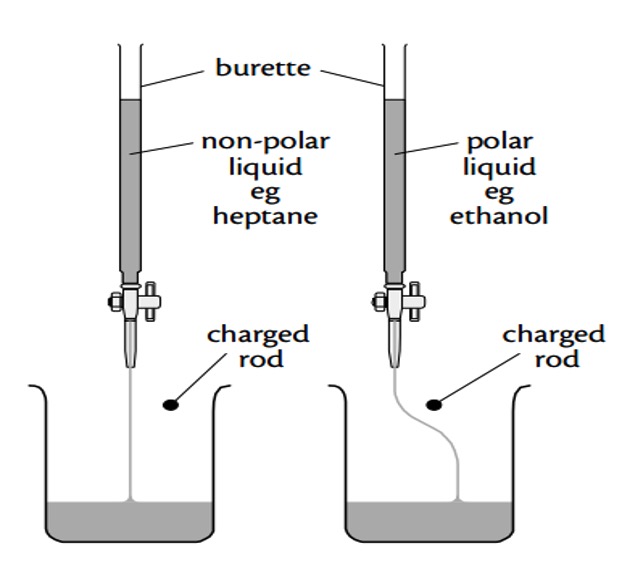 Polarity Experiment
You can experimentally determine if a molecule is polar or non-polar by placing a charged rod next to a flow of the substance in question.
If it is attracted towards the charged rod, it is a polar molecule.
If it is not attracted to the rod it is a non-polar molecule.
Hydrogen Bonding
Hydrogen bonding is a special type of dipole-dipole interaction between molecules that contain H-N, H-O or H-F bonds.
These bonds are very polar, as shown by the electronegativity values in the table below.
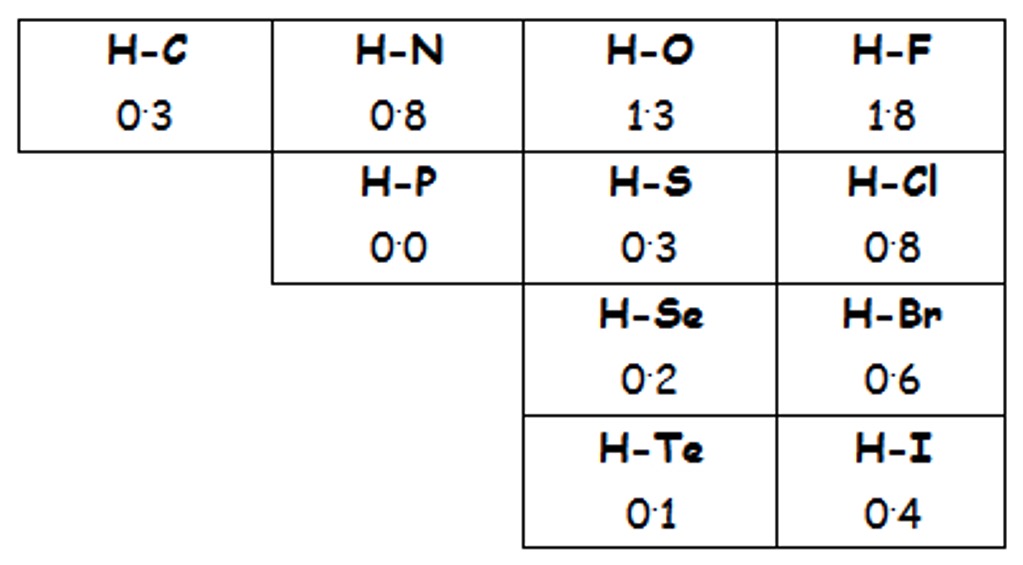
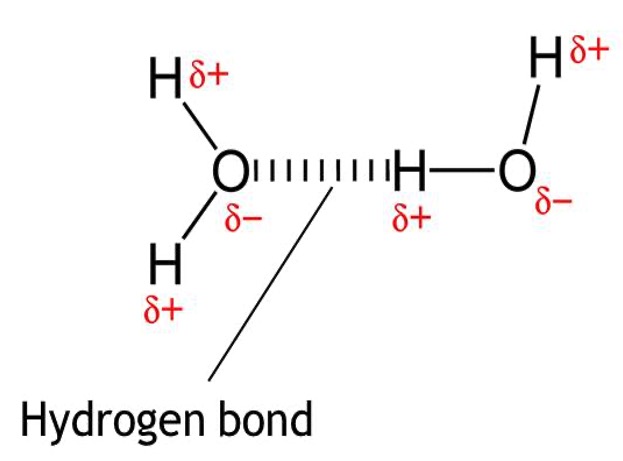 When a highly electronegative element such as nitrogen, oxygen or fluorine is bonded to hydrogen, the hydrogen ends up being slightly positively charged and the electronegative element becomes slightly negatively charged.
The most common example of hydrogen bonding is in water.
A hydrogen bond is stronger than other permanent dipole-permanent dipole interactions but weaker than a covalent bond.
Summary of van der Waals'
 London Dispersion Forces
Occur between all atoms and molecules. They are the only intermolecular force between non-polar molecules.
PD/PD Interactions
Occur between polar molecules with permanent dipoles.
Hydrogen Bonding
Occur between molecules containing H-N, H-O or H-F bonds: the δ+ H of one molecule is attracted to the δ- N, O or F of a neighbouring molecule.
Molecules which contain hydrogen bonding have much higher melting and boiling points than those with only dipole-dipole interactions or London dispersion forces and a similar number of electrons.
9. Identify which of the following is not an example of a Van der Waals' force?
Melting and Boiling Points
The melting and boiling point of a substance gives an indication of the quantity of energy needed to overcome the van der Waals' forces between molecules.
For non-polar molecules the melting and boiling points are related to the London dispersion forces between molecules.
The strength of London dispersion forces increases with the number of electrons in the molecule (bigger molecules have more electrons).
For polar molecules, the melting and boiling points are higher than those of non-polar compounds with similar numbers of electrons, due to more energy being required to overcome the dipole-dipole interactions of polar molecules.
Compounds which contain H-N, H-O or H-F bonds will have significantly higher melting and boiling points compared to other polar molecules and non-polar molecules due to more energy being required to overcome the strong hydrogen bond.
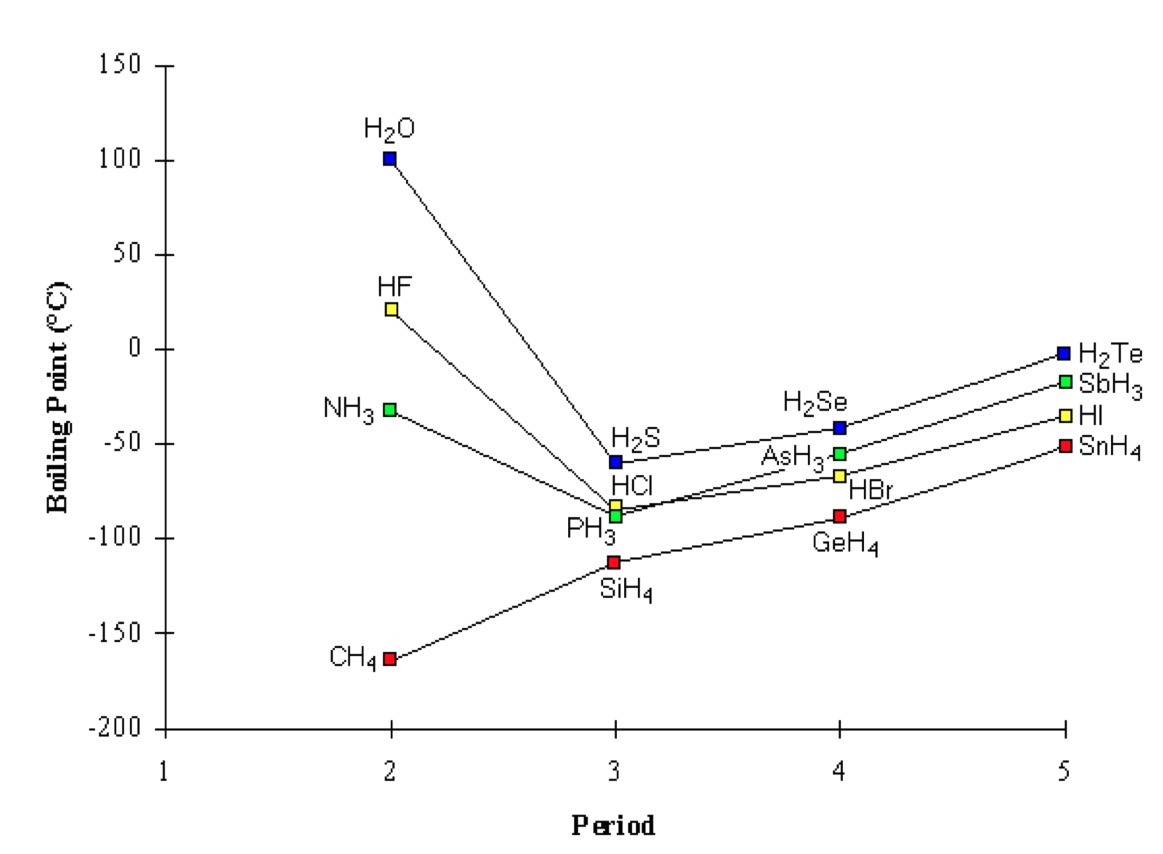
Water, hydrogen fluoride and ammonia have a boiling point higher than expected due to hydrogen bonding.
Summary of Relative Bond Strengths
Density of Water
Water is unusual as its solid form (ice) is less dense than its liquid form (water). This means that ice floats on water whereas most other solids sink in their own liquid forms. This phenomenon is due to the structure and bonding which takes place between the water molecules.
As water cools it contracts, like most liquids. However, below 4 °C it begins to expand, and when it freezes the hydrogen bonds between the water molecules hold them in an open, expanded structure. This decreases the density of ice (greater volume/same mass) compared to that of the liquid water.
Ice floating is vital in real life, e.g. fish and other aquatic life can survive under frozen lakes.
Solubility
'like substances dissolve in like substances'
Ionic compounds and polar molecular compounds tend to be soluble in polar solvents such as water, and insoluble in non-polar solvents. Non-polar molecular substances tend to be soluble in non-polar solvents and insoluble in polar solvents.
This is due to the attraction between δ+ and δ- atoms of the water and the polar substance.
Ionic compounds dissolve in polar solvents in a similar way due to the interaction between the ions and the δ+ and δ- atoms.
Ions surrounded by a layer of water molecules - held by electrostatic attraction - are said to be hydrated.
To predict whether a compound will dissolve in water, look for:
- O-H or N-H bonds, which mean the molecules can hydrogen bond
- the spatial arrangement (shape) of the polar bonds: an unsymmetrical arrangement gives the molecule a permanent dipole
Viscosity
The stronger the van der Waals forces between the molecules in a liquid, the more viscous it will be.
Liquids containing hydrogen bonding will be more viscous than liquids of similar-sized molecules with only dipole-dipole interactions or London dispersion forces.
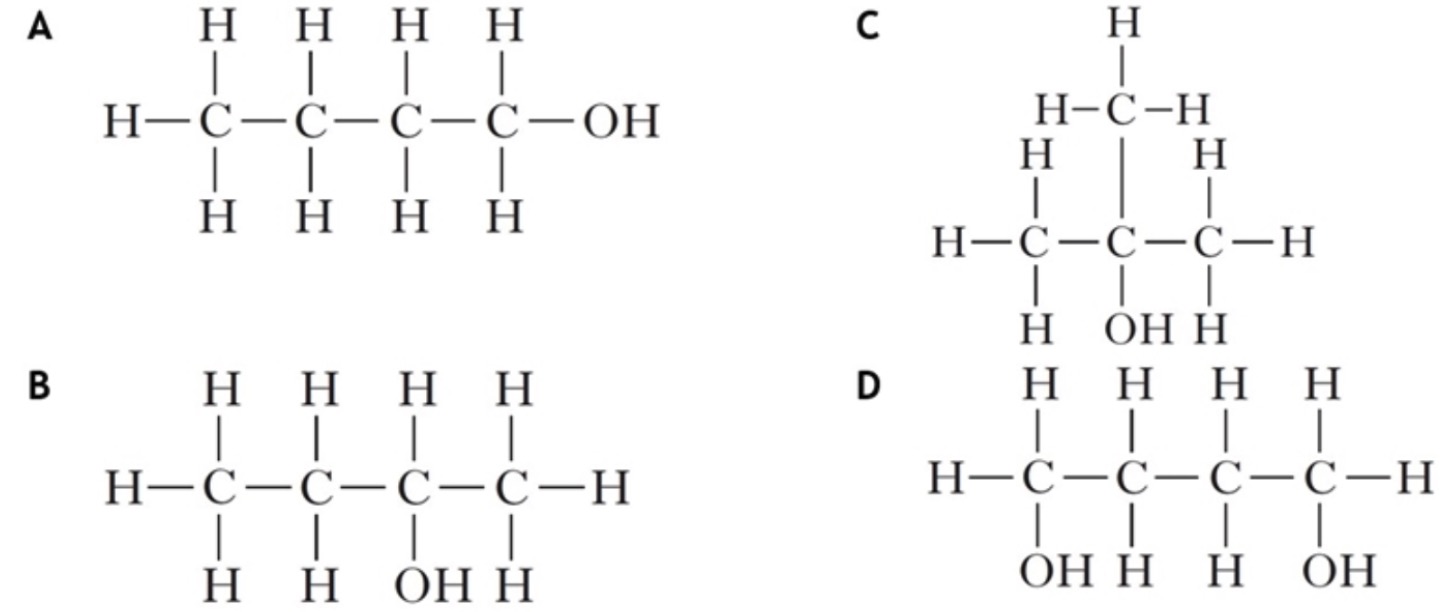
Propane-1,2,3-triol (glycerol) is very viscous: each molecule has three -OH groups, so many hydrogen bonds form between the molecules.
Viscosity depends on the size of the molecules and on hydrogen bonding. The -OH groups allow hydrogen bonding between the molecules and this increases the viscosity.
10. The structures for molecules of four liquids are shown below. Identify which liquid will be the most viscous.
11. The polarity of molecules can be investigated using a charged rod. The charged rod will attract a stream of polar liquid flowing from a burette.
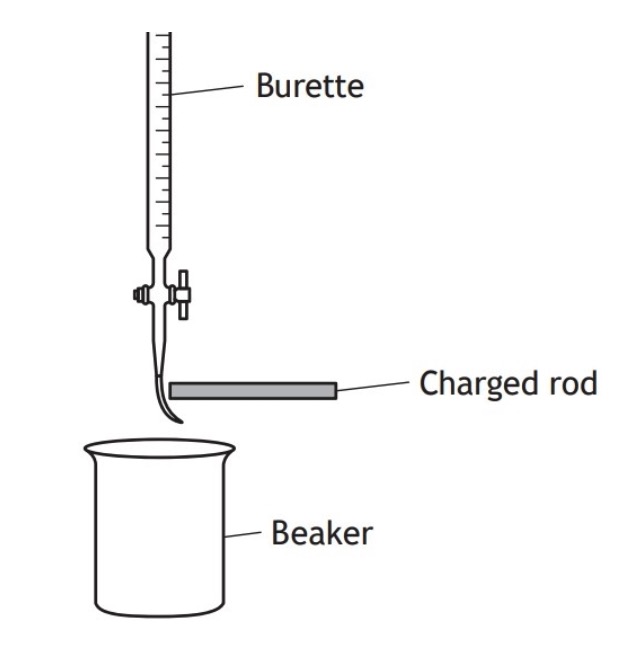
Which of the following liquids would not be attracted?
Solutions to questions
Part 1
Part 2
Part 3
(c) Oxidising and Reducing Agents
What you need to know
- Oxidation, reduction and redox reactions
- Oxidising and reducing agents, including elements, molecules and group ions
- Why oxidising agents are used as disinfectants and bleaches
- Using the electrochemical series
- Writing ion-electron equations and combining them into redox equations
Oxidation and Reduction
A redox reaction involves two half reactions: oxidation and reduction.
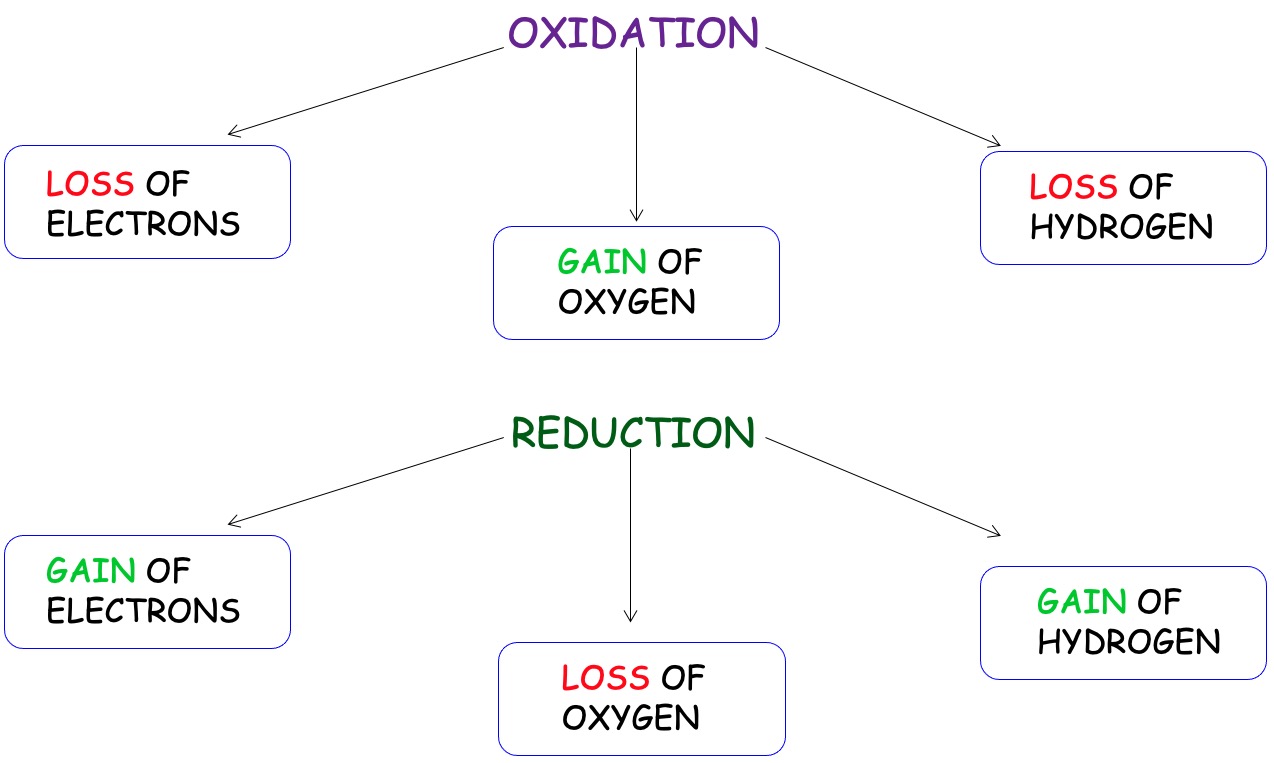
Oxidation is a loss of electrons by a reactant in any reaction. Reduction is a gain of electrons. In a redox reaction, oxidation and reduction take place at the same time.
Elements as Oxidising and Reducing Agents
Oxidising Agents
Oxidising agents are substances that cause another species to be oxidised. Oxidising agents are reduced. They specialise in electron removal, this means they accept electrons from other substances.
Elements with high electronegativities (non-metals) tend to form ions by gaining electrons (being reduced), so they can act as oxidising agents.
Reducing Agents
Reducing agents are substances that cause another species to be reduced. Reducing agents are oxidised. They specialise in electron donation, this means they donate electrons to other substances.
Elements with low electronegativities (metals) tend to form ions by losing electrons (being oxidised), so they can act as reducing agents.
Question 1
An oxidising agent?
Question 2
A reducing agent?
Compounds, Group Ions and Molecules as Oxidising or Reducing Agents
Oxidising agents are widely used because of the effectiveness with which they can kill fungi and bacteria, and can inactivate viruses. The oxidation process is also an effective means of breaking down coloured compounds, making oxidising agents ideal for use as 'bleach' for clothes and hair.
- hydrogen peroxide is a molecule that is an oxidising agent
- dichromate and permanganate ions are group ions that are strong oxidising agents in acidic solutions
- carbon monoxide is a gas that can be used as a reducing agent
Using the databook to identify oxidising and reducing agents
In the periodic table, the strongest reducing agents are in group 1, and the strongest oxidising agents are in group 7.
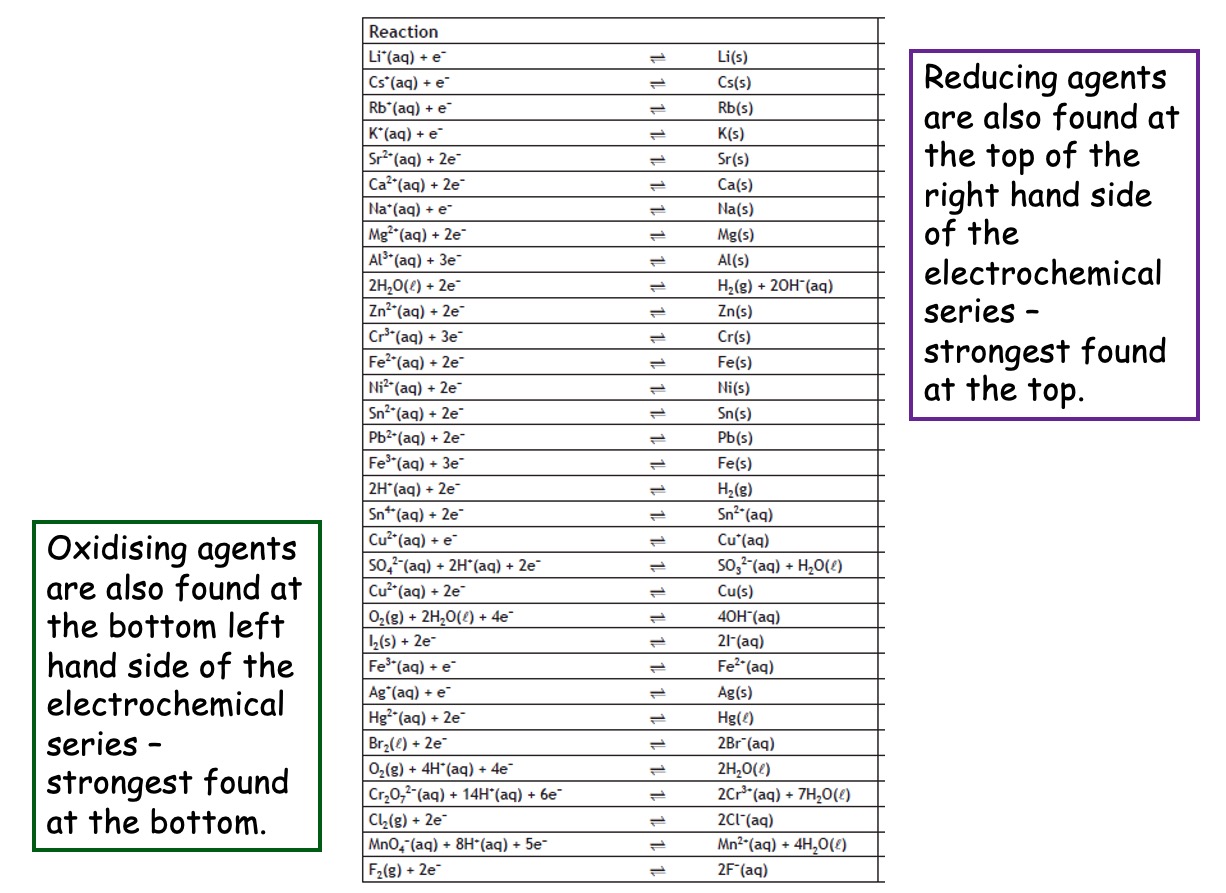
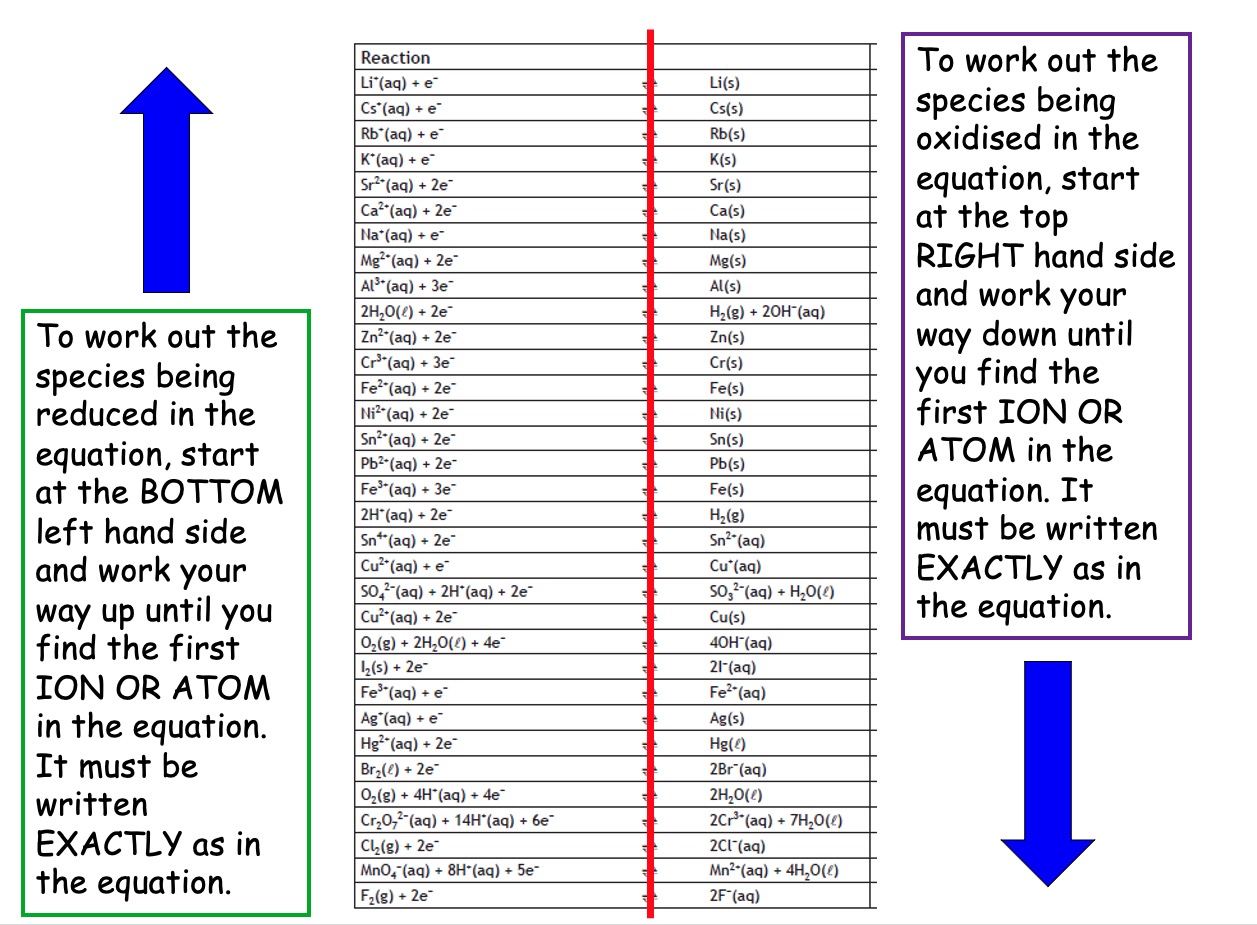
The electrochemical series in the data booklet is a series of reduction reactions.
- The strongest oxidising agents are at the bottom of the left-hand column.
- The strongest reducing agents are at the top of the right-hand column.
Ion-electron equations and Redox Reactions
Writing Redox Equations
Displacement reactions are examples of redox reactions.
E.g. Zinc metal displaces silver from silver (I) nitrate solution. This is because zinc is higher than silver in the electrochemical series.
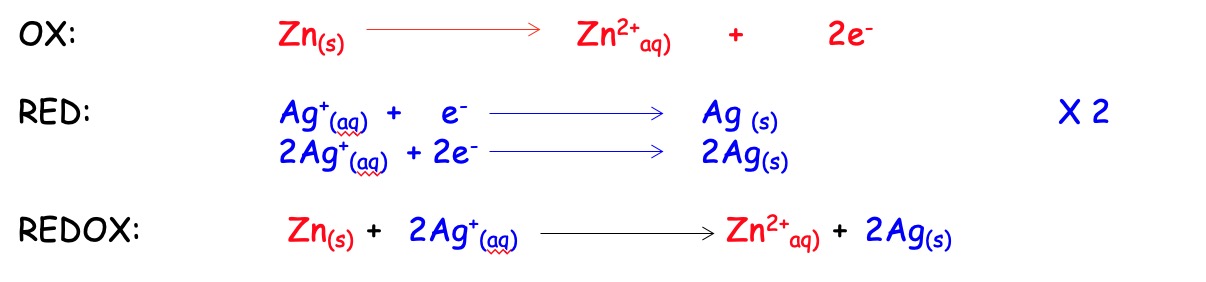
The zinc metal is the reducing agent. It donates electrons and it is oxidised.
The silver ion is the oxidising agent. It accepts electrons and it is reduced.
Oxidation cannot happen without reduction and vice versa. Combining the two equations produces a REDOX equation.
The number of electrons lost in the oxidation must balance the number of electrons gained in the reduction.
Redox equations never contain electrons.
NB -The nitrate ions do not appear in the redox equation. This is because they are spectator ions and are not directly involved in the electron transfer.
Question 3
Mg(s) + Cu2+(aq) → Mg2+ (aq) + Cu (s)
In the above equation the oxidising agent is:
Question 4
Fe3+ (aq) + 2I- (aq) → Fe2+ (aq) + I2 (aq)
In the above reaction, the reducing agent is
More Complex Redox Equations
Oxidation and reduction equations can be represented by ion-electron equations. When molecules or group ions are involved, the ion-electron equation is a little more complicated.
Some are given in the data book but some you will have to write yourselves using the rules.
- Write down the main chemical in its two forms (oxidised and reduced) and balance the central atom (non-oxygen).
- Balance oxygen by adding water molecules.
- Balance hydrogen by adding hydrogen ions (H+).
- Balance the charge by adding electrons (e-).
Worked Example 1: Writing Redox Equations
Potassium permanganate (KMnO4) oxidises Fe2+ ions to Fe3+ ions. During this reaction the MnO4- ions are reduced to Mn2+ ions.
a) Complete the reduction half equation:
b) Write the redox equation for the reaction.
Worked Example 2: Ion electron equations
Complete the ion-electron equation for the reduction reaction:
NO3- → NO
Show answer
NO3- + 4H+ + 3e- → NO + 2H2O
Add 2H2O to balance oxygen, 4H+ to balance hydrogen, then 3e- to balance the charge (left side: -1 + 4 = +3).
Worked Example 3: Writing Redox Equation
Write the redox equation for the reaction between bromine and sodium sulfite. In this reaction sodium (Na+) is a spectator ion.
Show answer
Reduction: Br2 + 2e- → 2Br-
Oxidation: SO32- + H2O → SO42- + 2H+ + 2e-
Both involve 2 electrons, so add them and cancel the electrons:
Br2 + SO32- + H2O → 2Br- + SO42- + 2H+
Question 5
The correct redox equation for the reaction of bromine with a solution containing iodide ions is:
Question 6
In an acidic solution it is possible to convert vanadium ions to vanadate ions i.e.
V3+ (aq) → VO43- (aq)
To balance this ion electron equation the number of electrons needed is
Redox Titrations
A titration is a technique which can be used to determine the concentration of a substance, based on known concentrations and volumes of other reactants.
For many reactants an indicator is required to identify the end-point of the reaction, however for some redox titrations the end-point can be recognised from a colour change in one of the reactants (self - indicating) eg. potassium permanganate solution, purple permanganate ions (MnO4-) are reduced to almost colourless manganese(II) ions (Mn2+), so no indicator is needed.
Worked Example 4: Redox Titration Calculations
A standard 250cm3 solution of vitamin C was prepared. 25cm3 of this solution was titrated against 0.034mol l-1 iodine solution using starch as an indicator. The average titre was 16.45cm3. Calculate the mass of vitamin C in the original tablet. The gram formula mass of vitamin C is 176 g.
C6H8O6 + I2 → 2I- + C6H6O6 + 2H+
Show answer
Moles of I2 = 0.034 × 0.01645 = 5.593 × 10⁻⁴ mol
1 mol I2 reacts with 1 mol vitamin C, so 25 cm3 contained 5.593 × 10⁻⁴ mol vitamin C.
The 250 cm3 solution contained 10 × 5.593 × 10-4 = 5.593 × 10⁻³ mol
Mass = 5.593 × 10-3 × 176 = 0.984 g
Worked Example 5: Redox Titration Calculations
A standard 250cm3 solution of vitamin C was prepared. 25cm3 of this solution was titrated against 0.031mol l-1 iodine solution using starch as an indicator. The average titre was 17.6cm3. Calculate the mass of vitamin C in the original tablet (gram formula mass 176 g).
C6H8O6 + I2 → 2I- + C6H6O6 + 2H+
Show answer
Moles of I2 = 0.031 × 0.0176 = 5.456 × 10⁻⁴ mol = moles of vitamin C in 25 cm3
In 250 cm3: 5.456 × 10⁻³ mol
Mass = 5.456 × 10-3 × 176 = 0.960 g
Worked Example 6: Redox Titration Calculations
25cm3 of acidified potassium permanganate solution reacts with 23.7cm3 of a 0.01mol l-1 solution of iron(II) sulfate. Calculate the concentration of potassium permanganate solution.
MnO4- + 8H+ + 5Fe2+ → Mn2+ + 4H2O + 5Fe3+
Show answer
Moles of Fe2+ = 0.01 × 0.0237 = 2.37 × 10⁻⁴ mol
1 mol MnO4- reacts with 5 mol Fe2+, so moles of MnO4- = 2.37 × 10⁻⁴ ÷ 5 = 4.74 × 10⁻⁵ mol
Concentration = 4.74 × 10⁻⁵ ÷ 0.025 = 1.90 × 10⁻³ mol l-1
Question 7
The following reactions take place when nitric acid is added to zinc.
NO3- (aq) + 4H+ (aq) +3e- → NO (g) + 2H2O (l)
Zn (s) → Zn2+ (aq) + 2e-
How many moles of NO3- (aq) are reduced by one mole of zinc?
Question 8
During a redox process in acid solution, iodate ions are converted into iodine.
To balance the equation, what is the value of x?
2IO3- (aq) + 12H+ (aq) +xe- → I2(aq) + 6H2O (l)
Worked Examples from Textbook Questions
Redox Equations Part 1
Redox Equations Part 2